
Three months ago, a Fortune 500 board received its first AI-specific risk briefing. The CISO walked through vendor relationships, data classification, and model deployment timelines. Fifteen minutes in, a director asked: "Are we liable if this thing hallucinates and gives customers bad advice?" The room went quiet. That question—and the long pause that followed—is where AI risk and compliance for boards begins.
Board oversight of AI isn't theoretical anymore. The EU AI Act is in force. The SEC expects material cybersecurity risk disclosure. State attorneys general are filing enforcement actions against companies whose AI tools produce discriminatory outcomes. And if your organization uses AI to make decisions about people—hiring, credit, healthcare, pricing—you're already subject to existing laws that most boards don't realize apply to algorithmic systems.
Directors have fiduciary duties. AI systems introduce operational, reputational, and regulatory risk. The question isn't whether boards need to engage with AI risk. It's what specific oversight responsibilities they should own, what questions actually matter, and how to structure reporting so the board sees what it needs to see before regulators or plaintiffs do.
Why AI Risk Is a Board-Level Issue
In my work with defense contractors, healthcare systems, and federal agencies, I've watched AI move from IT experiments to business-critical systems in less than two years. The pattern I see: organizations adopt AI tools faster than they build governance around them, and boards hear about the opportunity before they hear about the exposure.
AI risk reaches board materiality thresholds in three ways. First, regulatory enforcement. If you're subject to HIPAA, GDPR, fair lending laws, or employment discrimination statutes, AI doesn't get a free pass. Existing legal obligations apply to AI-driven processes. A healthcare provider using an AI scribe must still comply with the HIPAA Security Rule's administrative, physical, and technical safeguards. A lender using an AI underwriting model must still meet fair lending requirements. Boards that think AI is an innovation question instead of a compliance question are making a category error.
Second, operational dependencies. When an AI system becomes load-bearing in your business—customer service, clinical decision support, threat detection, pricing—its failure modes become business continuity risks. If your customer-facing chatbot goes down, can you handle volume manually? If your fraud detection model starts flagging legitimate transactions at scale, what's your rollback plan? These aren't CISO questions alone. They're enterprise risk questions that belong in the board's operational risk oversight.
Third, reputational and liability exposure. AI failures tend to be public and visceral. A biased hiring algorithm makes headlines. A medical AI that produces different accuracy rates by race creates litigation risk and destroys trust. The board's job isn't to prevent all AI risk—no one can do that—but to ensure management understands the risk, has controls in place, and escalates appropriately when things go wrong. That requires boards to ask better questions up front.
What Regulators Expect From Boards
Regulators are signaling clearly: ignorance isn't a defense. The EU AI Act explicitly assigns accountability to deployers and providers, and if you're a U.S. company doing business in Europe or using AI systems developed there, it applies to you. Even if you're purely domestic, state-level AI regulation is coming. Colorado, California, and others are moving fast. The EU AI Act creates a tiered risk framework—prohibited uses, high-risk systems, limited-risk transparency requirements—that boards should understand even if they're not subject to it, because it's shaping the global compliance baseline.
The Federal Trade Commission has made clear that if your AI tool causes harm through deceptive practices, biased outcomes, or inadequate data security, existing consumer protection laws apply. The Equal Employment Opportunity Commission is actively investigating AI hiring tools. OCR is watching AI in healthcare. The pattern across regulators is the same: we will hold you to existing standards, and we expect board-level oversight.
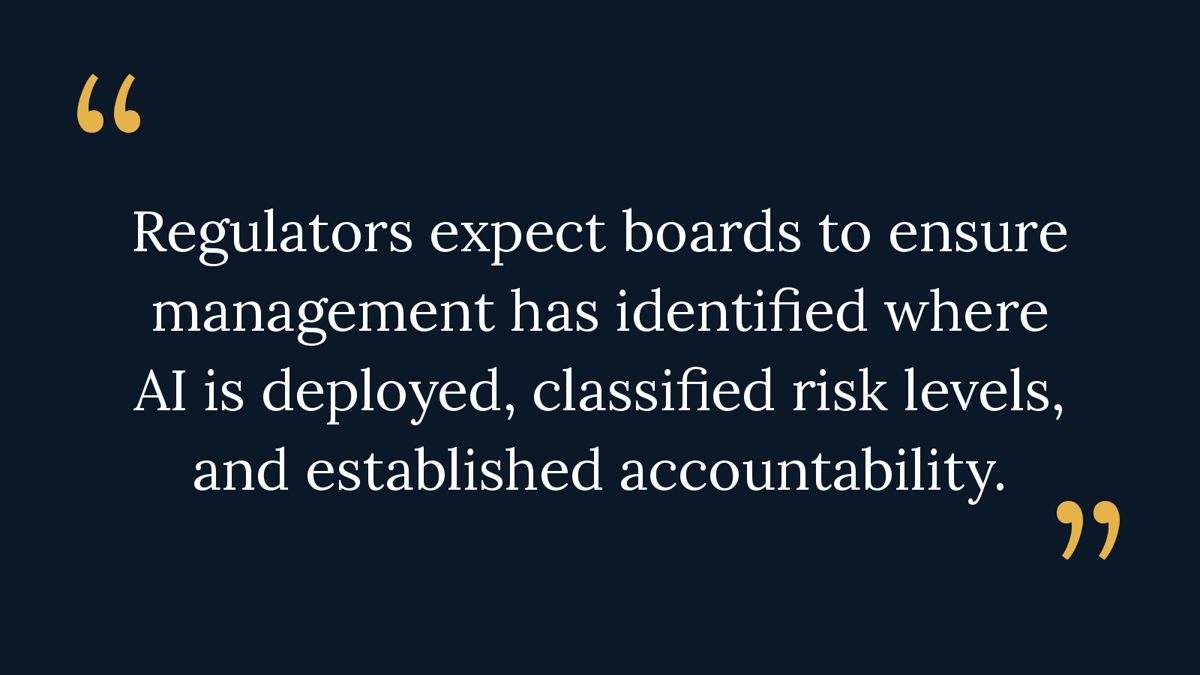
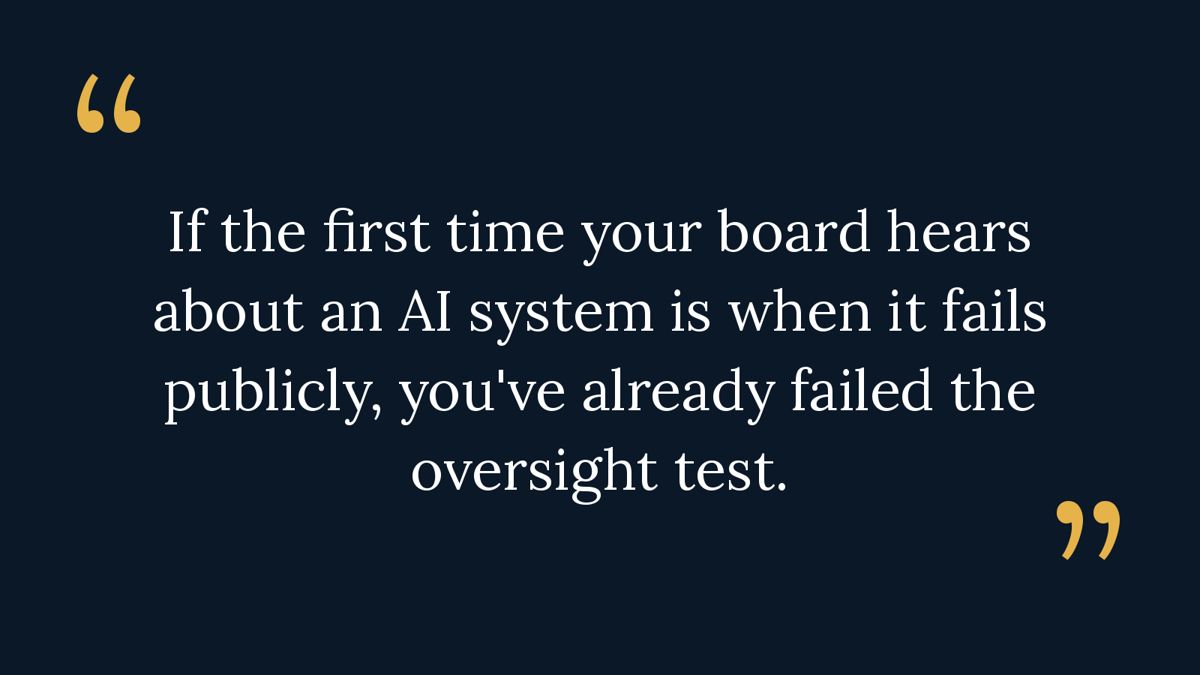
What does that oversight look like in practice? Regulators expect boards to ensure management has identified where AI is deployed, classified risk levels, implemented controls proportional to that risk, and established accountability. They expect documentation. They expect someone at the executive level owns AI risk, and that the board receives regular reporting. If the first time your board hears about an AI system is when it fails publicly, you've already failed the oversight test.
How AI Risk Should Reach the Board Agenda
Most boards hear about AI in one of two ways: a vendor pitch during a business development update, or a compliance item buried in the CISO's quarterly report. Neither is adequate. AI risk needs structured reporting, a clear escalation path, and board-level ownership of key decisions.
The reporting cadence I recommend: quarterly updates on AI inventory and risk classification, immediate escalation for high-risk deployments or incidents, and annual deep-dive reviews of governance maturity. That structure ensures the board stays informed without drowning in operational detail.
What Should Trigger Immediate Board Escalation
Not every AI deployment needs board approval, but certain categories demand it. High-risk systems—those that make consequential decisions about individuals, handle sensitive data at scale, or create significant operational dependencies—should go to the board before deployment. If you're using AI for clinical decision support, lending decisions, hiring, or pricing that could create disparate impact, the board should see the risk assessment, the control framework, and the rollback plan.
Incidents also trigger escalation. If an AI system produces a biased outcome that reaches customers or employees, if it hallucinates in a way that causes harm, if it creates a data breach or regulatory violation, the board needs to know immediately. Not in the next quarterly meeting. The same day. The pattern I've observed in organizations that manage this well: they treat AI incidents the same way they treat other critical incidents—board notification, root cause analysis, remediation tracking, lessons learned.
Third-party AI tools deserve scrutiny. If you're buying an AI service—AI scribes in healthcare, customer service bots, predictive analytics platforms—the vendor's controls matter, but so do yours. The board should understand your vendor risk management process for AI specifically. Do you require vendors to explain how their models are trained? Do you audit for bias? Do you have contractual protections if the model fails? These aren't checkbox questions. They're substantive risk transfer and control issues.
The Questions Directors Should Be Asking
Board members tell me they don't know what questions to ask about AI. That's understandable—AI governance is newer and more technical than traditional risk domains. But boards don't need to understand transformer architecture to ask the right oversight questions. They need to understand risk, accountability, and controls, which is exactly what they do in every other domain.
Start with inventory and classification. Does management have a complete inventory of AI systems in production? How are those systems classified by risk level? Who owns that classification process, and how often is it updated? If your CISO or chief data officer can't answer those questions confidently, you have a governance gap that needs to close before you worry about anything else. I've seen organizations running dozens of AI tools—many adopted at the department level without central IT involvement—where no one had a full picture until the board asked for it. Shadow AI is real, and it's more common than most executives admit.
Ask about data governance. AI is only as good as the data it's trained on. Where does the training data come from? Who controls access to it? How do you ensure it doesn't contain PII, PHI, or CUI that shouldn't be there? If you're in a regulated industry, this matters even more. A defense contractor using an AI tool that inadvertently exports ITAR-controlled technical data to a foreign cloud could face criminal penalties. A healthcare organization that feeds PHI into a third-party AI without a proper business associate agreement violates HIPAA. Boards should ask: do we have controls that prevent AI from becoming a data leakage vector?
Ask about explainability and auditability. Can management explain how a high-risk AI system reaches its decisions? If a regulator, auditor, or plaintiff demands documentation, can you produce it? This isn't an abstract concern. If your AI denies someone credit, rejects a job applicant, or flags a patient for differential treatment, you may be legally required to explain why. The board's question isn't "can you explain the math?" It's "can you demonstrate to a regulator that this system makes decisions in a lawful, non-discriminatory way?"
Ask about accountability. Who owns AI risk in your organization? Is it IT? The business units deploying the tools? Legal? Compliance? The right answer is usually a cross-functional governance body with executive sponsorship and clear escalation paths. But in many organizations, no one owns it. That ambiguity is itself a risk. The board should ensure someone senior—ideally C-level—has explicit accountability for AI governance and reports to the board on it.
Need to Educate Your Board on AI Risk?
Carl delivers keynote talks and board workshops on AI governance, risk, and compliance—tailored to the specific regulatory pressures and risk profiles your organization faces. No vendor pitches. Just clear-eyed guidance on what matters.
Book Carl to SpeakBuilding AI Governance That Works at Scale
Asking the right questions is necessary but not sufficient. Boards also need to ensure management has an AI governance framework that can scale as adoption grows. Early-stage AI governance often starts as a working group or a policy document. That's fine for ten tools. It breaks at a hundred.
Effective AI governance requires four components: policy, process, technology controls, and accountability. The policy sets boundaries—what AI uses are permitted, which are prohibited, and what approval is required for high-risk deployments. The process defines how AI systems are inventoried, risk-assessed, and monitored. Technology controls enforce the policy—data loss prevention to stop sensitive data from reaching external AI, access controls to limit who can deploy models, logging and monitoring to detect misuse. Accountability ensures someone owns each piece and reports up.
In practice, I see organizations struggle most with process and accountability. They write policies, but no one enforces them. They implement controls, but no one monitors compliance. The board's role is to ensure management has closed those gaps and that the framework is actually operating, not just documented.
The Role of AI Risk Assessments
Risk assessments are the engine of AI governance. Before deploying a new AI system—especially a high-risk one—management should conduct a formal risk assessment that examines the system's purpose, data sources, decision-making role, potential harms, mitigations, and residual risk. That assessment should be documented, reviewed by stakeholders across legal, compliance, IT, and the business, and approved by whoever owns AI risk.
The board doesn't need to review every risk assessment, but it should understand the process and see summary reporting. How many high-risk systems were deployed this quarter? Were any denied? What were the top risks identified, and how were they mitigated? If the answer is "we approved everything and didn't find any significant risks," that's a red flag. It suggests the process isn't rigorous or management isn't being candid about risk.
One pattern I've seen in mature programs: they treat AI risk assessments the same way they treat vendor security assessments or privacy impact assessments. Standardized questionnaires, defined risk thresholds, escalation criteria, and regular audits of whether the controls are working as designed. It's not glamorous, but it works.
What Good Board Reporting on AI Looks Like
Board reporting on AI risk should be concise, risk-focused, and action-oriented. A ten-slide deck every quarter is better than a 50-page report no one reads. What should be in it?
First, an inventory summary. How many AI systems are in production, categorized by risk level? How has that changed since last quarter? Are there systems in shadow IT that were recently discovered? This gives the board a sense of scale and trajectory.
Second, high-risk deployments and decisions. What high-risk AI systems were approved for deployment this quarter? What were denied or deferred? What criteria drove those decisions? This transparency helps the board understand whether management is applying the governance framework rigorously.
Third, incidents and near-misses. Were there any AI-related incidents—bias events, data leaks, model failures, compliance violations? Were there near-misses that didn't cause harm but revealed control gaps? How is management responding? Boards should normalize incident reporting. The absence of reported incidents doesn't mean the absence of risk. It often means the absence of visibility.
Fourth, regulatory and legal developments. What new AI regulations or enforcement actions are relevant to your industry or geography? How is management tracking and responding to them? This keeps the board ahead of the curve instead of reacting after the fact.
Fifth, governance maturity. Where does the organization stand in its AI governance journey? Are policies in place? Are controls implemented and tested? Is training happening? Are third-party AI vendors being managed appropriately? A maturity assessment every six to twelve months helps the board see progress—or lack of it.
Metrics That Matter
Boards love metrics, but not all AI metrics are meaningful. "Number of AI tools deployed" tells you nothing about risk. "Percentage of employees trained on AI policy" is a lagging indicator at best. Better metrics: percentage of AI systems with completed risk assessments, time to complete risk assessments, number of high-risk systems with active monitoring, number of incidents detected and resolved, audit findings related to AI controls.
The best metric is often qualitative: can management demonstrate that they know where AI is, understand the risk, and have controls in place that are actually working? If the answer is yes, the board can have confidence. If the answer is no—or if management can't answer the question—that's the signal the board needs.
Bring AI Governance Clarity to Your Leadership Team
Carl's keynotes help executives and boards cut through the hype and focus on the AI risks that actually matter—regulatory, operational, reputational. See all keynote speaking topics or reach out about your event.
Book Carl for Your EventThe Board's Role in Setting AI Risk Appetite
One of the board's most important jobs is defining risk appetite. That's true for financial risk, cyber risk, compliance risk, and it's true for AI risk. The organization needs to know: how much AI risk is the board willing to accept, and under what conditions?
Risk appetite for AI should be tied to business strategy and regulatory obligations. If you're a healthcare organization, your AI risk appetite for clinical decision support should be very low—high scrutiny, rigorous validation, continuous monitoring. If you're using AI for internal process automation with no patient impact, your risk appetite can be higher. The board's job is to make those distinctions clear so management knows where to invest in controls and where they have room to move fast.
In practice, this often takes the form of a risk appetite statement that categorizes AI use cases and sets boundaries. Prohibited uses: AI systems that make final decisions about people without human review, AI tools that process regulated data without appropriate safeguards, AI vendors who can't demonstrate basic security and privacy controls. High-scrutiny uses: AI in customer-facing applications, AI that influences regulatory compliance, AI that handles sensitive data. Lower-scrutiny uses: internal productivity tools, non-decision-making analytics, sandboxed development environments.
That kind of clarity is invaluable. It lets management move quickly where risk is low and apply rigor where it's high. It also protects the board, because it demonstrates that they've thought through the trade-offs and set intentional boundaries rather than allowing ad hoc decisions.
What Happens When Boards Get It Wrong
The consequences of poor board oversight of AI risk aren't hypothetical. We've already seen enforcement actions, lawsuits, and reputational damage. A major tech company faced regulatory scrutiny when its hiring algorithm was found to disadvantage women. A healthcare AI tool was pulled from the market after studies showed racial bias in risk prediction. A financial services firm settled a discrimination claim related to algorithmic underwriting. In each case, the question wasn't just "did the AI fail?" It was "did leadership know the risk, and did they do enough to mitigate it?"
Boards can also get it wrong by overcorrecting—banning AI entirely out of fear, which puts the organization at a competitive disadvantage and doesn't eliminate risk, because employees will use AI anyway, just without oversight. The right approach isn't to avoid AI. It's to govern it.
The pattern I see in organizations that manage AI risk well: the board treats it as a strategic enabler with guardrails, not as a compliance checkbox or a prohibited technology. They ask hard questions, they demand transparency, and they hold management accountable for building governance that works. They also recognize that AI risk and compliance for boards isn't a one-time conversation. It's an ongoing oversight responsibility that evolves as technology, regulation, and organizational use cases change.
What Directors Should Demand From Management
If you're a board member reading this, here's what you should expect from your executive team. First, a clear answer to the question: do we know where AI is being used in this organization? If the answer is no, that's your starting point. You can't govern what you can't see.
Second, a documented AI governance framework. That doesn't have to be a hundred-page manual. It can be a concise policy, a risk assessment process, a defined accountability structure, and a reporting cadence. But it has to exist, and it has to be more than aspirational. Ask to see evidence that it's being followed.
Third, a risk assessment for any high-risk AI deployment before it goes live. The board should have visibility into what's being deployed, why, what the risks are, and what controls are in place. If management is deploying high-risk AI without that level of rigor, you have a problem.
Fourth, a plan for regulatory compliance. If you operate in a regulated industry—and most industries have some form of AI-relevant regulation already—management should be able to explain how existing legal obligations apply to AI systems and what's being done to ensure compliance. If your CISO, general counsel, or chief compliance officer can't connect the dots between AI and your regulatory obligations, you need to escalate that gap.
Fifth, transparency about failures and near-misses. AI will fail. Models will drift. Vendors will have outages. Users will find creative ways to misuse tools. The board needs a culture where management reports those events honestly and quickly, not where they're hidden until they become public scandals. If you're not hearing about any AI incidents, either you're extraordinarily lucky or you're not hearing the truth.
Finally, evidence of continuous improvement. AI governance isn't static. New risks emerge. Regulations change. The organization's use of AI matures. Management should be able to show that governance is evolving in response. That might mean updated policies, new controls, additional training, or third-party audits. The absence of change over time is a warning sign.
Building Board Competence on AI Without Becoming Technical Experts
Board members sometimes worry that they need to become AI experts to provide effective oversight. They don't. You don't need a PhD in machine learning to ask whether management has a handle on AI risk any more than you need to be a network engineer to oversee cybersecurity risk. What you need is a framework for asking the right questions and the willingness to push back when answers are vague or overconfident.
That said, some level of AI literacy helps. Boards should invest in education—not technical training, but strategic context. What are the major categories of AI risk? What do regulators care about? What are peer organizations doing? What does good governance look like? A half-day workshop with someone who understands both AI and governance—not a vendor trying to sell you an AI solution—can be worth the investment. Many boards bring in outside experts annually to brief them on emerging risks. AI should be on that list if it isn't already.
The goal isn't to make board members AI practitioners. It's to ensure they can distinguish between real risk and hype, ask substantive questions, and hold management accountable for building a program that works. That's well within the competency of any experienced director.
Where AI Risk Fits Into Broader Enterprise Risk Oversight
AI risk doesn't exist in a vacuum. It intersects with cybersecurity, data privacy, regulatory compliance, operational risk, and third-party risk. Boards that treat AI as a separate silo miss those intersections. The better approach: integrate AI risk into existing risk oversight structures.
If your board has a risk committee or audit committee that oversees cybersecurity, add AI to their mandate. If you receive regular reports on cybersecurity risk, add an AI risk section. If you review third-party vendor risk, ensure AI vendor management is part of that process. If you track regulatory developments, include AI-specific regulations.
The advantage of integration: it leverages existing governance muscles instead of building new ones from scratch. It also forces management to think about AI risk holistically rather than treating it as an innovation project that lives outside normal risk management.
One practical way to do this: assign AI risk oversight to an existing executive who already owns a related domain. If your CISO owns cybersecurity and data governance, adding AI risk to their portfolio makes sense. If your chief data officer owns analytics and data strategy, they may be the right AI risk owner. If your general counsel owns regulatory compliance, they should at least co-own AI risk with a technical leader. The key is clarity and accountability, not org chart perfection.
Turning Board Oversight Into Strategic Advantage
Good governance isn't just about avoiding downside risk. It's also about enabling upside opportunity. Organizations that build strong AI governance can move faster, take on higher-value use cases, and differentiate themselves with customers and partners who care about responsible AI.
I've seen this play out in competitive procurements. A defense contractor with a documented AI governance program and a track record of compliance won a contract over competitors who couldn't demonstrate the same rigor. A healthcare technology company with clear AI explainability and bias mitigation controls earned the trust of hospital systems that were wary of black-box algorithms. A financial services firm that invested early in AI risk management avoided the reputational damage and regulatory scrutiny that hit peers who moved fast and broke things.
The board's role in that dynamic: set the expectation that governance is a competitive enabler, not a bureaucratic burden. Make it clear that management should be building AI capabilities and AI controls in parallel, not sequentially. Reward transparency and rigor, not just speed. And recognize that in a world where AI regulation is tightening and public scrutiny is high, being able to demonstrate responsible AI isn't a nice-to-have. It's a business requirement.
The organizations that will thrive in the next five years aren't the ones that avoid AI or the ones that adopt it recklessly. They're the ones that adopt it strategically, govern it rigorously, and can demonstrate to regulators, customers, and the public that they've thought through the risks and built controls that work. That outcome starts with the board asking the right questions, demanding real answers, and holding management accountable for building governance that scales. AI risk and compliance for boards isn't a distraction from strategy. It's part of strategy. And the boards that treat it that way will be better positioned than those that don't.