
We're in the middle of what vendors call an AI productivity revolution. Every software platform now includes "AI-powered" features. Industry analysts publish charts showing double-digit efficiency gains. Executives read case studies about companies that cut processing time in half or reduced headcount needs by 30%. Then they look at their own organizations and wonder why they're not seeing the same results.
The disconnect isn't because AI doesn't work. It's because most discussions about AI and workplace productivity confuse three different things: actual measured gains, theoretical efficiency if everything works perfectly, and vendor marketing. Understanding the difference matters, especially for leaders trying to set realistic expectations while making real investment decisions.
I've spent the past two years watching organizations implement AI tools across regulated environments—healthcare systems, defense contractors, federal agencies. Some saw genuine productivity improvements. Others spent six figures on platforms that employees routed around within weeks. The pattern that separates success from expensive distraction isn't technical sophistication. It's clarity about what productivity actually means in your specific context.
What Measurable Productivity Gains Actually Look Like
Real productivity gains from AI show up in ways you can measure before and after implementation. Not "users report feeling more efficient" or "estimated time savings of up to 40%." Actual numbers: tickets resolved per day, time from request to completion, error rates, rework cycles, hours spent on specific tasks.
The healthcare organizations I work with that successfully deployed AI scribing tools can point to concrete changes: clinicians completing notes in an average of 2.3 minutes instead of 8.5 minutes, measured across thousands of encounters. Not "up to 75% faster"—actual median improvement with variance data. They can show documentation quality scores before and after. They tracked adoption rates weekly and could tell you exactly when usage plateaued and why.
A defense contractor implementing AI-assisted proposal writing measured reduction in first-draft completion time, but also tracked revision cycles, win rates, and evaluator feedback scores. The time savings were real—about 35% on initial drafts—but revision cycles actually increased slightly in the first six months because the AI-generated prose required more editing for technical accuracy and compliance language. The net productivity gain was still positive, but it took nine months to materialize and looked nothing like the vendor's projections.
That pattern repeats. Organizations that achieve genuine productivity gains from AI measure specific workflows, track multiple dimensions of performance, and account for the full cycle time including error correction and rework. They don't rely on user surveys about perceived efficiency. They count things.
The Difference Between Time Saved and Work Eliminated
Most AI productivity claims focus on time savings: "This task that took 20 minutes now takes 5 minutes." But time saved doesn't always translate to productivity gained. If a knowledge worker saves 15 minutes on a task they perform twice a week, you've created 30 minutes of capacity per week—not enough to eliminate a position, not enough to take on significantly more work, just 30 minutes that gets absorbed into meeting bloat or email catch-up.
Actual productivity gains happen when you can either eliminate work entirely, materially increase throughput without adding headcount, or reallocate capacity to higher-value activities in measurable ways. An AI tool that summarizes meeting transcripts saves time. An AI tool that eliminates the need for certain meetings by surfacing decisions asynchronously creates actual productivity gain. The distinction matters when you're trying to justify investment.
Where the Hype Outruns Reality
The gap between vendor claims and operational reality tends to appear in predictable places. Understanding these patterns helps leaders separate genuine opportunity from expensive distraction.
The "Automation" That Requires Human Review
Many AI tools marketed as automation actually provide drafts that humans must review and revise. That's not automation—it's assistance. The distinction matters for capacity planning and ROI calculations.
I see this constantly in regulated industries. An AI tool generates a compliance document, but because of regulatory requirements or accuracy concerns, a human must review every line. If review takes 70% as long as original creation, and you're paying for the AI tool plus the human reviewer, your net efficiency gain is maybe 30% minus the tool cost minus the time spent correcting AI errors. That might still be worth it, but it's not the "10X productivity increase" the vendor promised.
The issue compounds when AI-generated output requires subject matter expertise to review effectively. If only your senior people can accurately assess whether the AI's work is correct, you haven't freed up senior capacity—you've just changed what they spend time on. Sometimes that's valuable. Often it's not.
The Training and Change Management Tax
Productivity projections rarely account for the full cost of getting people to actually use new AI tools effectively. The pattern I see: organization buys AI platform, holds a one-hour training session, wonders why adoption stalls at 30% after three months.
Effective AI adoption requires ongoing training, workflow redesign, and sustained change management. People need to unlearn existing habits and develop new patterns. They need time to experiment, make mistakes, and build trust in the tool's outputs. For complex knowledge work, this takes months, not weeks. During that period, productivity often decreases before it improves.
A manufacturing client implemented AI-assisted quality inspection. The system was technically sound. But getting inspectors to trust the AI recommendations, understand when to override them, and integrate the tool into existing workflows took four months of hands-on coaching and workflow adjustment. The vendor's ROI calculator assumed immediate adoption and full productivity gains in month one. Reality was closer to month six, and that gap represented real cost that wasn't budgeted.
Context-Switching Overhead
Some AI tools promise productivity gains but actually increase context-switching, which research consistently shows degrades knowledge worker performance. If your AI writing assistant requires opening a separate interface, copying content back and forth, and managing yet another subscription and login, the cognitive overhead can exceed the time savings.
The productivity equation has to account for the full workflow, not just the task the AI accelerates. I've seen AI research tools that genuinely save time on literature review but require so much context-switching and result verification that researchers abandon them after a few weeks. The tool worked as advertised. The integration cost made it net-negative for actual productivity.
Speaking on AI Governance and Productivity
Carl delivers keynotes on setting realistic AI expectations, implementing governance frameworks, and measuring what actually matters. His talks are built on real implementation experience, not vendor whitepapers.
Book Carl to Speak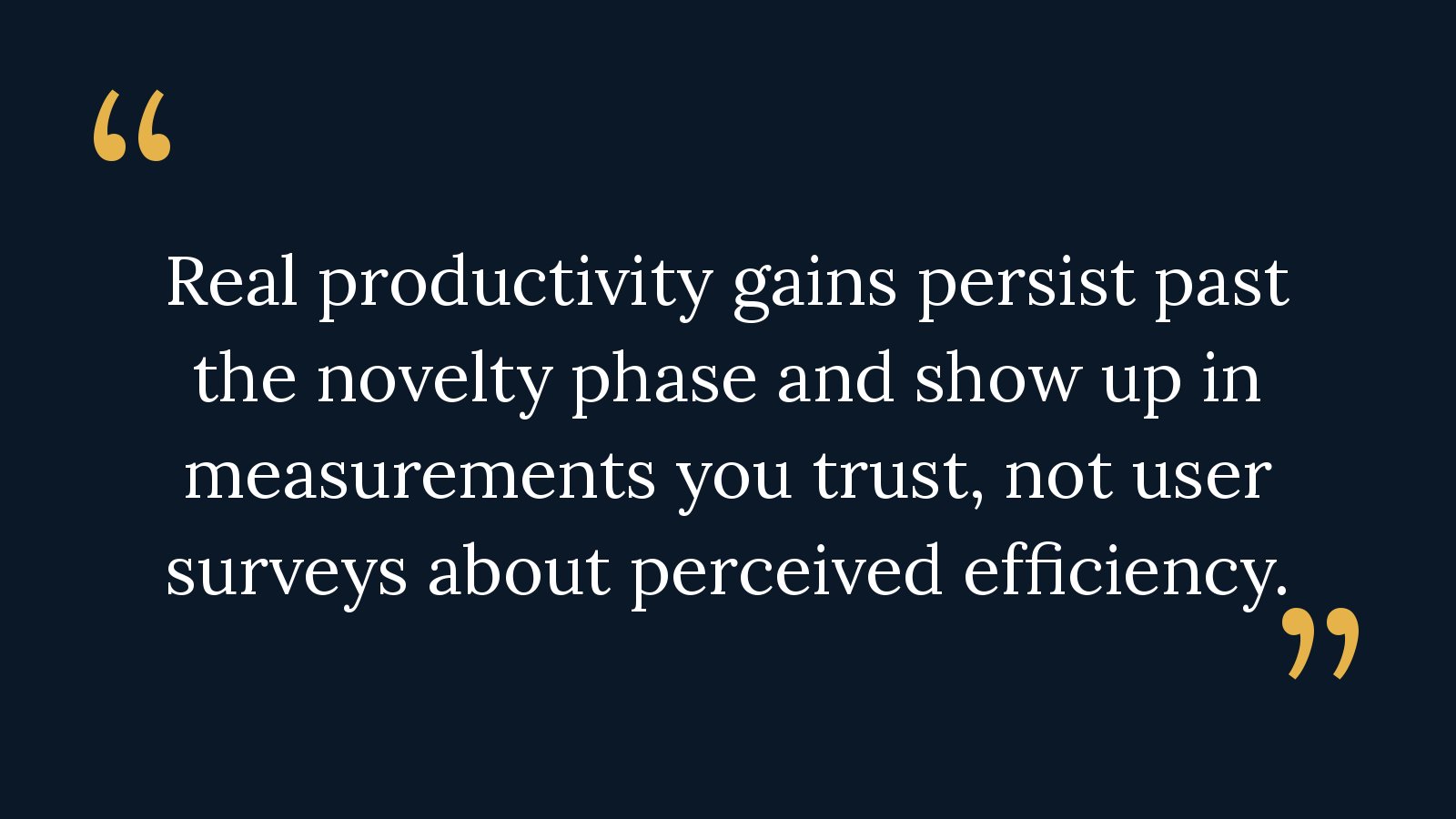
The Measurement Problem
Most organizations can't accurately measure AI productivity gains because they weren't accurately measuring the baseline. If you don't know how long proposal development actually took before the AI tool, you can't measure whether it's faster now. You just have impressions and user reports, which are notoriously unreliable.
This creates a measurement paradox: the organizations most likely to benefit from AI productivity tools are often those with the least capability to measure the impact. Small and mid-sized companies that could genuinely benefit from efficiency gains typically don't have mature process measurement in place. Enterprises with good measurement infrastructure can more accurately assess AI impact but often have less room for dramatic improvement because they've already optimized workflows.
What to Measure (and What's Noise)
Useful productivity metrics for AI tools focus on outcomes and complete workflows, not isolated task components:
- Cycle time for complete work products (not just time for one step in the process)
- Quality metrics and rework rates (AI assistance that increases error rates isn't productive)
- Throughput per person or per team (actual capacity increase, not theoretical time savings)
- Adoption and sustained usage rates (tools that people stop using after a month didn't create lasting gains)
- Downstream impact (did faster draft creation lead to faster project completion, or just earlier waiting?)
User satisfaction surveys are noise. "Perceived productivity" is noise. "Estimated time savings" is noise. What matters is whether you're producing more work, better work, or the same work with fewer resources—measured objectively over time periods long enough to account for learning curves and novelty effects.
The Six-Month Test
Real productivity gains persist past the novelty phase. I use a six-month test: if people are still actively using the AI tool six months after implementation without being reminded or required to, and metrics show sustained improvement over baseline, it's probably delivering genuine value. If usage drops off, or sustained improvement doesn't materialize, it was hype.
This approach has saved clients from doubling down on tools that showed promising early adoption but faded once the novelty wore off. It's also helped identify which AI applications genuinely transform workflows versus which ones just shift where time gets spent.
Domain-Specific Patterns
Productivity gains from AI vary dramatically by domain. What works in software development often fails in regulated industries. What succeeds for creative work may be irrelevant for operational processes.
Regulated Industries: The Compliance Tax
In healthcare, defense, and financial services, the compliance verification overhead fundamentally changes the productivity equation. Any AI-generated content that touches regulated data or processes must be reviewed for compliance. That review requirement caps the maximum possible productivity gain and often shifts rather than eliminates human effort.
Healthcare organizations using AI scribes for clinical documentation still need clinicians to review and sign notes. The AI might reduce documentation time from 10 minutes to 3 minutes, but you can't eliminate those 3 minutes without violating documentation requirements. Defense contractors using AI for proposal writing still need subject matter experts to verify technical accuracy and compliance with solicitation requirements. The review burden is real, time-consuming, and non-negotiable.
This doesn't mean AI can't drive productivity in regulated industries—it absolutely can. But the gains are incremental, not revolutionary, and the ROI calculation must account for mandatory human-in-the-loop requirements. Organizations in these sectors that approach AI with realistic expectations about the compliance tax tend to make better implementation decisions than those chasing vendor promises of 10X improvements.
For organizations developing comprehensive approaches to these challenges, the NIST AI Risk Management Framework provides a structured methodology. And the emerging regulatory landscape around AI bias and compliance increasingly shapes what "responsible productivity gains" actually means in practice.
Knowledge Work: The Quality Question
For knowledge work—writing, analysis, research, strategy—AI productivity gains are real but harder to measure because quality matters as much as speed. An AI tool that lets you produce five mediocre strategy documents in the time it used to take to produce one excellent document hasn't increased productivity. It's increased output, which is different.
The knowledge workers I see getting genuine productivity gains from AI use it to accelerate research, generate alternative framings, or handle routine components of complex work while they focus on the high-judgment elements. They're not using AI to replace their thinking—they're using it to handle the scaffolding around their thinking more efficiently.
That's a subtle but important distinction. AI that helps a consultant prepare for client meetings by summarizing background materials and suggesting discussion frameworks creates genuine productivity gain. AI that generates the consultant's recommendations removes the actual value-add activity and tends to produce generic output that clients can tell was AI-generated.
Operational Processes: Where AI Often Wins
The clearest AI productivity gains I've observed come from well-defined operational processes with clear success criteria. Document classification, data extraction, routine customer service queries, basic code generation, image analysis for quality control—these use cases tend to deliver on productivity promises because success is measurable and the tasks are genuinely automatable.
A logistics company using AI for shipment documentation processing can measure documents processed per hour, error rates, and exception-handling time. If the AI system processes 1,000 documents per day with 2% error rate versus humans processing 300 documents per day with 5% error rate, the productivity gain is clear and measurable. This is where the "automation" framing is actually accurate.
The pattern: AI delivers on productivity promises when the work being automated is repetitive, high-volume, and has objective quality criteria. It overpromises and underdelivers when the work requires judgment, context, or handling of edge cases that weren't in the training data.
Need a Framework for AI Implementation?
Carl speaks on practical AI governance, managing AI risk, and building programs that deliver real value without falling for vendor hype. See all keynote speaking topics or reach out about your event.
Book Carl for Your Event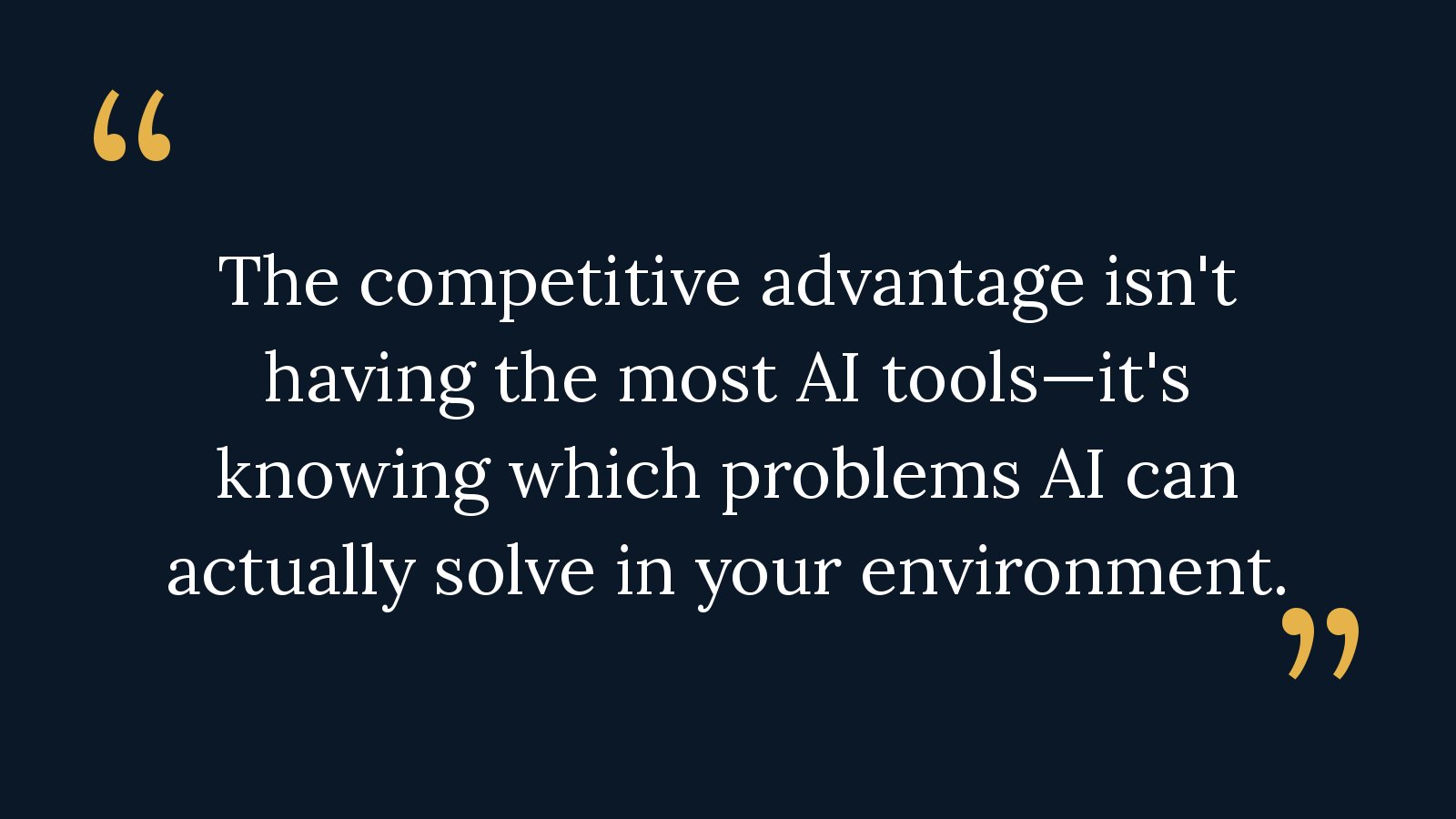
How Leaders Should Set Expectations
Setting realistic expectations about AI and workplace productivity requires understanding the difference between theoretical capability, average implementation results, and what's achievable in your specific organizational context.
Start with the Problem, Not the Technology
The organizations that achieve genuine productivity gains from AI start with a clear problem they're trying to solve and specific metrics they're trying to move. They don't start with "we need an AI strategy" or "what can we use AI for?" They start with "proposal development takes too long and we're losing bids because we can't respond fast enough" or "clinicians are spending 40% of their time on documentation instead of patient care."
This focus on problems rather than technologies forces clarity about what productivity gain would actually look like and how you'd measure it. It also surfaces whether AI is genuinely the right solution or whether you're trying to use technology to solve a process problem, a training problem, or an organizational design problem.
I've seen companies spend significant money on AI tools to solve productivity problems that were actually caused by approval bottlenecks, unclear requirements, or poor communication between teams. The AI didn't help because it wasn't addressing the actual constraint. Starting with the problem makes this visible early.
Pilot Small, Measure Honestly
Run limited pilots with clear success criteria and honest measurement. Not "does this feel more efficient?" but "did cycle time decrease by X% while maintaining or improving quality metrics?" Pick workflows where you already have baseline measurements or can easily establish them.
Build in time for learning and adaptation. Expect productivity to dip initially as people learn new tools and workflows. Plan for at least three months before assessing results, and six months before deciding whether to scale. Track both quantitative metrics and qualitative feedback, but weight the quantitative data more heavily—people's perception of productivity gains often diverges from measured reality.
If the pilot doesn't show clear, measured productivity gains within six months, seriously question whether to proceed. Vendors will tell you that you just need to give it more time, adjust the implementation, or expand usage. Sometimes that's true. Often it's sunk cost fallacy.
Account for the Full Cost
Realistic ROI calculations for AI productivity tools must include:
- Licensing or usage costs (which often increase as you scale)
- Integration and customization effort
- Training and change management time (both initial and ongoing)
- Additional review and verification work for AI-generated outputs
- Support and maintenance overhead
- Productivity loss during the learning curve period
- Risk and compliance overhead in regulated environments
Most vendor ROI calculators include the licensing cost and maybe integration effort, then assume immediate full-scale adoption and maximum theoretical time savings. Real implementation costs are typically 2-3X higher than initial projections, and productivity gains take 2-3X longer to materialize. Budget and plan accordingly.
Separate Enablement from Replacement
Be clear about whether you're using AI to enable people to do more work or to replace work they're currently doing. These are different strategies with different success patterns and different organizational impacts.
Enablement strategies—giving people AI tools to enhance their existing capabilities—tend to show faster adoption and clearer productivity gains because they're additive rather than disruptive. People generally accept tools that make their jobs easier without threatening their role.
Replacement strategies—using AI to do work currently done by humans—tend to face resistance, require longer implementation timelines, and need more careful change management. They can deliver larger productivity gains but carry higher execution risk.
Many organizations try to have it both ways: they position AI tools as enablement to minimize resistance while secretly planning for headcount reduction. This creates cynicism, undermines adoption, and usually backfires. Pick a strategy and be honest about it.
The Governance Question You Can't Skip
Productivity gains from AI only matter if they're sustainable and compliant. Organizations that chase efficiency without establishing proper AI governance tend to create productivity gains in the short term and compliance problems or security incidents in the medium term.
Effective AI governance doesn't have to be bureaucratic or slow. But it does need to answer basic questions: What AI tools are employees allowed to use? What data can be sent to AI systems? Who reviews AI-generated outputs before they're used in decisions or shared externally? How do we monitor for bias, errors, or misuse?
Organizations serious about both productivity and risk management develop clear policies, implement technical controls where possible, and build regular review into their processes. The framework doesn't have to be complex, but it has to exist. For organizations building out these capabilities, understanding what AI governance actually means in practical terms is a necessary foundation.
The pattern I see most often: organizations implement AI tools for productivity gains, realize six months later that employees are using them in ways that create compliance or security risk, then have to scale back or retrofit governance after the fact. Starting with basic governance principles and building productivity experiments within those guardrails takes slightly longer initially but avoids expensive course correction later.
What "Good Enough" Looks Like
Realistic expectations for AI and workplace productivity in 2025 look like incremental gains rather than transformation. Most organizations should expect:
- 10-30% efficiency improvements on specific, well-defined tasks (not across-the-board productivity gains)
- 6-12 month implementation timelines before seeing sustained measurable impact
- Need for ongoing human review and oversight, especially in regulated environments
- Variation in results across teams, use cases, and individual users
- Continuous adjustment and optimization rather than "set it and forget it" automation
Those gains are real and valuable. A 20% reduction in time spent on proposal development or clinical documentation or contract review adds up to significant capacity over a year. But it's not revolutionary, it's not going to eliminate headcount in most cases, and it requires sustained management attention to achieve and maintain.
Organizations that approach AI productivity tools with these expectations tend to make better investment decisions, achieve better results, and avoid the cynicism that comes from overpromising and underdelivering. They also tend to build sustainable AI practices rather than cycling through tools every 18 months when the latest platform doesn't deliver on marketing promises.
The Strategic Implication
Leaders who separate AI productivity signal from hype position their organizations to make better technology investments and set achievable goals. They avoid the trap of chasing vendor promises while missing genuine opportunities that might show smaller but more reliable gains.
The competitive advantage in AI and workplace productivity isn't going to come from having the most AI tools or the biggest AI budget. It's going to come from knowing which problems AI can actually solve in your environment, implementing solutions effectively, and measuring results honestly. That requires leaders who ask hard questions about measurement, who demand proof rather than accepting case studies, and who are willing to pull the plug on initiatives that aren't delivering despite what the vendor dashboard says.
The organizations winning with AI productivity tools are the ones treating implementation as an operational discipline rather than a technology acquisition. They're measuring baselines before implementation, tracking multiple dimensions of impact, accounting for full costs including human overhead, and making go/no-go decisions based on data rather than sunk cost or vendor roadmaps.
That's not sexy. It doesn't make for good conference presentations about "AI transformation." But it's what actually works, and over time it creates sustainable competitive advantage rather than expensive distraction. The gap between organizations that approach AI this way and those chasing hype is already visible. Over the next few years, it will become determinative.