
The European Union's Artificial Intelligence Act went into force in August 2024, establishing the first comprehensive regulatory framework for AI systems worldwide. Unlike GDPR, which most U.S. companies eventually scrambled to understand after it was too late, the EU AI Act gives you time to prepare. The enforcement timeline stretches through 2027, with different requirements kicking in at different stages. But waiting until enforcement begins is the wrong strategy.
I've watched too many organizations treat European regulations as someone else's problem until they suddenly weren't. The pattern is predictable: delayed attention, rushed implementation, expensive retrofitting of systems that should have been designed correctly from the start. The EU AI Act deserves better planning, especially because its extraterritorial reach is broader than most people realize.
This isn't theoretical compliance work. U.S. companies deploying AI systems that affect EU residents, feeding outputs into EU markets, or working with EU-based organizations may already fall under these requirements. The Act's risk-based approach sounds reasonable until you map your actual AI systems against its categories and realize how many of them qualify as high-risk.
How the EU AI Act Risk Tiers Work
The EU AI Act structures its requirements around four risk tiers: unacceptable risk (prohibited), high-risk (heavily regulated), limited risk (transparency requirements), and minimal risk (largely unregulated). Understanding which tier your AI systems fall into determines everything else.
Prohibited AI practices include systems that deploy subliminal manipulation, exploit vulnerabilities of specific groups, enable social scoring by governments, and use real-time remote biometric identification in public spaces by law enforcement (with narrow exceptions). These aren't edge cases in experimental labs. The social scoring prohibition directly affects any AI system that evaluates individuals' trustworthiness or behavior for generalized decision-making. The manipulation ban covers AI that materially distorts behavior in ways that cause psychological or physical harm.
High-risk AI systems face the bulk of the regulatory requirements. The Act defines these in two ways: AI systems used as safety components in products already covered by EU safety legislation, and AI systems explicitly listed in an annex covering eight specific areas. Those areas include biometric identification, critical infrastructure management, education and vocational training, employment and worker management, access to essential services, law enforcement, migration and border control, and administration of justice.
The employment and worker management category catches many U.S. companies off guard. AI systems used for recruiting, screening applications, making hiring decisions, allocating tasks, monitoring performance, or making promotion decisions all qualify as high-risk. If your HR tech stack includes AI-powered tools touching any of these functions and those tools affect EU-based employees or applicants, you're in scope.
The General-Purpose AI Wrinkle
The Act also addresses general-purpose AI models (GPAIs), including foundation models like large language models. Providers of GPAIs face baseline transparency and documentation requirements. If the model presents systemic risk—defined partly by computational power thresholds—additional obligations kick in, including adversarial testing, tracking serious incidents, and ensuring cybersecurity protections.
For most U.S. companies, the GPAI provisions matter less than how you deploy or integrate these models. Using GPT-4 or Claude in a customer service application doesn't make you a GPAI provider, but it doesn't exempt you from high-risk classification if your specific use case falls into one of those eight categories.
When U.S. Companies Fall Under the EU AI Act
The Act's jurisdictional reach follows the GDPR playbook: if you're placing AI systems on the EU market, or if outputs produced by your AI systems are used in the EU, the regulation applies to you. Geographic location of your headquarters doesn't matter. Neither does where you host your infrastructure.
Three scenarios trigger compliance obligations for U.S. companies. First, you're directly placing an AI system on the EU market—selling, licensing, or otherwise making it available to EU customers. Second, you're a user of a high-risk AI system and you're established in the EU or located elsewhere but the output is used in the EU. Third, you're an importer or distributor bringing an AI system from outside the EU into the European market.
The "output used in the EU" language is broader than it sounds. If your AI-powered employment screening system evaluates a candidate in your Dublin office, you're in scope even if the system runs entirely on U.S. infrastructure. If your credit decisioning model affects loan applications from EU residents, you're in scope. If your medical diagnostic AI is used by a hospital in Germany, you're in scope.
In my experience working with federal contractors and healthcare organizations, scope questions consume more time than they should because companies want certainty before they invest in compliance. The EU AI Act doesn't offer clean boundaries. The conservative approach—assume you're in scope if you have any EU nexus involving AI—costs more upfront but avoids expensive course corrections later.
The Provider vs. Deployer Distinction
The Act distinguishes between providers (who develop or substantially modify AI systems and place them on the market) and deployers (who use AI systems under their authority). Providers carry heavier obligations, but deployers aren't off the hook. Deployers of high-risk systems must ensure appropriate human oversight, monitor operation based on instructions, and maintain logs. If you modify an AI system substantially, you may become a provider yourself under the law, inheriting the full compliance burden.
This matters for procurement. When you license AI tools from vendors, the vendor typically remains the provider, but you're the deployer. Your compliance obligations are lighter but not zero. When you build custom AI systems in-house or heavily customize vendor solutions, you may cross into provider territory. The line isn't always clear, and that ambiguity creates risk.
Need Clarity on AI Compliance for Your Organization?
Carl delivers keynotes on AI governance, regulatory risk, and building programs that scale with emerging requirements like the EU AI Act. His sessions cut through vendor noise and focus on practical implementation patterns drawn from real regulatory environments.
Book Carl to Speak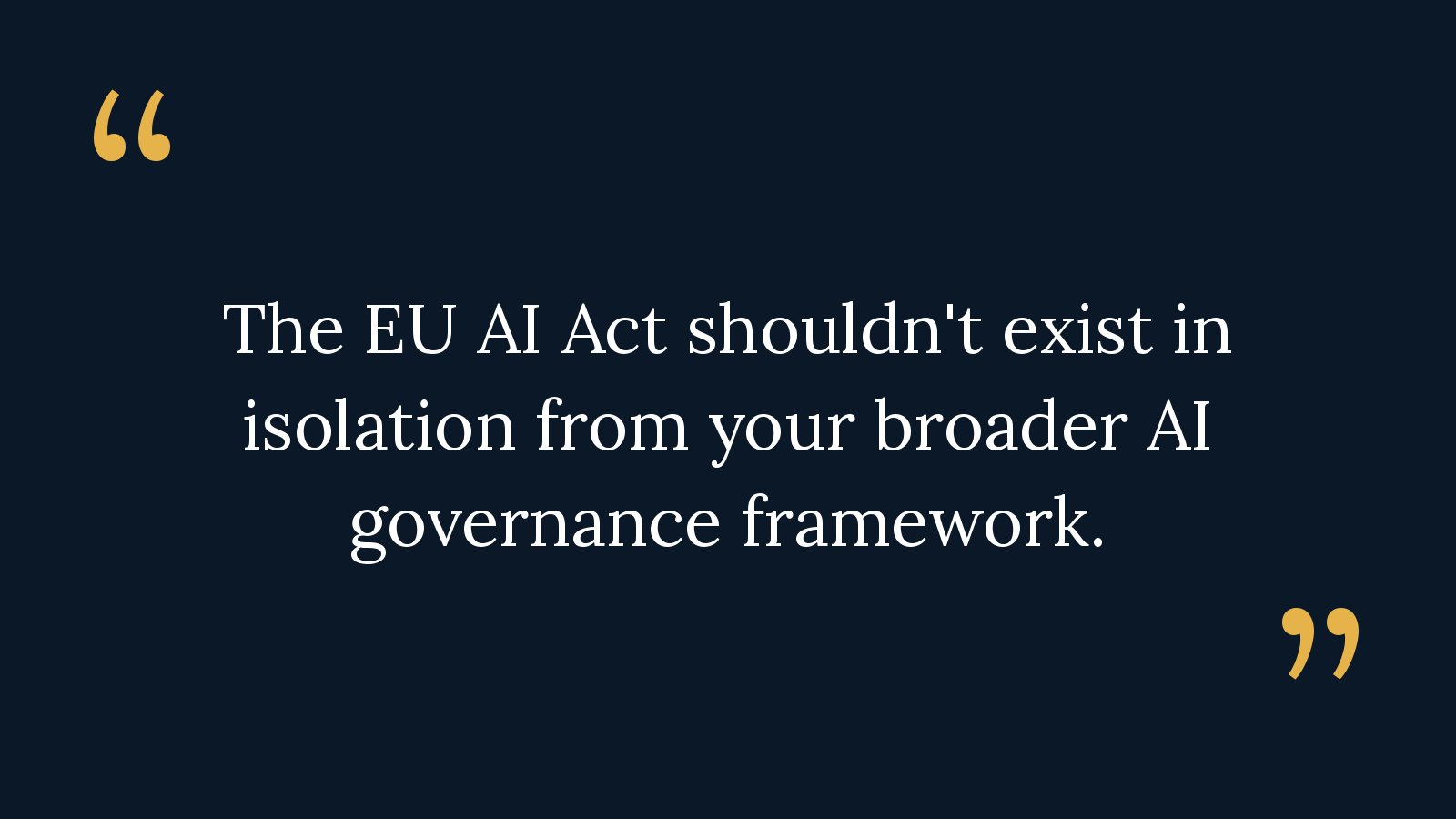
What High-Risk Classification Actually Requires
If your AI system qualifies as high-risk under the EU AI Act, you face a specific set of obligations that go beyond typical software development practices. These requirements aren't aspirational best practices. They're mandatory compliance checkpoints with enforcement teeth.
High-risk AI systems must implement a risk management system throughout the entire lifecycle. This isn't a one-time risk assessment. The Act requires continuous risk identification, analysis, estimation, evaluation, and mitigation. You document foreseeable misuse scenarios, test for them, and update your analysis as the system evolves. When I see companies treating AI risk management as a launch checklist rather than an ongoing program, I know they're not ready for this regulatory environment.
Data governance requirements mandate that training, validation, and testing datasets meet specific quality criteria. Data must be relevant, representative, and free from errors to the extent possible. You need to examine datasets for biases that might lead to discrimination. For systems deployed in sensitive areas like employment or credit decisions, this means documenting not just where your data came from, but how you validated its appropriateness, identified gaps, and addressed potential bias vectors.
Technical Documentation and Record-Keeping
The technical documentation requirements go deeper than most software documentation standards. You must maintain comprehensive records demonstrating compliance with all requirements, including design specifications, development methodologies, information about datasets, validation and testing procedures, and human oversight measures. This documentation must be detailed enough for authorities to assess compliance.
Logging requirements mean high-risk systems must automatically record events throughout their operation. The Act specifies logs must enable tracing of system functioning throughout its lifecycle, identify situations that may lead to prohibited uses or high-risk system malfunctions, and facilitate post-market monitoring. The logs must be kept for a period appropriate to the intended purpose, with specific consideration for systems used in biometric applications.
Transparency obligations require clear information for users about the AI system's capabilities, limitations, appropriate use, and expected level of accuracy. Users need to understand when they're interacting with an AI system. For employment AI, this means candidates must be informed that AI is part of the decision-making process. For systems making predictions or recommendations, users must understand the confidence levels and error rates.
Human Oversight
Human oversight requirements deserve special attention because they're often misunderstood. The Act requires high-risk AI systems to be designed and developed with appropriate human oversight measures. This means humans must be able to fully understand the system's capacities and limitations, remain aware of automation bias, correctly interpret the system's output, and decide not to use the system or override its output in any particular situation.
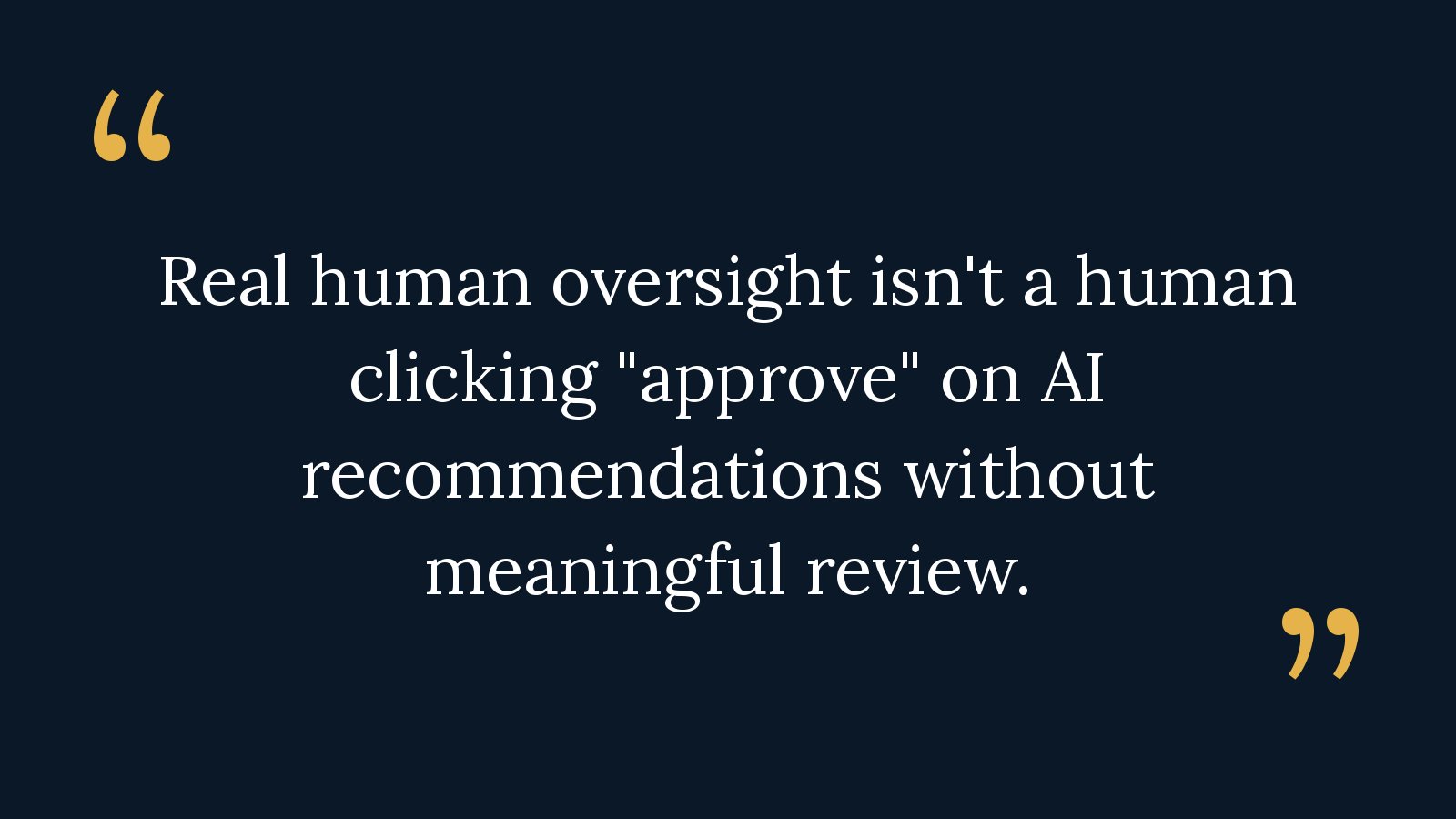
Real human oversight isn't a human clicking "approve" on AI recommendations without meaningful review. It requires system design that enables genuine human judgment. If your AI outputs aren't explainable enough for a human to evaluate their validity, or if the operational tempo doesn't allow time for meaningful review, you don't have adequate human oversight regardless of what your process documentation claims.
Conformity Assessment and CE Marking
Before placing a high-risk AI system on the EU market, providers must complete a conformity assessment to demonstrate compliance with the Act's requirements. For most high-risk AI systems, providers can conduct this assessment internally. The assessment must verify the risk management system is appropriate, training data meets quality standards, technical documentation is complete and accurate, logs are properly maintained, transparency requirements are met, and human oversight measures are effective.
Once a system passes conformity assessment, it receives CE marking—the same marking required for many physical products sold in the EU. The CE mark on an AI system signals to authorities and users that the provider has assessed compliance with all applicable requirements. Affixing CE marking without proper assessment is a violation that carries significant penalties.
Some high-risk AI systems require third-party conformity assessment by notified bodies. This applies primarily to AI systems used as safety components in products already subject to third-party conformity assessment under existing EU legislation, and to biometric systems used for remote identification. For these systems, you can't self-certify. A notified body must review your technical documentation and verify compliance before you can place the system on the market.
The conformity assessment process isn't a one-time gate. When you make substantial modifications to a high-risk AI system, you must repeat the assessment. The definition of "substantial modification" isn't perfectly clear yet, but it includes changes that affect compliance with requirements or alter the system's intended purpose. Regular updates and model retraining may trigger new assessments depending on their scope and impact.
The Enforcement Timeline You Need to Know
The EU AI Act's enforcement follows a staggered timeline. Understanding these dates matters for planning your compliance roadmap. Getting the sequence wrong means either wasting resources on premature implementation or missing deadlines that carry penalties.
Prohibitions on unacceptable AI practices took effect in February 2025, six months after the Act entered into force. If your AI systems involve any of the prohibited practices, they should already be off the EU market or redesigned. This deadline wasn't theoretical. Companies still operating social scoring systems or deploying manipulative AI targeting vulnerable groups after February 2025 face penalties.
Requirements for general-purpose AI models apply starting in August 2025. If you're developing or providing GPAIs, your compliance clock is already running. For models with systemic risk, the additional requirements for adversarial testing and incident reporting kick in at the same time.
The main compliance deadline for high-risk AI systems is August 2027, three years after the Act entered into force. This is when the full regulatory framework becomes enforceable for new high-risk systems. Conformity assessments, technical documentation, risk management systems, data governance, logging, transparency, and human oversight requirements must all be in place.
However, high-risk AI systems that are components of large-scale IT systems used by EU institutions, agencies, and bodies have a different timeline. For these systems, full compliance is required by August 2030. This extension recognizes the complexity of updating existing government infrastructure, but it doesn't help most U.S. companies.
What "August 2027" Actually Means
Three years sounds like comfortable lead time. It's not. Building a genuine risk management program, implementing appropriate data governance, creating technical documentation that meets regulatory standards, and establishing human oversight mechanisms that actually work takes longer than most organizations expect. The pattern I see repeatedly: companies assume they can start serious compliance work in 2026 and still make the deadline. They're wrong.
AI systems deployed before August 2027 aren't grandfathered indefinitely. If you're already using high-risk AI systems in the EU, you must bring them into compliance by August 2030. That's a longer runway, but it's not unlimited. And if you make substantial modifications to those systems before 2030, the 2027 requirements may apply immediately.
Building an AI Governance Program That Scales With Regulation
Carl helps leadership teams understand how to structure AI governance programs that work across multiple regulatory frameworks, including the EU AI Act, emerging U.S. state laws, and sector-specific requirements. See all keynote speaking topics or reach out about your event.
Book Carl for Your EventPenalties and Enforcement Approach
The EU AI Act's penalty structure follows the GDPR model of tiered fines based on violation severity and company size. Maximum penalties reach €35 million or 7% of global annual turnover, whichever is higher, for violations of prohibited AI practices. Non-compliance with other Act requirements can result in fines up to €15 million or 3% of global turnover. Supplying incorrect, incomplete, or misleading information to authorities carries penalties up to €7.5 million or 1% of turnover.
These aren't theoretical maximums. GDPR enforcement demonstrated that EU regulators will impose substantial fines for serious violations. The "global annual turnover" language means penalties scale with company size. A small startup might face millions in fines; a large tech company could face hundreds of millions. For organizations I work with, the financial risk alone justifies serious compliance investment.
Beyond fines, enforcement can include orders to withdraw AI systems from the EU market, prohibitions on placing systems on the market, and product recalls. For companies whose business models depend on AI systems, these remedies carry more impact than financial penalties. Being banned from operating in the EU market isn't just a compliance failure—it's a business continuity crisis.
Market Surveillance and Audits
EU member states must designate market surveillance authorities with power to access training, validation, and testing datasets; review technical documentation; request explanations of AI system outputs; and test systems under their jurisdiction. These authorities can conduct audits without advance notice. The compliance posture you maintain daily is the one that will be evaluated, not what you can assemble when an audit is announced.
The Act establishes a European Artificial Intelligence Board to coordinate enforcement across member states, provide guidance, and ensure consistent application. This structure aims to avoid the fragmented enforcement patterns that complicated early GDPR compliance. Whether coordination succeeds or member states diverge in interpretation remains to be seen, but planning for coordinated enforcement makes more sense than assuming regulatory fragmentation will create loopholes.
What This Means for AI Governance Programs
The EU AI Act shouldn't exist in isolation from your broader AI governance framework. If you're building governance capabilities that only check the EU compliance box, you're building the wrong program. The Act's risk-based approach, emphasis on documentation and transparency, and focus on human oversight align with emerging regulatory patterns globally. Several U.S. states are considering AI legislation that borrows concepts from the EU framework. Federal AI policy discussions reference similar principles.
Smart AI governance programs treat the EU AI Act as one instantiation of broader requirements that will spread. The risk management system you build for EU compliance should inform how you evaluate AI risks everywhere. The data governance practices required for high-risk systems should become baseline standards for any AI deployment handling sensitive decisions. The technical documentation you create shouldn't be a compliance artifact filed away for auditors—it should be a living resource that helps your organization understand and manage the AI systems you deploy.
For organizations exploring frameworks like the NIST AI Risk Management Framework, the EU AI Act provides concrete, enforceable requirements that give teeth to NIST's voluntary guidance. You can map NIST RMF activities to EU AI Act obligations. Risk identification and mitigation under NIST directly supports the required risk management system. NIST's emphasis on validity and reliability connects to EU data governance requirements. The frameworks complement each other when implemented thoughtfully.
The Vendor Management Challenge
The EU AI Act complicates AI vendor management because it shifts some compliance obligations to you as a deployer even when you're licensing technology from providers. You can't fully delegate AI compliance to your vendors. If you're using a vendor's high-risk AI system and outputs affect EU residents, you have deployer obligations including ensuring human oversight, monitoring system operation, maintaining use logs, and reporting serious incidents.
This changes procurement conversations. Due diligence questions must cover whether the vendor can demonstrate conformity with the Act's requirements for providers, provide technical documentation sufficient for you to meet deployer obligations, support your logging and monitoring requirements, and facilitate human oversight. Vendors who can't clearly answer these questions create compliance risk you inherit. The patterns emerging in AI third-party risk management increasingly mirror the stringent vendor assessments common in healthcare and defense sectors—and for good reason.
Building Your Compliance Roadmap
Organizations with EU nexus involving AI systems need a structured approach to EU AI Act compliance. Waiting until 2027 to begin is already too late for complex implementations. A realistic roadmap starts with inventory and classification: identifying all AI systems that might fall under the Act's scope and determining which risk tier each system occupies.
The inventory phase surprises most organizations. AI functionality has proliferated across enterprise systems—in HR tools, customer service platforms, fraud detection, content moderation, and dozens of other applications. Many of these deployments happened organically without central visibility. Before you can plan compliance, you need to know what you're working with. This discovery work often reveals gaps in AI governance that go beyond EU AI Act compliance.
Once you've identified high-risk systems, gap assessment determines how far current practices fall from Act requirements. Most organizations discover they're missing comprehensive risk management processes, lack adequate data governance documentation, have insufficient logging capabilities, and haven't formalized human oversight procedures. The gap analysis should be specific: what exact artifacts, processes, and technical capabilities are missing for each high-risk system?
Implementation Priorities
Remediation should prioritize based on risk and timeline. AI systems already in EU deployment face the August 2030 deadline, but any substantial modification could trigger earlier compliance requirements. New AI systems planned for EU deployment after August 2027 must be compliant from launch. Systems used in particularly sensitive areas—employment decisions, credit decisioning, law enforcement support—warrant earlier attention because the reputational and regulatory risk is highest.
Technical implementation of requirements like logging, transparency interfaces, and human oversight controls takes longer than policy documentation. Start technical work early. You can refine policies as regulatory guidance evolves, but retrofitting AI systems with new technical capabilities often requires substantial engineering investment and testing cycles.
Don't ignore change management. The human oversight requirements mean operational changes for teams using AI systems. People accustomed to accepting AI recommendations without deep review need new training and accountability. Process changes that slow down operations will face resistance. Building buy-in for compliance requirements before they're mandatory makes implementation smoother than forcing changes under deadline pressure.
The companies best positioned for EU AI Act compliance are those who treated AI governance seriously before regulation forced it. They already have risk assessment processes, maintain documentation, and built human oversight into their AI deployments. They're enhancing and formalizing existing practices rather than creating programs from scratch. This pattern holds across every regulatory domain I work in: organizations with mature compliance cultures adapt to new requirements more efficiently than those who treat compliance as reactive box-checking.
The Strategic Implications for Leadership
The EU AI Act represents a regulatory approach that will likely influence AI governance globally. For executives making AI investment decisions, this has strategic implications beyond EU market access. Building AI systems and governance programs that meet EU standards positions you well for similar requirements that will emerge elsewhere. The alternative—fragmenting your AI governance across different regional requirements—costs more and creates operational complexity that scales poorly.
Leadership teams should view EU AI Act compliance not as a European market access checkbox but as part of building organizational capability to deploy AI responsibly at scale. The risk management, documentation, transparency, and oversight practices required under the Act improve AI outcomes regardless of regulatory drivers. Systems developed with these disciplines are more likely to perform as intended, less likely to produce discriminatory outcomes, and easier to troubleshoot when problems arise.
The companies that will struggle most with the EU AI Act are those still treating AI governance as theoretical or postponable. AI systems are already making consequential decisions in employment, credit, healthcare, and education. Those decisions affect real people in ways that create legal, reputational, and ethical risk. The EU AI Act forces practices that reduce those risks. Organizations waiting for regulatory enforcement to drive AI governance are making a strategic mistake that goes beyond compliance exposure.
The pattern I see across regulated industries is consistent: companies that lead regulation rather than follow it gain competitive advantage. They move into markets faster because compliance infrastructure is already built. They win contracts that require demonstrated governance maturity. They avoid the crisis cycles that consume leadership attention when enforcement actions hit unprepared competitors. The EU AI Act creates the same opportunity. The question is whether your organization will lead or scramble.