
The attorney started the call with a simple question: "Who authorized the deployment?" The CISO looked at the VP of Operations. The VP looked at the CTO. The CTO said the business unit requested it. The business unit said IT approved it. And the AI system that had been making automated decisions about customer creditworthiness for eight months? Nobody could point to a single person who had actually signed off on it going live.
This is the accountability gap, and it's not theoretical. I've watched it unfold in conference rooms where executives suddenly realize that their organizational structure has no clear answer to the question of who is responsible when AI systems cause harm. The assumption that existing governance structures will naturally extend to AI is proving dangerously optimistic.
Why "The Algorithm Did It" Isn't a Defense
Courts and regulators have made something clear: delegating decision-making to an algorithm doesn't delegate liability. When a healthcare AI misses a diagnosis, when a hiring algorithm violates discrimination law, when a trading algorithm manipulates markets—someone human is accountable.
The pattern I see in incident response is executives treating AI systems as if they exist in a separate category from other business operations. They wouldn't deploy a new medical device without clear regulatory approval and executive sign-off. They wouldn't launch a new investment product without compliance review and board awareness. But they'll deploy an AI system that does functionally similar work with a fraction of the oversight.
This disconnect creates real legal exposure. Under existing frameworks—fiduciary duty, duty of care, regulatory accountability—executives cannot claim ignorance of what their systems do. The Securities and Exchange Commission has been explicit about this in the financial sector. The Department of Health and Human Services has made similar statements about HIPAA-covered entities. State attorneys general are issuing guidance about consumer protection law applying to algorithmic decisions.
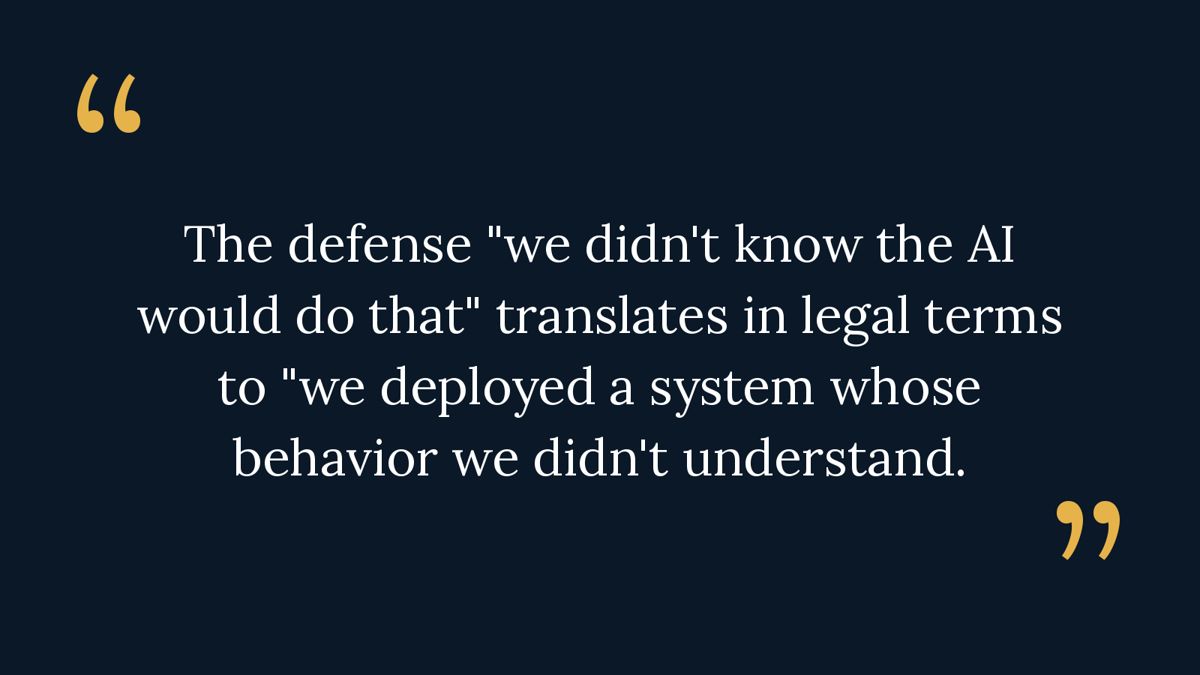
The defense "we didn't know the AI would do that" translates in legal terms to "we deployed a system whose behavior we didn't understand and whose outputs we couldn't predict." That's not a defense. That's an admission of negligence.
The Fiduciary Duty Lens
Directors and officers have fiduciary duties: duty of care and duty of loyalty. These duties don't pause because the decision was made by software. The Delaware Court of Chancery has established that board oversight obligations extend to ensuring adequate information and reporting systems exist. If your AI systems are making material decisions and you don't have mechanisms to understand, monitor, and control them, you're likely in breach of duty of care.
This isn't about understanding the mathematics of neural networks. It's about understanding what the system does, what decisions it makes, what risks it creates, and having controls in place. The standard is informed oversight, not technical expertise. But informed oversight requires information systems that most organizations deploying AI simply don't have.
The Regulatory Accountability Reality
Regulators are not waiting for new AI-specific laws to enforce accountability. They're applying existing frameworks, and those frameworks already have teeth.
In healthcare, if your AI scribe or diagnostic tool violates HIPAA, the covered entity is liable. The OCR doesn't care that it was "just the AI." You're responsible for your business associates, and you're responsible for your own systems. I've seen organizations surprised to learn that using AI doesn't create a safe harbor from regulatory requirements—it often creates additional obligations.
In the defense industrial base, if your AI system causes an export control violation, the company and potentially individual executives face penalties. ITAR doesn't have an exception for algorithmic mistakes. When I work with defense contractors on ITAR compliance, the conversation about AI-generated technical data often reveals that nobody had considered whether the AI system itself could create or transmit controlled information.
In financial services, algorithmic trading and automated advice are already heavily regulated. The SEC's guidance is clear: you're responsible for your algorithms. If your AI manipulates markets, violates fiduciary duty, or makes unsuitable recommendations, the firm and its executives are liable. "The model drifted" is not a defense the SEC accepts.
The EU AI Act's Ripple Effects
Even if you're not operating in the European Union, the EU AI Act is worth understanding. It establishes a risk-based classification system and assigns specific accountability to "providers" and "deployers" of AI systems. High-risk systems face significant requirements around transparency, human oversight, and risk management.
The extraterritorial reach is real. If your AI system's outputs are used in the EU, you may fall under the regulation. More importantly, the EU AI Act is becoming a template. Other jurisdictions are watching and drafting similar frameworks. The direction of travel is toward explicit accountability, not away from it.
Where AI Governance Fails in Practice
Most organizations I work with have some form of AI governance on paper. The problem is the gap between the policy document and operational reality. Building an AI governance framework that actually works requires more than a committee and a charter.
The common failure patterns are predictable. First, shadow AI—systems deployed without going through any governance process. When I assess an organization's AI landscape, we almost always find 30-50% more AI deployments than the governance committee knows about. Someone in marketing is using an AI tool for customer segmentation. Someone in HR is using AI to screen resumes. Someone in operations has built a forecasting model. None of it went through review.
Second, governance processes that can't keep pace with deployment velocity. The committee meets quarterly. The business unit deploys new AI capabilities weekly. By the time something gets reviewed, it's been in production for months. Governance becomes retrospective documentation, not prospective control.
Third, lack of technical depth in governance bodies. I see boards and executive committees trying to oversee AI without anyone in the room who can actually evaluate what they're being told. The presentations are polished. The assurances are confident. The underlying risks are invisible to people who don't know what questions to ask.
Fourth, no connection between AI governance and existing risk management. You have a vendor management process, but somehow AI vendors don't go through it. You have a change management process, but AI model updates aren't treated as changes. You have an incident response process, but nobody's sure if an AI failure triggers it. The AI governance framework exists in parallel to, not integrated with, your actual operational controls.
Speaking on AI Governance and Executive Accountability
Carl delivers keynotes on AI governance, regulatory compliance, and the practical realities of accountability in the age of automation. His talks are built on real-world patterns from regulated industries, not vendor narratives or academic theory.
Book Carl to SpeakPersonal Liability: When Executives Are Individually Exposed
Corporate liability is one thing. Personal liability is what gets executives' attention. And the exposure is real.
In regulated industries, individual executives can face personal penalties. HIPAA violations can result in criminal charges against individuals who knowingly permit violations. Export control violations can result in personal fines and imprisonment. Securities violations can result in personal liability for officers and directors.
The standard for personal liability typically requires knowledge or willful blindness. But here's the problem: if you're in a position of authority over AI deployments and you've made no effort to understand what those systems do, no effort to implement controls, no effort to ensure monitoring—that starts to look like willful blindness.
I've watched general counsels walk executives through this logic, and it's sobering. You can't claim you didn't know about risks you made no effort to identify. You can't claim you had adequate controls when you can't describe what those controls are. You can't claim you provided proper oversight when you can't explain what the system does or how it's monitored.
The D&O Insurance Question
Directors and officers liability insurance is supposed to protect against personal exposure, but policies are starting to add exclusions or sublimits for AI-related claims. Insurers are asking detailed questions about AI governance in underwriting. Organizations with poor AI governance are facing higher premiums or coverage restrictions.
More importantly, D&O policies don't cover everything. They typically exclude intentional acts, criminal conduct, and regulatory fines in many contexts. If regulators determine that executives knowingly deployed AI systems without adequate controls, insurance may not respond.
What Adequate AI Oversight Actually Requires
The accountability gap exists because oversight mechanisms haven't kept pace with deployment. Closing it requires specific, operational changes.
First, you need an actual inventory. Not a list of what's supposed to be there. An inventory of what's actually deployed, what it does, what data it uses, what decisions it makes, and who's responsible for it. This inventory needs to be maintained, not created once for a board presentation and forgotten.
Second, you need a risk classification system that makes sense for your business. Not every AI system creates the same risk. A chatbot that answers FAQ questions is different from an AI making credit decisions. Your governance should be proportional to risk, but that requires actually assessing risk, not making assumptions.
Third, you need clear accountability assignments. For every AI system in use, someone specific should be accountable for its operation, monitoring, and risk management. Not a committee. Not a "shared responsibility." A person with the authority and resources to actually manage the system.
Fourth, you need monitoring that would actually detect problems. If your AI is making decisions, you need to know when those decisions are wrong, biased, or harmful. That requires logging, auditing, and someone actually looking at the data. The productivity gains from AI are real, but they don't come from systems running unsupervised.
Fifth, you need integration with existing governance. AI vendor relationships should go through vendor management. AI system changes should go through change management. AI incidents should go through incident response. AI data handling should go through data governance. Creating a separate parallel structure for AI guarantees gaps.
The Board's Role
Boards don't need to become technical experts, but they do need to ask better questions. The questions I recommend boards ask:
- What AI systems are we using that make decisions affecting customers, employees, or business operations?
- Who is accountable for each of those systems?
- How do we know when those systems make mistakes or cause harm?
- What would happen if a regulator asked us to explain how one of these systems works and why we believe it's compliant?
- What AI systems are being used that we don't know about, and how would we find out?
The answers to these questions reveal whether you have actual governance or governance theater.
Keynote Topics on AI, Governance, and Leadership
From AI governance to regulatory compliance to board-level cybersecurity reporting, Carl speaks on the topics that matter to executive teams navigating real accountability. See all keynote speaking topics or reach out about your event.
Book Carl for Your EventBuilding an Accountability Framework That Works
The goal isn't to prevent AI deployment. The goal is to deploy AI with the same level of accountability and control you apply to other material business decisions.
An accountability framework starts with policy, but policy alone is worthless. I've reviewed dozens of AI use policies that have no connection to how the organization actually operates. The policy says all AI deployments must be reviewed. The reality is that business units deploy tools and inform IT afterward, if at all. Writing an AI use policy that people actually follow requires understanding how your organization works, not copying a template.
The framework needs to define roles clearly. Who approves AI deployments? Who conducts risk assessments? Who monitors performance? Who is authorized to shut a system down if it's causing problems? These aren't questions you want to be answering during an incident.
You need documentation that would survive regulatory scrutiny. This means records of what was deployed, when, by whom, with what approvals. Records of risk assessments and their conclusions. Records of monitoring and any issues identified. Records of decisions made and the basis for those decisions. If you can't produce this documentation, you can't demonstrate that you exercised adequate oversight.
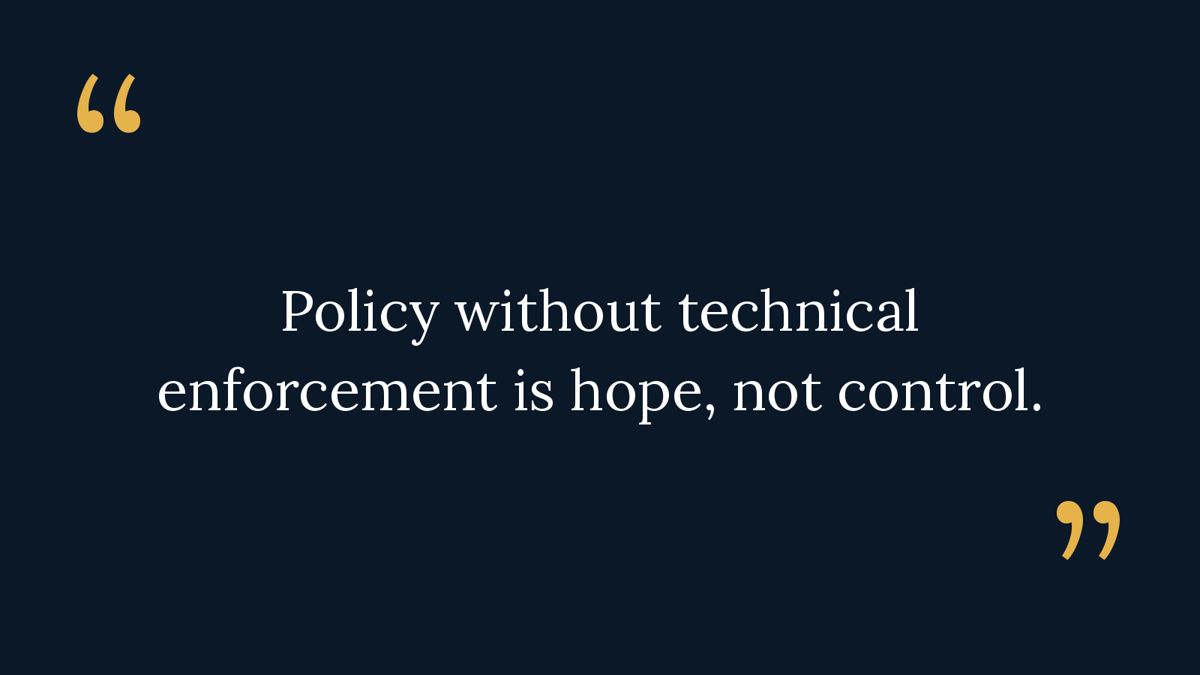
You need technical controls, not just policies. Role-based access control for who can deploy AI systems. Logging of AI system decisions. Data loss prevention that understands when sensitive data is being sent to AI systems. Network controls that can identify unauthorized AI tool usage. Policy without technical enforcement is hope, not control.
And you need consequence management. What happens when someone deploys an AI system without approval? What happens when monitoring reveals a problem and nobody acts? What happens when an AI vendor refuses to provide adequate transparency? If there are no consequences for violating the framework, it's not a framework—it's a suggestion.
The Third-Party Risk Dimension
Much of the AI risk organizations face comes not from systems they build but from vendors they use. AI is embedded in software products across every category. Your email system has AI. Your CRM has AI. Your HR platform has AI. Your accounting software has AI. Most of it was deployed without anyone thinking about the implications.
The challenge is that traditional vendor risk management wasn't designed for AI. You can send a vendor a security questionnaire, but does it ask whether their AI model was trained on your data? Does it ask about model drift and monitoring? Does it ask about algorithmic bias testing? Does it ask about the ability to explain individual decisions? Probably not.
AI third-party risk management requires different questions and different contractual terms. You need to understand what data the vendor's AI uses, where that data goes, how the model was trained, how it's updated, and what happens if it makes a wrong decision. You need contractual rights to audit, to require transparency, and to terminate if the vendor can't meet your requirements.
For regulated industries, vendor AI use can create direct liability. If you're a healthcare provider and your vendor's AI violates HIPAA, you're liable. If you're a defense contractor and your vendor's AI causes an export control violation, you're liable. The vendor relationship doesn't transfer the accountability.
The Strategic Implications for Leadership
AI and executive liability isn't an emerging issue—it's here now. The question is whether your organization is ahead of it or behind it.
Being ahead means treating AI deployment with the same rigor you apply to other significant business changes. It means having clear accountability, documented processes, and the ability to demonstrate oversight. It means being able to answer a regulator's questions about what your AI systems do and why you believe they're compliant. It means knowing about AI deployments before they become problems.
Being behind means operating in the accountability gap. It means having AI systems in production that nobody owns, doing things you don't fully understand, creating risks you haven't assessed. It means hoping nothing goes wrong because you don't have a good answer if it does.
The executives who are taking this seriously are the ones who've actually read the regulatory guidance, who've talked to their lawyers about personal exposure, who've sat in a conference room and realized that nobody could answer basic questions about what their AI systems do. They're building frameworks not because it's trendy but because they understand the liability.
The gap between AI capability and AI accountability is real, and it's a leadership problem, not a technical problem. The technology will continue to advance. The question is whether governance keeps pace. Because when something goes wrong—and something will go wrong—the question of who was responsible will have an answer whether you've designated one or not. Better to make that decision deliberately than to have it made for you by a regulator or a court.