
Most organizations deploying AI tools have skipped a step. They've approved vendor contracts, given employees access to ChatGPT or Claude, and started building automation into workflows—but they haven't established the governance structure to manage what comes next. The pattern I see across mid-market companies is consistent: adoption happens faster than oversight, and by the time leadership asks "who's tracking this?" the answer is usually no one.
An AI governance framework for business isn't about blocking innovation. It's about creating the structure that lets you deploy AI responsibly, track what's in use, understand the risks, and demonstrate control when regulators, auditors, or customers ask. This matters whether you're in healthcare, defense contracting, financial services, or any industry where data handling and decision quality have consequences.
This article lays out a practical blueprint for building an AI governance framework sized for organizations that don't have enterprise-scale compliance teams. The approach covers policy, inventory, risk classification, human oversight, vendor management, and ongoing monitoring—components that work whether you have five AI tools in production or fifty.
Start With Policy, Not Tools
The first mistake organizations make is starting with technology. They evaluate specific AI vendors, compare features, negotiate contracts—and only later realize they have no organizational position on what AI use is acceptable in the first place.
Your AI governance framework for business needs to begin with policy. Not a fifty-page document that no one reads, but a clear organizational statement that defines what AI is in your context, where it can and cannot be used, who can authorize new tools, and what approval process applies.
In my experience working with defense contractors and healthcare organizations, effective AI policies address these elements:
- Scope and definitions: What counts as AI? Are you including traditional machine learning, generative AI, decision-support systems, or all of the above? Clarity here prevents confusion later.
- Prohibited use cases: Where is AI categorically not allowed? High-stakes decisions without human review? Processing of controlled unclassified information or protected health information without specific safeguards? Be explicit.
- Approval authority: Who can authorize new AI tools at different risk levels? A department head for low-risk productivity tools? CISO review for anything touching customer data? Board involvement for anything affecting core business decisions?
- Data handling requirements: What data can and cannot be sent to AI systems? How do you handle training data, input data, and model outputs?
- Documentation requirements: What records must be kept for each AI system? Who's responsible for maintaining them?
The policy doesn't need to solve every edge case on day one. It needs to establish the ground rules and the process for making decisions about exceptions. If you're building this from scratch, start with a framework document that takes a position on the high-risk areas most relevant to your industry, then expand from there. For guidance on how policy should be structured, see How to Write an AI Use Policy for Your Organization.
Build an AI Inventory (You Probably Already Need One)
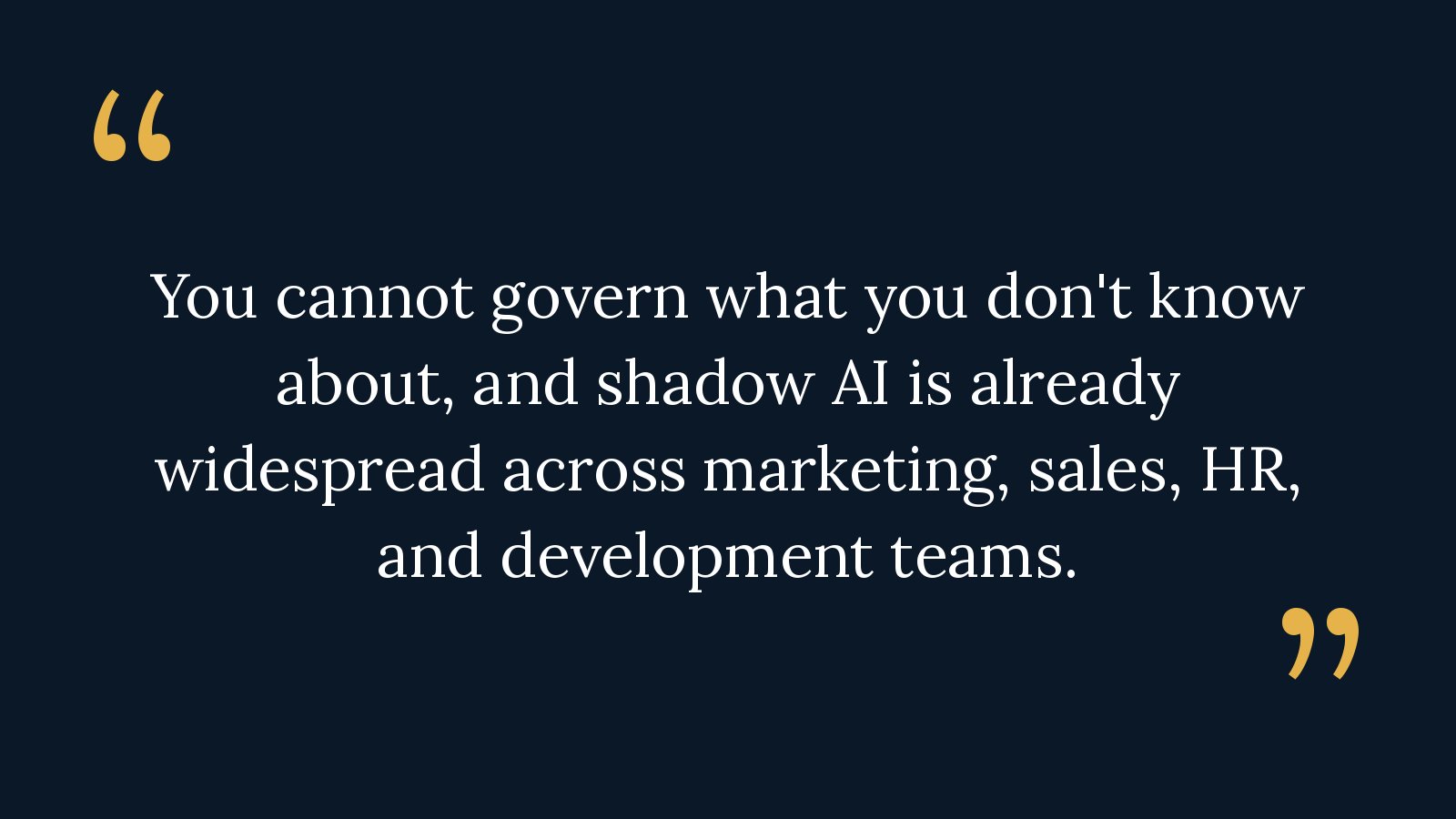
You cannot govern what you don't know about. The second component of an effective AI governance framework is maintaining an inventory of AI systems in use across your organization—both sanctioned and shadow deployments.
Shadow AI is already widespread. Marketing uses AI writing assistants, sales teams run prospects through AI qualification tools, HR has adopted resume screening systems, and your developers are using code completion services. Most of these adoptions happened without IT involvement, and many create risk you haven't assessed. The problem is documented across industries; Shadow AI: What's Happening in Your Organization That You Don't Know About covers the scope of what's typically operating under the radar.
Your inventory should capture:
- System name and vendor: What is it, who makes it?
- Business owner: Who authorized it, who's responsible for its ongoing use?
- Use case: What business function does it serve?
- Data processed: What data goes into the system? Does it include customer data, regulated data, proprietary information?
- Risk classification: Based on your framework (more on this below), what risk tier does this system fall into?
- Vendor contract details: Who owns the data, how is it used for training, what's the liability structure?
- Integration points: What other systems does it connect to? Where does data flow?
Discovering What's Already There
Building the initial inventory requires detective work. Review SaaS vendor lists from your finance or procurement systems. Survey department heads. Check browser extension deployments. Review API logs for common AI service endpoints. Talk to your developers about what they're using in their workflows.
This process almost always surfaces AI deployments that leadership didn't know existed. That's not a failure—it's the point. You're establishing visibility before something goes wrong, not after.
Implement Risk Classification That Drives Decisions
Not all AI systems carry the same risk. A writing assistant that helps draft internal emails is categorically different from an AI system making decisions about loan approvals, patient care recommendations, or access to controlled information. Your AI governance framework for business needs a risk classification system that reflects those distinctions and drives different levels of oversight.
The NIST AI Risk Management Framework provides a solid foundation for thinking about AI risk categories, and I've written about how to apply it practically in NIST AI Risk Management Framework: A Practical Walkthrough. For a governance framework, you need something simpler: a tiered system that your organization can apply consistently.
Here's a classification structure that works for most mid-market organizations:
Low-Risk AI Systems
These systems process non-sensitive data, have limited business impact, and involve human review before any consequential action. Examples: writing assistants for internal documents, meeting summarization tools, internal search enhancement, code completion for non-critical systems.
Governance approach: Manager approval, basic vendor due diligence, documentation in inventory, standard data handling requirements apply.
Medium-Risk AI Systems
These systems process business-sensitive or customer data, produce outputs that inform decisions, or have moderate business impact. Examples: customer service chatbots (with human escalation), AI-assisted data analysis, recruitment screening tools, marketing automation with AI targeting.
Governance approach: Department head and IT/security approval, vendor risk assessment, data flow documentation, regular output review, human oversight requirements, training for users on limitations.
High-Risk AI Systems
These systems process regulated data (PHI, CUI, PII at scale), make or heavily influence consequential decisions, or carry significant legal or safety implications. Examples: clinical decision support, automated credit decisioning, systems processing ITAR-controlled data, AI influencing hiring/termination decisions, fraud detection systems with automated actions.
Governance approach: Executive and CISO approval, comprehensive vendor risk assessment including security audit, legal review of contracts and liability, detailed documentation of decision logic and limitations, mandatory human review of outputs, bias and fairness evaluation, incident response planning, regular audit of outcomes.
Prohibited AI Use
Some uses should be off the table entirely until your organization has developed specific capabilities to manage them. Examples vary by industry, but commonly include: fully automated decisions about employment, AI processing of regulated data without appropriate safeguards, use of AI tools in contexts that violate license agreements or terms of service, AI systems where the vendor claims rights to use your input data for training.
The value of classification isn't just labeling systems—it's creating a decision tree that tells your organization what level of review, documentation, and ongoing oversight each AI deployment requires. When someone proposes adopting a new tool, your framework should make it clear what they need to do to get it approved.
Bringing AI Governance to Your Leadership Team or Conference
Carl delivers keynotes on AI governance, risk management, and compliance strategy for organizations navigating responsible AI deployment. His talks provide practical frameworks your teams can implement.
Book Carl to SpeakEstablish Human Oversight Requirements
One of the central questions in any AI governance framework is: where does human judgment remain mandatory? The answer affects how you design workflows, what approval processes look like, and how you demonstrate accountability when something goes wrong.
Human oversight isn't about distrust of AI systems—it's about recognizing that AI tools make mistakes in ways that are often harder to detect than human errors. They produce outputs that sound authoritative but may be incorrect, biased, or based on outdated information. They lack context that humans bring to decisions. And when they fail, the failure mode can affect hundreds or thousands of cases before anyone notices.
Your governance framework needs to specify where human review is required and what that review should accomplish. In the organizations I work with, effective human oversight typically includes:
Mandatory Review Points
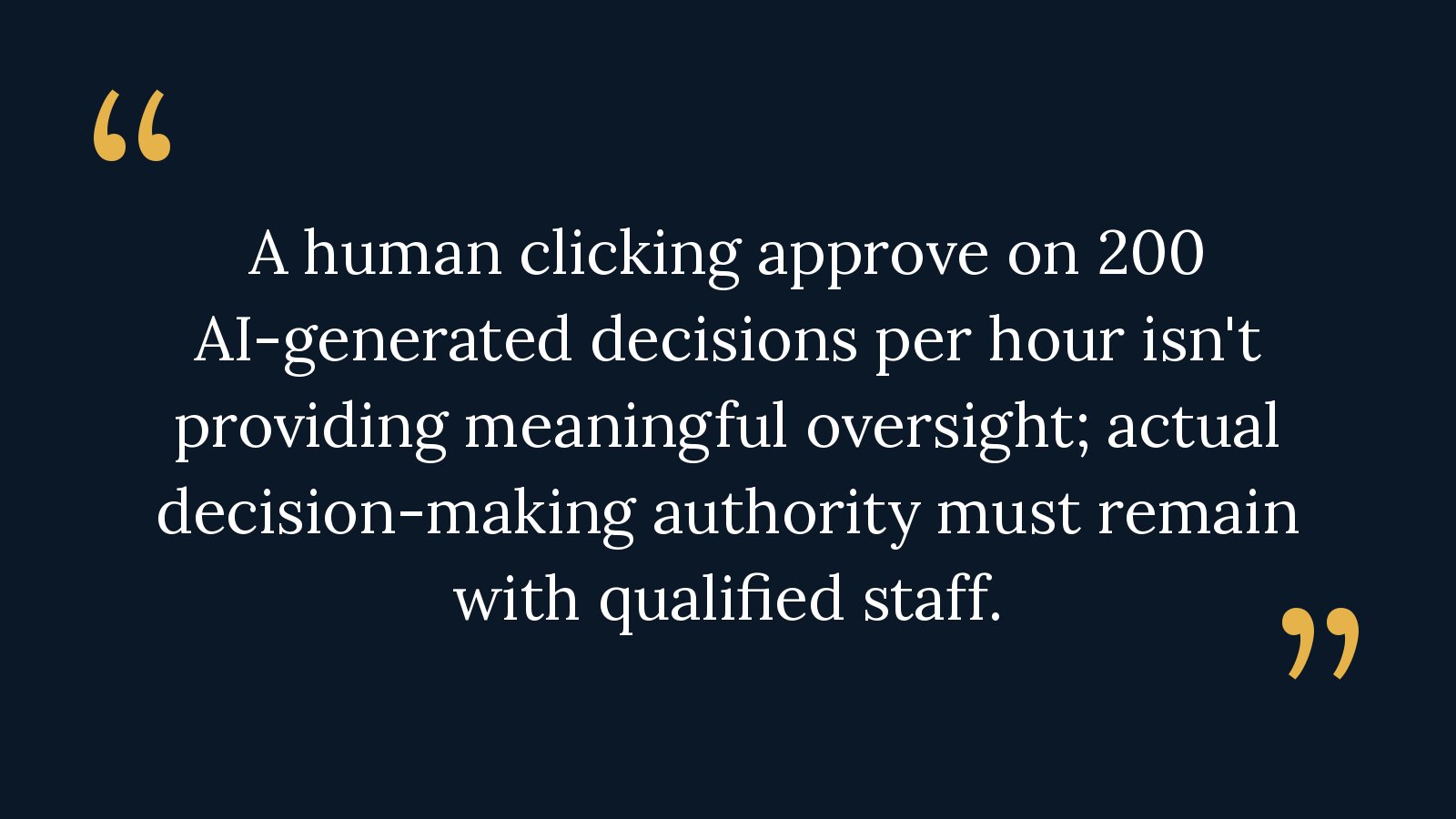
Define the decision points where AI output cannot be acted on without human evaluation. For medium-risk systems, this might mean human review of all external-facing content. For high-risk systems, it means human decision-making authority remains with qualified staff who are reviewing AI recommendations, not just approving them.
The distinction matters. A human clicking "approve" on 200 AI-generated decisions per hour isn't providing meaningful oversight. A human reviewing AI analysis, applying professional judgment, and making the actual decision is.
Competency Requirements
Who is qualified to provide oversight for different AI systems? A junior team member can review a writing assistant's grammar suggestions. A licensed professional needs to review clinical decision support output. A senior analyst should evaluate AI-generated financial recommendations.
Your framework should specify what qualifications are required for oversight roles tied to different risk levels.
Documentation of Review
When human oversight is required, you need records that it happened. This doesn't mean bureaucracy for its own sake—it means being able to demonstrate, when audited or when something goes wrong, that qualified humans were in the loop and applied judgment.
For high-risk systems, document what was reviewed, who reviewed it, what decision was made, and what factors influenced that decision. For medium-risk systems, documentation can be lighter but still present.
Override Authority
Humans providing oversight need clear authority to reject or modify AI outputs. If your process makes it procedurally difficult to override the AI recommendation, you don't have meaningful human oversight—you have a rubber stamp.
Make it clear that human judgment can and should override AI outputs when appropriate, and ensure that overrides are logged (both to track when they happen and to improve the AI system over time).
Build Vendor Management Into Your Framework
Most AI deployments in mid-market organizations involve third-party vendors. You're not training foundation models from scratch—you're subscribing to services from OpenAI, Anthropic, Google, Microsoft, or specialized AI vendors in your industry. That means AI governance can't be separated from vendor risk management.
The due diligence required depends on your risk classification of the AI system and what data you're sending to it. Low-risk systems processing non-sensitive data need basic vendor review. High-risk systems processing regulated data require comprehensive third-party risk assessments.
Key vendor management components for an AI governance framework:
Contract Terms That Matter
Standard software contracts weren't written with AI in mind, and vendor terms of service often include provisions that create risk you haven't thought about. Read the agreements. Specifically:
- Data usage and training rights: Does the vendor use your input data to train or improve their models? If so, for what purposes? Can your proprietary information or customer data end up benefiting competitors?
- Data retention and deletion: How long does the vendor retain your data? Can you request deletion? What happens to data used in training—can it be removed?
- Liability and indemnification: Who's liable if the AI system produces output that causes harm? If it generates content that infringes IP? If it exposes data?
- Model changes: Can the vendor change the underlying model without notice? How do you know if a new model version performs differently on your use case?
- Compliance representations: What does the vendor actually commit to regarding HIPAA, GDPR, CMMC, or other regulatory frameworks? Generic "we take security seriously" language doesn't cut it.
For healthcare organizations deploying AI, the question of Business Associate Agreements comes up constantly. The answer is more nuanced than most vendors acknowledge; Do AI Vendors Need to Sign a BAA? The Answer Is More Complex Than You Think walks through the analysis.
Security and Privacy Assessment
For any AI vendor processing sensitive data, conduct the same security assessment you'd do for any critical SaaS vendor. Review their security practices, certifications (SOC 2, ISO 27001, FedRAMP if relevant), data handling procedures, and incident response capabilities.
Pay particular attention to where data is processed and stored (jurisdiction matters for privacy laws), who has access to your data, and whether the vendor uses subprocessors (and if so, who they are). The complexity of AI third-party risk is significant enough that I've covered it separately in AI Third-Party Risk: What Vendor Management Should Look Like in 2026.
Performance and Bias Evaluation
Vendor claims about AI system accuracy, fairness, and performance should be validated, especially for high-risk applications. Request documentation of how the model was trained, what bias testing was conducted, and what the error rates look like across different populations or use cases.
If the vendor can't or won't provide this information for a high-risk application, that's a red flag. You're responsible for the outcomes of systems you deploy, even if a vendor provides them. "The AI told us to" is not a defense when your decision harms someone or violates regulations.
Custom Keynotes on Compliance, AI Risk, and Governance
Carl speaks at conferences, board meetings, and corporate events on risk management, compliance program design, and governance frameworks for emerging technology. See all keynote speaking topics or reach out about your event.
Book Carl for Your EventImplement Monitoring and Audit Processes
An AI governance framework isn't a set-it-and-forget-it document. AI systems change over time—vendors update models, your use cases evolve, new risks emerge, and regulatory expectations shift. Your governance framework needs ongoing monitoring and periodic audit to remain effective.
Monitoring for AI governance includes several layers:
System Performance Tracking
For medium and high-risk AI systems, track output quality over time. Are error rates increasing? Are you seeing unexpected patterns in recommendations or decisions? Is the system behaving differently than when you first deployed it?
This requires establishing baselines when you deploy systems and having mechanisms to detect drift. For some applications, this means regular sample review by qualified staff. For others, it means automated quality checks or comparison against known-good outputs.
Incident and Near-Miss Reporting
Create a process for reporting AI system failures, unexpected outputs, or near-misses. When someone catches the AI making a significant error before it causes harm, you want to know about it. When an AI system produces output that violates policy or creates risk, that needs to be documented and reviewed.
This isn't about punishment—it's about learning and improvement. Most AI problems I see could have been caught earlier if there had been a low-friction way to report concerns.
Compliance and Policy Audits
Periodically audit compliance with your own AI governance framework. Are new systems being added to the inventory? Are required approvals actually happening? Is documentation being maintained? Are human oversight requirements being followed?
For regulated industries, this audit process becomes evidence that your governance framework is operational, not just theoretical. When auditors or regulators ask how you're managing AI risk, you need to be able to show that your framework is actually being used.
Regulatory Landscape Monitoring
AI regulation is moving faster than most areas of compliance. The EU AI Act is in force and affects U.S. companies with European operations or customers. State-level AI regulation is emerging. Industry-specific guidance continues to develop. Your governance framework needs regular updates to reflect new requirements.
If you're selling to or operating in European markets, you need to understand how the EU's risk-based approach affects your AI deployments; The EU AI Act, Explained: What U.S. Companies Need to Understand provides the foundation. Even if you're purely domestic, state privacy laws and sector-specific regulation increasingly address AI use.
Connect Governance to Broader Risk and Compliance Programs
Your AI governance framework for business shouldn't exist in isolation. It needs to integrate with your broader risk management, compliance, privacy, and security programs.
In practical terms, this means:
- AI systems should be included in vendor risk assessments alongside other third-party services
- Privacy impact assessments should address AI tools that process personal data
- Security incident response plans should cover AI-related incidents, including data exposure through AI tools, AI system compromise, or harmful outputs
- Compliance reporting should include AI governance metrics when relevant to your regulatory obligations
- Training programs should cover AI use policies for staff using AI tools in their work
For organizations subject to frameworks like CMMC, NIST 800-171, HIPAA, or GDPR, AI governance becomes part of demonstrating that you maintain appropriate controls over data and systems. The question "how do you govern AI use?" is already appearing in customer due diligence questionnaires and audit protocols.
If your organization is in healthcare, AI governance intersects directly with HIPAA requirements around administrative safeguards, access controls, and business associate management. The analysis in HIPAA and AI Tools: What Healthcare Leaders Are Getting Wrong covers where healthcare organizations commonly miss the connection between AI adoption and existing compliance obligations.
Size the Framework to Your Organization
The AI governance framework I've outlined here is designed to scale. A 50-person company doesn't need the same infrastructure as a 5,000-person enterprise, but both need the same core components: policy, inventory, risk classification, oversight, vendor management, and monitoring.
The difference is in implementation detail, not structure. A smaller organization might:
- Have a simpler approval process with fewer approval tiers
- Maintain the AI inventory in a spreadsheet rather than a GRC platform
- Conduct vendor assessments through questionnaires and contract review rather than on-site audits
- Assign AI governance responsibility to an existing role (often CISO or compliance officer) rather than creating a dedicated AI governance position
- Conduct quarterly rather than monthly governance reviews
What doesn't change is the need to answer the fundamental questions: What AI are we using? What data does it process? What risks does it create? Who's accountable? How do we know it's working as intended?
Mid-market organizations often have an advantage over larger enterprises in implementing AI governance: fewer legacy systems, less organizational inertia, and clearer lines of communication. You can establish governance practices now that will scale as your AI use grows, rather than trying to retrofit governance onto sprawling, undocumented AI deployments later.
What This Enables
A functioning AI governance framework changes the conversation about AI in your organization. Instead of ad-hoc decisions about individual tools, you have a systematic way to evaluate, approve, and manage AI deployments. Instead of hoping nothing goes wrong, you have visibility into what's in use and what risks it creates. Instead of scrambling when a customer or auditor asks about AI governance, you have documentation and processes to point to.
More importantly, it changes what you can say yes to. With governance in place, you can evaluate AI opportunities based on business value and manageable risk, rather than avoiding AI entirely out of uncertainty. You can deploy tools that improve productivity, enhance customer service, or enable new capabilities—with appropriate oversight and controls.
The organizations that get AI governance right will have a competitive advantage. They'll be able to adopt AI faster and more safely than competitors who either avoid it entirely or deploy it recklessly. They'll be ready when customers require AI governance as part of vendor due diligence. They'll have evidence of responsible AI use when regulators start asking. And they'll avoid the costly mistakes that come from deploying AI without adequate oversight.
Building an AI governance framework for business isn't optional anymore. The question is whether you'll do it proactively, on your timeline, or reactively after something forces your hand. The former is significantly less expensive and less painful than the latter.