
HIPAA compliance is an operational requirement, not a legal abstraction. If you run a healthcare organization, work with one, or touch protected health information in any capacity, you're subject to the Health Insurance Portability and Accountability Act. That means specific obligations around privacy, security, and breach notification that carry real penalties when you get them wrong.
I've worked with healthcare organizations, business associates, and contractors who thought they understood HIPAA compliance until an audit or incident proved otherwise. The pattern I see most often: leadership treats it as a checklist rather than a risk management program. They sign the right documents, run annual training, and assume they're covered. Then something breaks, and they discover their understanding had gaps that matter.
This guide covers what HIPAA compliance actually requires—not in legal terminology, but in operational terms. We'll walk through the Privacy Rule, the Security Rule, and the Breach Notification Rule, with focus on what healthcare leaders need to implement and where organizations typically fail.
What HIPAA Actually Regulates
HIPAA applies to covered entities and business associates. Covered entities include healthcare providers who transmit health information electronically, health plans, and healthcare clearinghouses. Business associates are vendors, contractors, or partners who create, receive, maintain, or transmit protected health information (PHI) on behalf of a covered entity.
The scope matters because many organizations assume they're not subject to HIPAA when they actually are. If you process claims, provide billing services, store medical records, offer IT support to a healthcare provider, or run analytics on patient data, you're likely a business associate. That designation carries the same compliance obligations as covered entities in most respects.
Protected health information is any individually identifiable health information transmitted or maintained in any form. This includes obvious elements like medical records, test results, and billing information, but also extends to email threads discussing patient care, appointment schedules with patient names, and even phone conversations about treatment. The medium doesn't matter—paper, electronic, or oral PHI all fall under HIPAA.
The Three Core Rules
HIPAA compliance breaks down into three regulatory components: the Privacy Rule, which governs how PHI can be used and disclosed; the Security Rule, which establishes safeguards for electronic PHI; and the Breach Notification Rule, which dictates what you must do when something goes wrong. Each carries distinct requirements, but they're interconnected. You can't claim Security Rule compliance if your Privacy Rule policies don't align with your actual security controls.
The Privacy Rule: Use and Disclosure of Protected Health Information
The Privacy Rule establishes standards for how covered entities and business associates may use and disclose PHI. The foundational principle is minimum necessary: you should only access, use, or share the least amount of PHI required to accomplish a specific purpose.
In my experience, this is where operational discipline breaks down. Clinical staff access full patient records when they only need specific test results. Billing departments keep copies of complete medical histories when they only need diagnosis codes and service dates. IT teams run database queries that pull entire patient tables for troubleshooting when targeted logs would suffice.
The Privacy Rule requires specific policies around permissible uses and disclosures. Treatment, payment, and healthcare operations (TPO) activities generally don't require patient authorization. Everything else typically does. Marketing uses, sale of PHI, and psychotherapy notes have additional restrictions.
Organizations must provide patients with a Notice of Privacy Practices that explains how their information may be used and their rights under HIPAA. Patients have the right to access their records, request amendments, receive an accounting of disclosures, and request restrictions on uses. These aren't courtesy provisions—they're enforceable rights with specific timelines.
What Minimum Necessary Actually Means
Minimum necessary doesn't mean implementing role-based access control and calling it done. It requires ongoing assessment of what information different roles actually need. Your electronic health record system might allow nurses to see a patient's full psychiatric history, but do they need it to administer a flu vaccine? Probably not.
The Privacy Rule allows reasonable reliance on requests from other covered entities, but that's not a blank check. If a specialist requests all records for a patient when the referral is for a specific condition, you're supposed to question whether the full chart is necessary. Most organizations don't.
The Security Rule: Safeguarding Electronic PHI
The Security Rule establishes standards for protecting electronic protected health information (ePHI). It's organized into administrative, physical, and technical safeguards—each with required and addressable implementation specifications. Required means mandatory. Addressable means you must implement it or document why it's not reasonable and appropriate for your organization, along with what alternative you've adopted.
Many organizations treat addressable specifications as optional. They're not. The distinction is about implementation flexibility, not whether you address the risk. If you decide an addressable specification doesn't fit your environment, you still need a compensating control.
Administrative safeguards include security management processes, workforce security, information access management, security awareness training, and security incident procedures. These are governance and policy requirements—the foundation that makes technical controls effective. You need a designated security official, risk analysis processes, sanction policies for violations, and documented training programs.
Physical safeguards cover facility access controls, workstation use and security, and device and media controls. This means controlling who enters areas where ePHI is stored or accessed, defining how workstations should be used and positioned to prevent unauthorized viewing, and managing what happens to devices and media when they're moved or disposed of.
Technical safeguards require access controls, audit controls, integrity controls, and transmission security. You need unique user identification, emergency access procedures, automatic logoff, and encryption or equivalent protections for ePHI in transit. Audit controls must record access and activity, creating trails you can review when something seems wrong.
The Security Rule is detailed enough that it warrants dedicated coverage. For a comprehensive breakdown of each safeguard category and what implementation actually looks like, see The HIPAA Security Rule, Explained: Administrative, Physical, and Technical Safeguards.
Risk Analysis as a Living Process
The Security Rule requires an accurate and thorough risk analysis, but it doesn't prescribe a methodology. You need to identify where ePHI lives, catalog threats and vulnerabilities, assess current safeguards, determine likelihood and impact of potential breaches, and document everything.
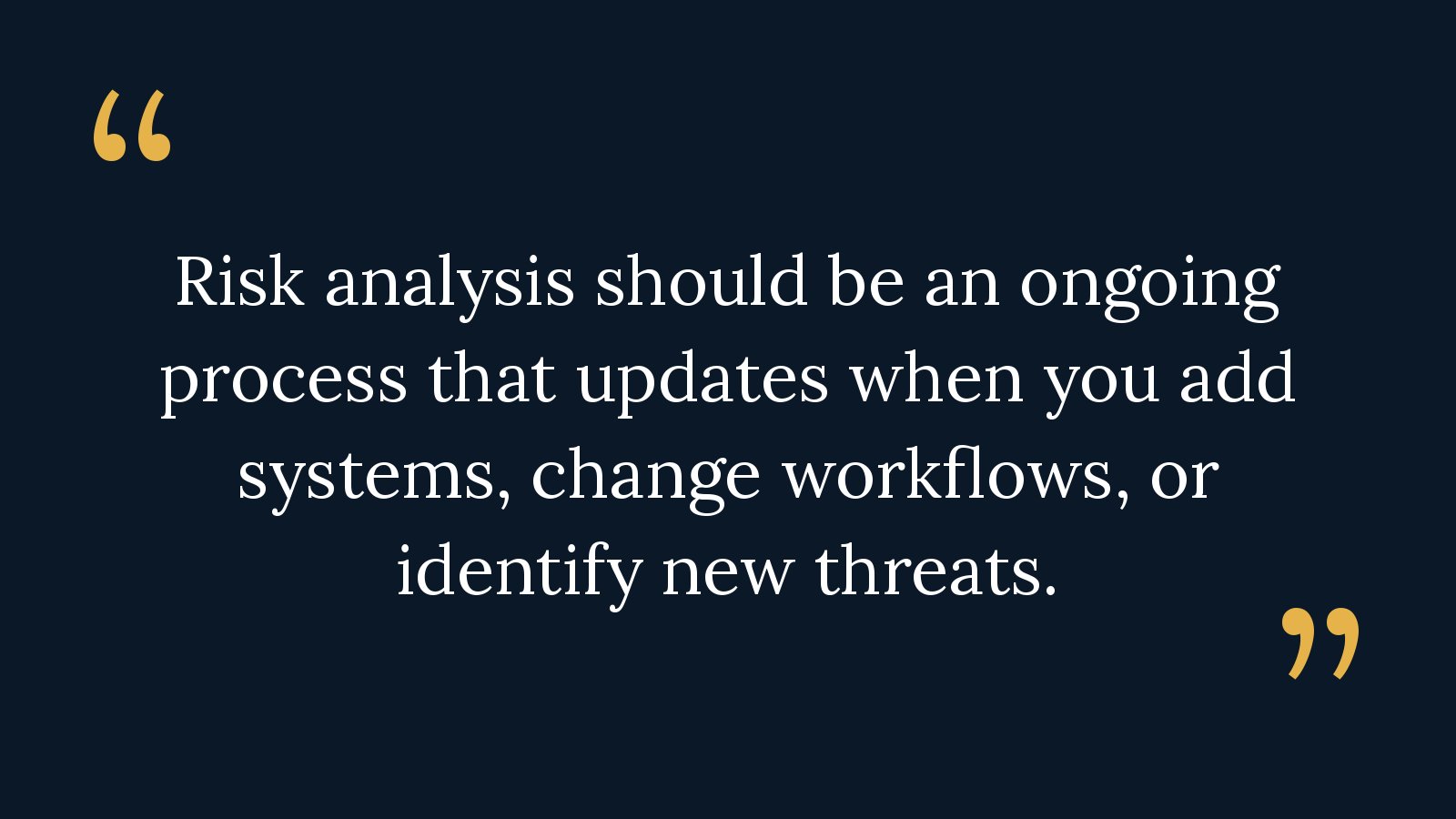
The failure pattern I see: organizations treat risk analysis as a one-time project, usually conducted by a consultant who produces a report that sits in a shared drive. Risk analysis should be an ongoing process that updates when you add systems, change workflows, or identify new threats. If your risk analysis is more than a year old and doesn't reflect current infrastructure, it's not compliant.
Need a Speaker Who Understands Healthcare Compliance?
Carl B. Johnson delivers keynotes on HIPAA compliance, healthcare privacy, and AI governance for healthcare conferences and leadership teams. His talks cut through vendor marketing and focus on operational realities.
Book Carl to SpeakThe Breach Notification Rule: When Things Go Wrong
The Breach Notification Rule establishes what you must do when PHI is impermissibly used or disclosed in a way that compromises security or privacy. A breach is an acquisition, access, use, or disclosure that violates the Privacy Rule and poses a significant risk of financial, reputational, or other harm to the individual.
You must notify affected individuals within 60 days of discovering a breach. If the breach affects 500 or more individuals, you also notify the Department of Health and Human Services and prominent media outlets. Breaches affecting fewer than 500 individuals get reported to HHS annually. Business associates must notify the covered entity within 60 days.
The complexity comes with determining whether an incident qualifies as a breach. Not every impermissible disclosure triggers notification requirements. HIPAA includes a harm threshold—you must conduct a risk assessment to determine if there's a low probability that PHI has been compromised. This assessment must consider the nature and extent of the PHI involved, who made the unauthorized disclosure and who received it, whether PHI was actually acquired or viewed, and the extent to which risk has been mitigated.
The Risk Assessment That Actually Matters
Organizations often treat the breach risk assessment as a way to avoid notification obligations. That's backwards. The assessment is supposed to be objective, documented, and defensible. If you experience an incident and immediately conclude there's no risk without a thorough analysis, regulators will question your methodology.
I've reviewed dozens of breach risk assessments where the conclusion was predetermined. An unencrypted laptop gets stolen from an employee's car, but the organization decides no breach occurred because the laptop was password-protected and there's "no evidence" PHI was accessed. That's not a risk assessment—that's wishful thinking documented after the fact.
A proper assessment documents what PHI was on the device, who had access to it, what security controls were in place, whether there's evidence the device was targeted for its data versus opportunistically stolen, and what the realistic risk profile looks like. You might still conclude notification isn't required, but the analysis needs substance.
Business Associate Agreements: The Contract That Matters
If you're a covered entity working with vendors who touch PHI, you need a Business Associate Agreement (BAA) in place before sharing any protected information. If you're a vendor providing services to healthcare organizations, you'll be asked to sign BAAs. These aren't optional, and the standard terms aren't negotiable on most key points.
A compliant BAA must specify permitted and required uses of PHI, require the business associate to implement appropriate safeguards, require reporting of security incidents and breaches, ensure subcontractors also sign BAAs, make records available to HHS for compliance reviews, require return or destruction of PHI at contract termination, and authorize the covered entity to terminate if the business associate violates material terms.
The pattern I see with BAAs: both parties treat them as administrative paperwork rather than operational commitments. A SaaS vendor signs a BAA without understanding what HIPAA compliance actually requires. A covered entity sends a BAA template to every vendor without assessing whether each one actually needs access to PHI. Neither side monitors ongoing compliance with the agreement's terms.
For a detailed look at what BAAs must include and how to handle them properly, see What Is a Business Associate Agreement (BAA)? Why It Matters in 2026.
When Subcontractors and AI Vendors Complicate the Picture
Business associates must ensure their subcontractors also comply with HIPAA and sign BAAs. This creates a chain of responsibility that many organizations don't manage well. Your vendor signs your BAA, but then uses cloud infrastructure, backup services, analytics platforms, and support contractors without ensuring each one has proper agreements and safeguards.
AI vendors present a particularly complex BAA scenario. Many AI tools process data in ways that don't fit traditional BAA frameworks. The vendor might need access to PHI for training, the service might create derivative data that includes protected information, or the model architecture might make it impossible to delete specific individual records. For healthcare organizations evaluating AI tools, this isn't just a contracting question—it's a fundamental compliance question. I cover this dynamic in depth at Do AI Vendors Need to Sign a BAA? The Answer Is More Complex Than You Think.
Enforcement and Penalties: What Violations Actually Cost
HIPAA violations carry civil monetary penalties that range from $100 to $50,000 per violation, with an annual maximum of $1.5 million per violation category. The penalty tier depends on the level of culpability: whether the violation was unknown and couldn't have been discovered with reasonable diligence, whether it was due to reasonable cause rather than willful neglect, or whether it constituted willful neglect that was or wasn't corrected within 30 days.
In my experience, most organizations focus too much on the penalty amounts and not enough on what triggers enforcement. HHS Office for Civil Rights (OCR) investigates complaints and conducts compliance reviews. They receive tens of thousands of complaints annually. Not all lead to penalties, but the investigation process itself is disruptive and expensive.
What gets OCR's attention: large breaches affecting thousands of individuals, repeated complaints against the same organization, complaints involving particularly sensitive information like mental health or HIV status records, incidents involving apparent indifference to compliance obligations, and cases where the organization's response suggests systematic problems rather than isolated incidents.
The resolution agreements OCR publishes offer useful patterns. Organizations pay penalties, but they also commit to corrective action plans that include risk analysis, policy revisions, workforce training, monitoring, and reporting. The ongoing compliance obligations often cost more than the settlement amount.
For a detailed breakdown of how violations are categorized and what actually drives enforcement, see HIPAA Violation Penalties: How Fines Are Calculated and What Drives Them.
Healthcare Privacy and Compliance Keynotes
Carl speaks on HIPAA compliance, AI in healthcare, business associate management, and privacy program design for healthcare conferences and organizations. See all keynote speaking topics or reach out about your event.
Book Carl for Your EventCommon Compliance Failures Healthcare Organizations Should Avoid
Certain failures appear across healthcare organizations regardless of size or sophistication. These aren't edge cases—they're predictable gaps that show up during audits and after breaches.
Incomplete risk analysis. Organizations identify some systems and some risks, but they don't catalog all locations where ePHI exists. Shadow IT, departmental databases, backup systems, and mobile devices often don't make it into the risk analysis. If it's not in your risk analysis, you're not managing its risk.
Training that checks boxes without changing behavior. Annual HIPAA training modules with multiple-choice questions don't create security-conscious workforces. Staff complete the training because it's required, not because it changes how they handle PHI. Effective training is role-specific, scenario-based, and reinforced with real consequences when policies are violated.
Access controls that expand over time without review. Someone needs temporary access for a specific project, gets added to a group, and never gets removed. Employees change roles but keep their old permissions. Contractors finish their work but maintain system access indefinitely. Most organizations don't have effective processes for periodic access recertification.
Policies that don't match actual practices. The policy says all portable media must be encrypted, but staff regularly transfer files to unencrypted USB drives. The policy requires minimum necessary access, but the EHR defaults to all-access permissions and nobody customizes them. When policies and reality diverge, you're not compliant with either.
Vendor management that stops at contract signing. Once the BAA is executed, organizations assume the vendor is handling their obligations. They don't verify security practices, don't review audit reports, don't track subcontractor relationships, and don't monitor for incidents. Then a vendor breach occurs and they discover they had no visibility into what safeguards were actually in place.
HIPAA Compliance as a Leadership Responsibility
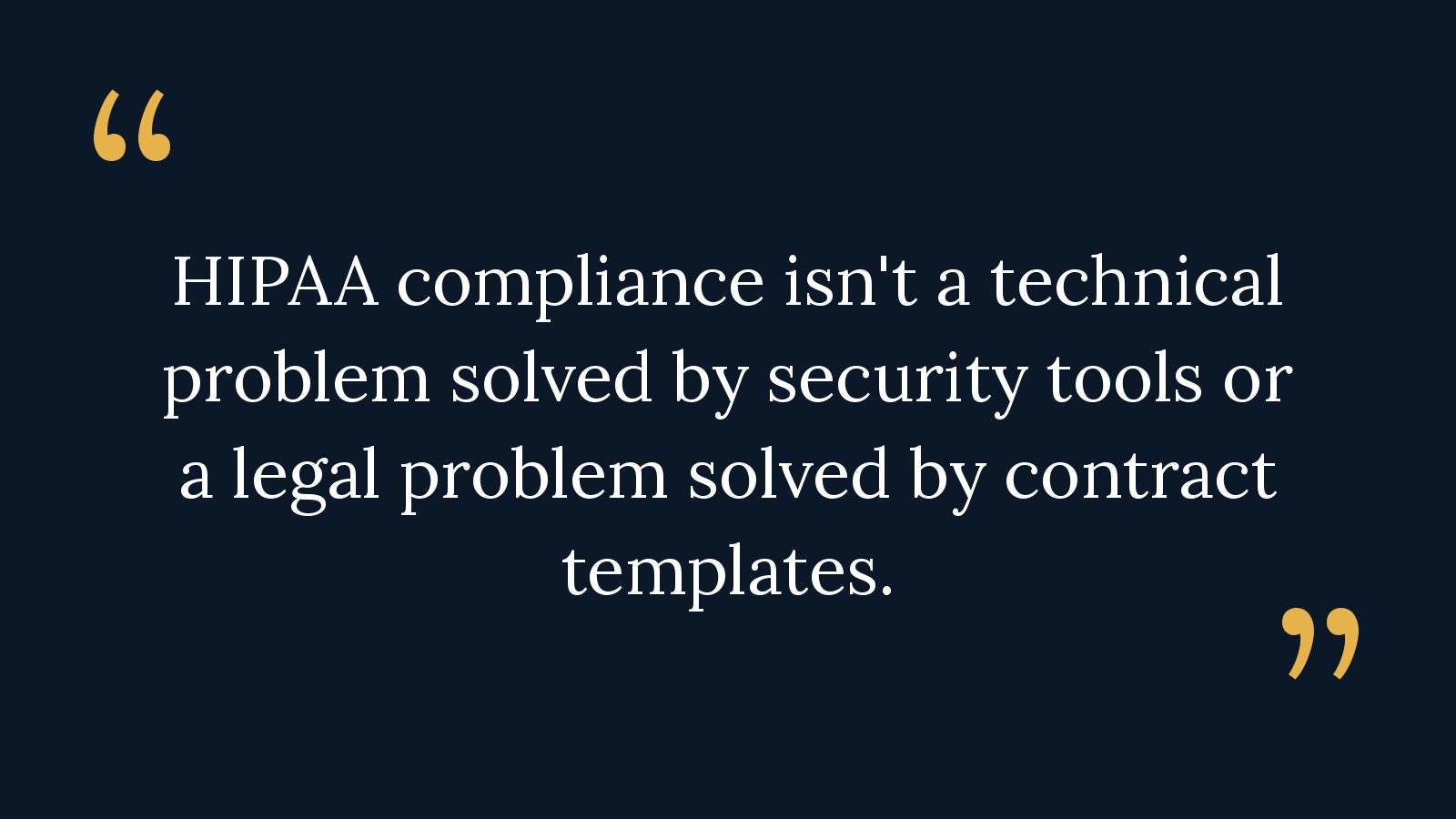
HIPAA compliance isn't a technical problem solved by security tools or a legal problem solved by contract templates. It's an operational discipline that requires executive commitment, resource allocation, and accountability structures.
The organizations that get HIPAA right treat it as a risk management program, not a checklist. They designate clear ownership—usually a Privacy Officer and Security Officer who have authority and resources, not just titles. They integrate HIPAA requirements into operational processes rather than treating them as parallel compliance activities. They monitor effectiveness through metrics that matter: access certification completion rates, incident response times, training effectiveness measures, and audit findings.
Healthcare leaders should ask specific questions about their HIPAA compliance posture: When was our last comprehensive risk analysis, and does it reflect current infrastructure? How do we verify that business associates are maintaining appropriate safeguards? What percentage of our workforce has access to more PHI than their role requires? How long does it take us to detect and respond to potential privacy incidents? Can we produce documentation that would satisfy an OCR audit tomorrow?
If those questions don't have clear answers, the compliance program needs work. HIPAA has been law since 1996, with the Security Rule effective since 2005 and the Breach Notification Rule since 2009. There's no excuse for uncertainty about foundational requirements.
The healthcare industry is adding complexity faster than most organizations are adding maturity. Telehealth, remote monitoring, AI-powered diagnostics, third-party analytics, and patient engagement platforms all expand the attack surface and create new PHI flows. HIPAA compliance in this environment requires continuous attention to where data goes, who touches it, and what controls protect it at each step. Organizations that treat compliance as a static achievement will find themselves behind faster than they expect.