
Most non-technical leaders I meet worry they can't contribute meaningfully to cybersecurity conversations. They sit in briefings, hear acronyms pile up, and leave with a vague sense that things are either fine or falling apart—but they're not sure which. The problem isn't their intelligence or judgment. The problem is that security teams often explain the wrong things in the wrong way, and leaders don't know which questions will cut through the noise.
You don't need to understand encryption algorithms or firewall rule syntax to lead effective cybersecurity decisions. You need to understand risk, resource allocation, and accountability. Those are leadership problems, not technical ones. The gap between what most security teams present and what executives actually need is where organizations get stuck—and where bad decisions happen in both directions.
This briefing covers what non-technical leaders should actually know about cybersecurity for non-technical leaders: the concepts that matter, the questions that reveal truth, and how to engage productively with your security function without pretending to be someone you're not.
The Mental Model: Risk, Not Perfection
Security is not a binary state. You're never "secure" or "not secure." You're managing a constantly shifting risk profile across assets that matter to different degrees, against threats that evolve faster than your defenses, within resource constraints that are always tighter than you'd like.
The first mental shift for cybersecurity for non-technical leaders is abandoning the idea that your job is to eliminate risk. It's not. Your job is to understand which risks you're taking, make conscious decisions about which ones are acceptable, and ensure you're deploying resources where they'll have the most impact. Perfect security doesn't exist. Perfect security would mean no business operations—no email, no customer data, no internet connectivity, no third-party vendors. The question is never "are we totally safe?" The question is "are we managing risk in a way that aligns with our business objectives and risk tolerance?"
In my experience working with healthcare organizations and defense contractors, the boards and executive teams that struggle most are the ones still looking for yes-or-no answers. They want to hear "we're compliant" or "we're protected." The ones who succeed understand that security is a spectrum, compliance is a floor not a ceiling, and their role is to pressure-test the risk decisions being recommended to them.
What "Managing Risk" Actually Means
Managing cybersecurity risk means you have a defensible process for:
- Identifying what assets matter most (customer data, intellectual property, operational technology, financial systems)
- Understanding what threats are realistic for your organization (nation-state actors care about defense contractors, not local restaurants; ransomware crews target everyone with money)
- Deciding which controls to implement based on cost, effectiveness, and business impact
- Monitoring whether those controls are working
- Accepting the residual risk that remains after you've done all that
The last one is where leadership comes in. Your security team can recommend controls. Only you can accept residual risk on behalf of the organization. That's not a technical decision. It's a business decision that requires understanding what you're trading off.
The Questions That Matter
Most security briefings to executives are either too detailed (here's every vulnerability we patched this month) or too vague (we're enhancing our security posture). Neither helps you make decisions. The questions below will get you past performance theater and into substance.
What Are We Protecting, and Why?
If your security lead can't answer this clearly, you have a strategy problem. Not every asset deserves the same level of protection. Customer payment data and last year's marketing slides are not equivalent risks. Your security program should be able to articulate what the crown jewels are—the data, systems, or processes that would cause the most damage if compromised—and explain how resources are weighted toward protecting them.
The pattern I see in organizations that struggle is equal treatment of unequal risks. They spend as much effort locking down conference room schedules as they do protecting design files worth millions. Ask: "If you had to rank our top five assets by risk exposure and business impact, what would they be?" If the answer is everything, you don't have a strategy.
What Would a Breach Actually Look Like for Us?
This is a scenario question. Not "could we be breached"—of course you could. But "walk me through what happens if our customer database is exfiltrated" or "what if ransomware locks up our manufacturing systems?" You want to understand the business impact in terms that matter: revenue loss, regulatory penalties, customer trust, operational downtime, legal exposure.
Good security leaders can paint this picture without hyperbole. Bad ones either catastrophize everything or downplay everything. You're looking for a calibrated answer that ties technical events to business consequences. If the answer is always "it would be bad," press harder. How bad? Compared to what? What's the recovery time? What's the notification obligation?
How Do We Know Our Controls Are Working?
Controls are the specific safeguards you've implemented—multi-factor authentication, encryption, access reviews, security training, patch management. The question is whether they're operating as intended. Many organizations implement controls and then never check if they're effective.
Ask: "How do you test our controls? How often? When was the last time a control failed a test, and what did we do about it?" You're not looking for perfection. You're looking for a testing rhythm and a learning loop. Organizations with mature programs can show you evidence: penetration test results, tabletop exercise outcomes, audit findings, metrics on phishing click rates over time.
If the answer is "we have the tools in place," that's not the same as "we've verified they work."
What Are We Not Doing, and Why?
This is the residual risk question. Every security program has gaps—controls that aren't implemented because they're too expensive, too disruptive, or just lower priority than other investments. Knowing what you're not doing is as important as knowing what you are.
A strong security leader will tell you: "We're not implementing X because the cost outweighs the risk reduction, and here's the risk we're accepting by not doing it." That's a conversation you can have. What you don't want is surprise gaps discovered during an audit or after an incident. If your security team can't articulate the conscious trade-offs, they either haven't thought it through or they're not comfortable being honest with you. Both are problems.
Need to Bring Cybersecurity Clarity to Your Leadership Team?
Carl delivers executive briefings and keynotes that translate complex security concepts into strategic decision-making frameworks—no jargon, no vendor pitches, just what leaders need to know.
Book Carl to Speak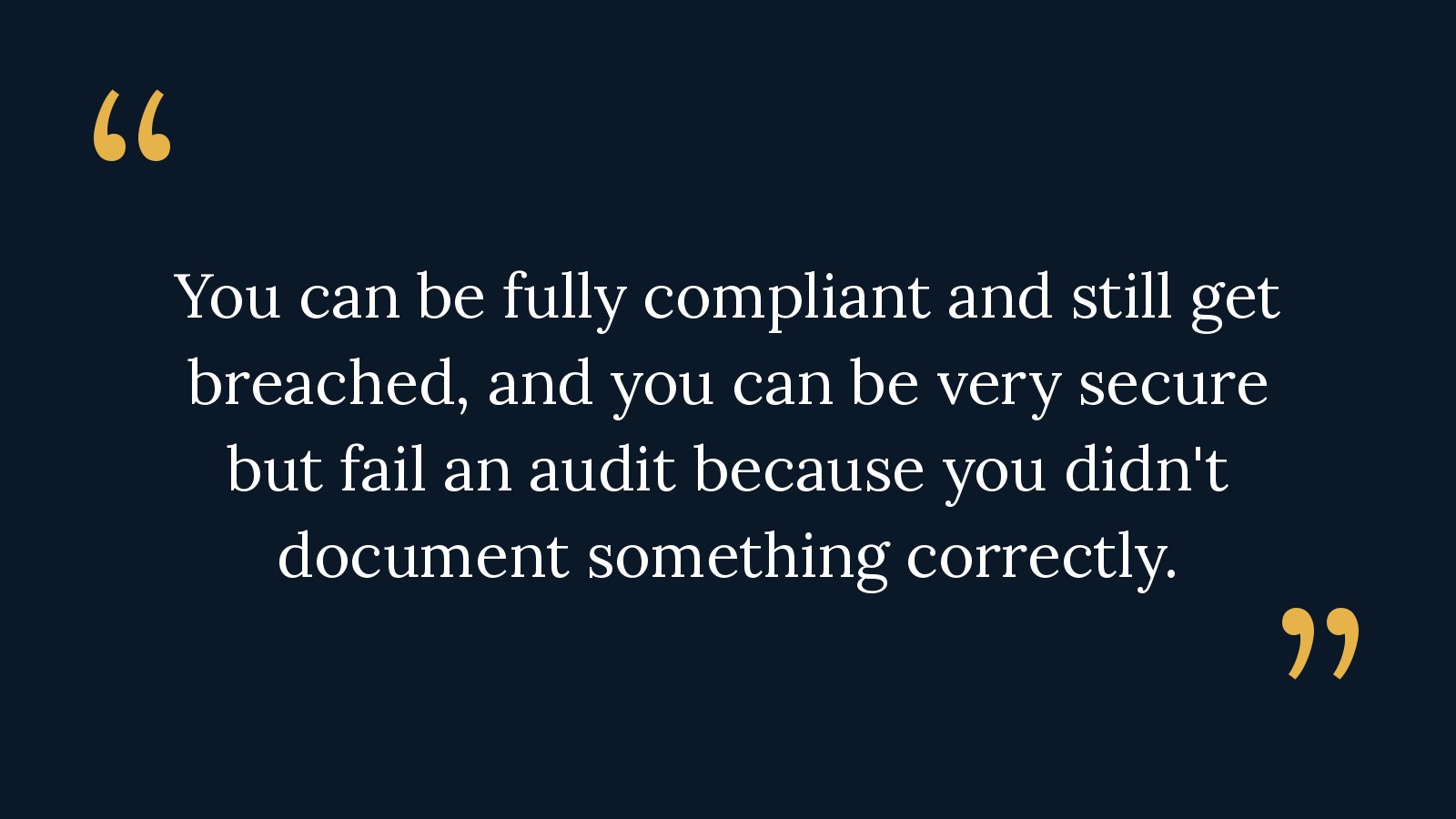
Understanding Compliance vs. Security
If your organization handles regulated data—healthcare information under HIPAA, federal contract data under CMMC, payment card data under PCI-DSS, personal information under state privacy laws—you're going to hear a lot about compliance. Compliance and security are related but not identical, and confusing the two leads to bad outcomes.
Compliance is about meeting a defined set of requirements, usually legal or contractual. It's a checklist. Security is about reducing risk in a way that's appropriate for your threat environment and business model. You can be fully compliant and still get breached. You can also be very secure but fail a compliance audit because you didn't document something correctly.
The mistake I see most often: leaders assume that achieving compliance means they're secure. It doesn't. Compliance frameworks are designed to establish a baseline, not to address your specific risks. A healthcare startup using AI tools faces different threats than a hospital system running legacy EMR software, but both have to meet the same HIPAA Security Rule requirements. Compliance gets you to the starting line. Security is the race.
That doesn't mean compliance is unimportant. In regulated industries, it's the cost of doing business. But treating compliance as the goal rather than the floor leaves you exposed. Ask your security team: "Where does our actual risk profile exceed what compliance requires, and what are we doing about it?" If the answer is nowhere, you're probably underinvesting in security.
For more on this distinction, see my article on compliance vs security, which walks through why they're not the same thing and what that means for resource allocation.
How to Evaluate Your Security Team's Recommendations
Security teams will bring you requests: budget for new tools, headcount for new roles, approvals for projects that will disrupt operations. Your job isn't to second-guess the technical details. It's to pressure-test the business case and the trade-offs.
Start With the Threat Model
Every security recommendation should be tied to a threat or risk it's meant to address. If the proposal is "we need to implement extended detection and response," the question is: "What threat does this address that our current tools don't handle? What's the likelihood and impact of that threat? What happens if we don't do this?"
Good recommendations will connect dots: "We're seeing an increase in credential-based attacks in our sector. Our current tools alert us after the fact, but this would give us real-time detection and response. The cost is $X, and the risk reduction is Y." Bad recommendations sound like: "This is best practice" or "Everyone in the industry is doing it." Best practice and industry trends are inputs, not justifications. You're managing your risk, not someone else's.
Understand the Operational Impact
Security controls often create friction. Multi-factor authentication slows down login. Data loss prevention tools block certain file transfers. Access reviews require managers to spend time auditing permissions. None of that is inherently bad, but it has a cost in productivity, user experience, and morale.
Ask: "What will this do to our users' workflows? What's the plan for minimizing disruption and getting buy-in?" Security teams that haven't thought through implementation and change management will cause resentment and workarounds. If the answer is "users will just have to deal with it," you're going to have a culture problem.
Validate the ROI, or Lack Thereof
Some security investments have measurable ROI: reducing fraud losses, avoiding regulatory fines, preventing downtime. Many don't. Insurance is a cost center until you need it. The same is true for security controls that mitigate low-probability, high-impact events.
Don't force your security team to manufacture fake ROI metrics ("this will save us $2 million in potential breach costs"). That's guesswork dressed up as analysis. But do ask them to explain the value in terms you can weigh against other investments. Is this a regulatory requirement? A contractual obligation? A risk reduction that keeps you in business if the worst happens? Those are all valid, but they're different justifications with different decision frameworks.
For leaders evaluating whether a virtual CISO model makes sense for their organization, I cover that question in detail in what is a vCISO, including when fractional security leadership delivers more value than a full-time hire.
Building a Productive Relationship With Your Security Function
The most effective working relationships I've seen between non-technical executives and security teams are built on mutual respect, not technical fluency. You don't need to learn their language. They need to learn to translate. But you do need to create the conditions where honest conversation can happen.
Make It Safe to Deliver Bad News
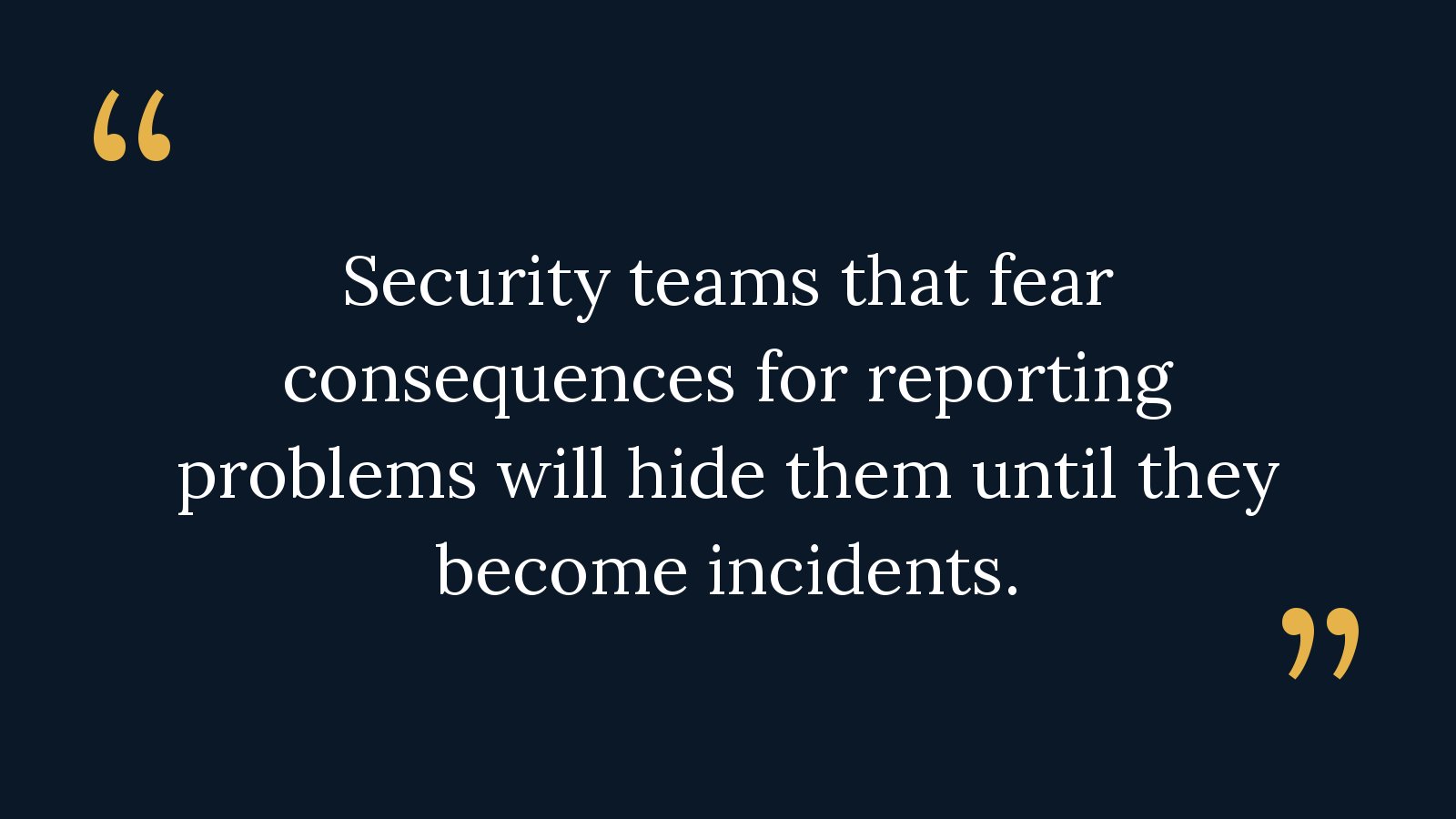
Security teams that fear consequences for reporting problems will hide them until they become incidents. If your security lead comes to you and says "we found a gap in our access controls" or "that third-party vendor doesn't meet our standards," your response sets the tone. If the response is "how did this happen, who's responsible, why didn't we catch this sooner," you'll train them to avoid uncomfortable updates.
The better response: "What's the risk? What are our options? What do you need from me to fix it?" You can hold people accountable for not following process or for repeating the same mistakes. But punishing people for surfacing risk just drives it underground.
Create Regular Touchpoints That Aren't Crisis-Driven
Most executives only hear from security when something is on fire or when budget season rolls around. That's a missed opportunity. Regular, structured touchpoints—monthly or quarterly, depending on your organization's size and risk profile—give you visibility into trends, early warnings, and strategic issues before they become urgent.
What should those touchpoints cover? Not a laundry list of tickets closed or patches deployed. You want a narrative: What changed in our risk landscape this quarter? What are we tracking that could become a problem? Where are we behind where we should be? What decisions do I need to make or resource constraints do I need to know about?
If you're working with a fractional or virtual CISO, this rhythm is especially important. The engagement model may be part-time, but the communication cadence should still be predictable. For more on how that relationship should work, see my piece on the first 90 days of a vCISO engagement.
Don't Mistake Activity for Progress
Security teams can generate endless activity: vulnerability scans, policy updates, training modules, tool evaluations. None of that matters if it's not tied to measurable risk reduction. In my experience, the weakest security programs are often the busiest—lots of motion, little impact.
Ask: "What are the three things that will reduce our risk the most over the next 12 months?" If the answer is a list of 15 initiatives, none of which are prioritized, you have a focus problem. Good security leadership is about trade-offs and sequencing. If everything is a priority, nothing is.
Looking for Strategic Cybersecurity Guidance?
Carl helps leadership teams cut through complexity and build security programs that align with business goals. See all keynote speaking topics or reach out about your event.
Book Carl for Your EventWhat to Do When You Disagree With Security Recommendations
Sometimes your security team will recommend something you don't want to do. Maybe it's too expensive, too disruptive, or it conflicts with a business objective. That's fine. You have the authority to say no. But you need to own the decision and the risk that comes with it.
The process should look like this: Your security team explains the risk, the recommendation, and the consequences of not acting. You explain your concerns—cost, timing, operational impact, whatever it is. You have a real conversation about alternatives. Maybe there's a partial implementation that gets you 80% of the risk reduction at 40% of the cost. Maybe the risk is real but the timing is wrong, and you revisit it in six months. Maybe you accept the risk as-is and document that decision.
What shouldn't happen: overruling security without understanding what you're trading off, or letting security veto business decisions without articulating the specific risk. Both patterns create dysfunction. Security exists to enable the business within acceptable risk, not to prevent all risk or to rubber-stamp decisions that expose the organization.
One area where this comes up constantly is third-party vendors. Security will flag a vendor as high-risk. Business will say the vendor is critical to a revenue stream. The conversation shouldn't be "security says no" or "business overrules security." It should be: what additional controls can we layer on to reduce the vendor risk? What's the exit strategy if the vendor gets breached? What's the contractual language around liability? That's a negotiation between risk and opportunity, and it's exactly where leadership adds value.
Reading the Board Report (Or Asking for One That's Useful)
If you sit on a board or receive board-level reporting, you've probably seen a cybersecurity update that looks like a status dashboard: green, yellow, red indicators across various categories, maybe a few bullet points about initiatives in progress, and a slide that says "no incidents this quarter."
That's not a board report. That's a report designed to avoid questions. A useful board report tells you: What are the top three risks we're managing right now? What are we doing about them? What decisions or resources do we need from the board? What's changed since last quarter that we should pay attention to? Where are we exposed in ways we've chosen to accept, and does the board agree with that trade-off?
The single most important element of board-level cybersecurity reporting is the risk acceptance section. Every organization has risks it's not fully mitigating—because of cost, because of competing priorities, because the business case doesn't support it. The board should know what those are. If the board report shows all green lights and no residual risk, either your organization has an unlimited security budget (it doesn't) or the reporting is dishonest.
For a deeper look at what boards should be asking for and what security teams should be delivering, see my article on cybersecurity reporting to the board.
Recognizing When You Need Outside Help
Not every organization needs a full-time CISO. Plenty of small and mid-sized companies can't justify the cost, don't have the workload, or don't have the complexity. But every organization above a certain size needs someone thinking strategically about security—and that someone needs to be credible, experienced, and able to speak to both technical teams and business leadership.
The signs you need help: Your IT team is managing security as a side responsibility and it's getting lost in the noise. You're facing regulatory requirements or customer security questionnaires you don't know how to answer. You had an audit or assessment that revealed gaps you don't have the expertise to close. You're about to pursue a contract or partnership that requires security commitments you can't currently meet.
This is where fractional or virtual CISO services come in. You get strategic security leadership without the cost of a full-time executive. The model works well for organizations that need experience and judgment more than they need someone in the building 40 hours a week. You get roadmap development, risk assessments, program oversight, vendor management, and board reporting from someone who's done it before in your industry.
The model doesn't work if what you actually need is hands-on implementation or if your organization is large and complex enough that security is a full-time job. For more on when a vCISO makes sense and when it doesn't, see my breakdown of vCISO vs full-time CISO.
Moving Past the Jargon
The cybersecurity industry has a jargon problem. Vendors and consultants use it to sound credible. Practitioners use it as shorthand. The result is that non-technical leaders sit in meetings and hear "zero-trust architecture," "SIEM," "EDR," "attack surface management," and walk away with no idea what was just said or whether it mattered.
You're allowed to ask for translation. In fact, you should demand it. If your security team can't explain a concept in plain language, it's usually because they don't understand it well enough themselves or they're trying to avoid scrutiny. The best security leaders I know can explain complex topics to a board member, a regulator, or a customer without a single acronym. It's a skill, and it's one you should expect from anyone in a leadership role.
When you hear jargon, stop the conversation and ask: "Explain what that means in terms of business risk. Why does this matter? What happens if we don't have it?" If the answer is more jargon, push again. If the person can't get to a plain-language answer, you've learned something about their communication skills and possibly their depth of understanding.
The same applies to vendor pitches. If a vendor can't explain what their product does and what problem it solves without buzzwords, they're either selling something you don't need or they don't understand their own product. Either way, it's a red flag.
The Leadership Accountability You Can't Delegate
Cybersecurity for non-technical leaders isn't about becoming a technical expert. It's about owning the risk decisions that only you can make. You can delegate implementation. You can delegate tool selection and policy drafting and incident response coordination. You can't delegate the decision about how much risk your organization will accept, where you'll prioritize resources, and what trade-offs you're willing to make between security and other business objectives.
The organizations that do this well have leaders who ask hard questions, demand clear answers, and make decisions with eyes open. They don't defer to security on everything, and they don't overrule security without understanding the consequences. They treat cybersecurity as a business enabler and a risk management function, not as an IT problem or a compliance checkbox.
That's the shift. You don't need to learn to code or understand network architecture. You need to understand risk, ask the right questions, and hold your security function accountable for translating technical problems into business language. If you can do that, you're already ahead of most leaders I meet.