
I watched a federal contractor celebrate their FedRAMP certification while their developers pushed code to production with hardcoded AWS credentials. The compliance program was immaculate. The security was catastrophic.
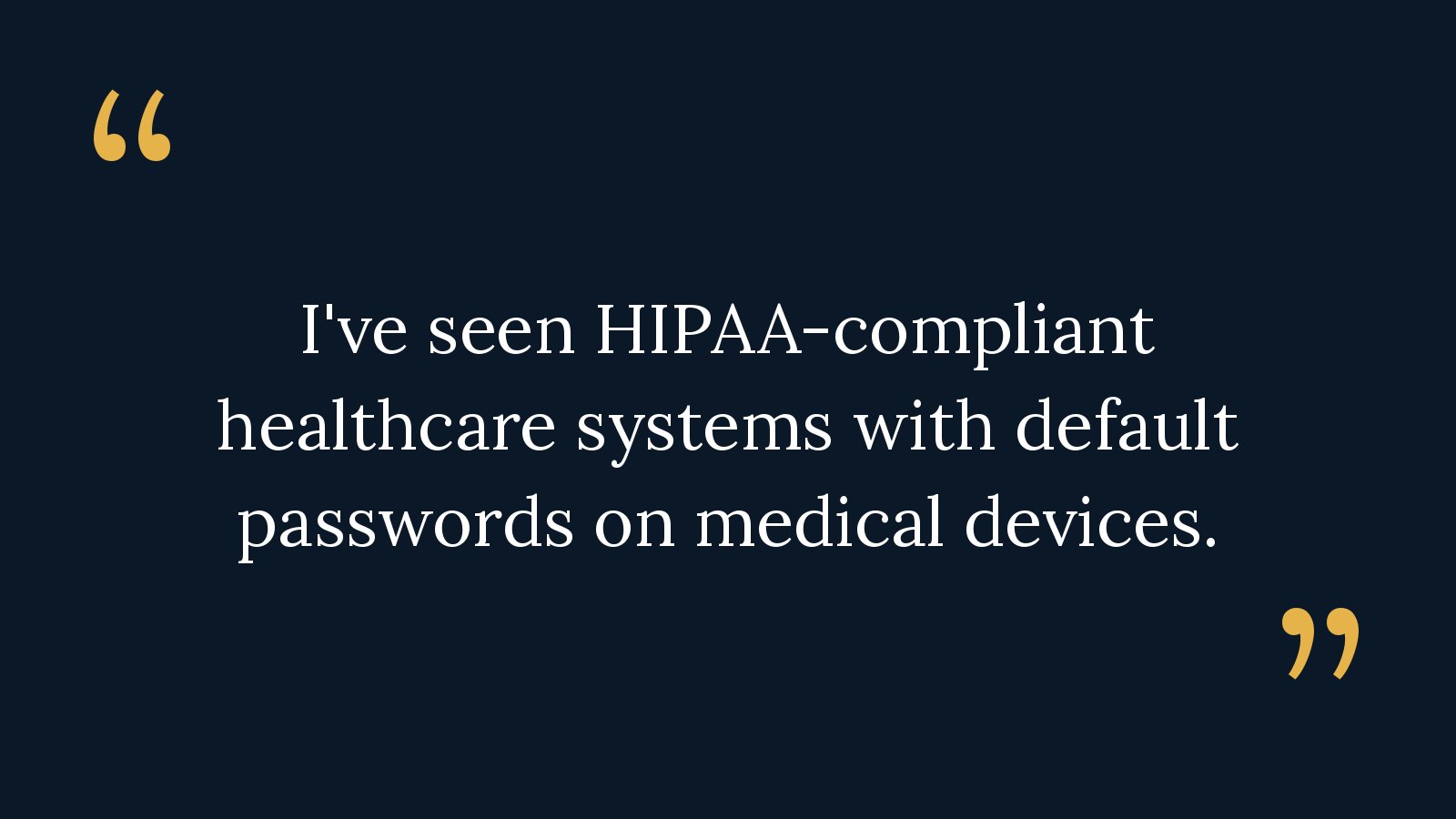
This wasn't an outlier. I've seen HIPAA-compliant healthcare systems with default passwords on medical devices. Defense contractors with perfect CMMC documentation and wide-open file shares. Organizations that passed every audit while bleeding data.
The relationship between compliance and security isn't what most people think. They're not synonyms. They're not even close cousins. Understanding the difference, and more importantly, understanding why compliance-focused programs fail at security and security-focused programs fail at compliance, is fundamental to building something that actually works.
What Compliance Actually Measures
Compliance measures your ability to demonstrate documented conformance to a specific set of requirements at a particular point in time. That's it. That's the entire scope.
When an auditor reviews your HIPAA compliance, they're checking whether you have the required policies, whether you've completed your risk assessment, whether you've documented your workforce training. They're not testing whether an attacker can actually exfiltrate patient data. They're verifying that you followed the process the regulation prescribes.
This isn't a criticism of compliance frameworks. It's their design. Regulations have to be:
- Specific enough to audit consistently
- Broad enough to apply across different organizations
- Stable enough that organizations can plan around them
- Defensible enough to withstand legal challenge
These constraints mean compliance frameworks lag behind threats by years, sometimes decades. HIPAA's Security Rule was finalized in 2003. The threat landscape from 2003 is ancient history. Yet organizations are still being measured against controls designed for that era, supplemented by guidance documents that try to bridge a twenty-year gap.
The pattern I see repeatedly: organizations treat the compliance framework as the ceiling rather than the floor. If HIPAA requires annual security awareness training, they do annual security awareness training. Not because annual training is effective—it demonstrably isn't for most organizations—but because it satisfies the requirement. The compliance checkbox becomes the security strategy.
What Security Actually Requires
Security requires that your systems resist actual attack from actual adversaries using actual techniques. This is a completely different measurement problem.
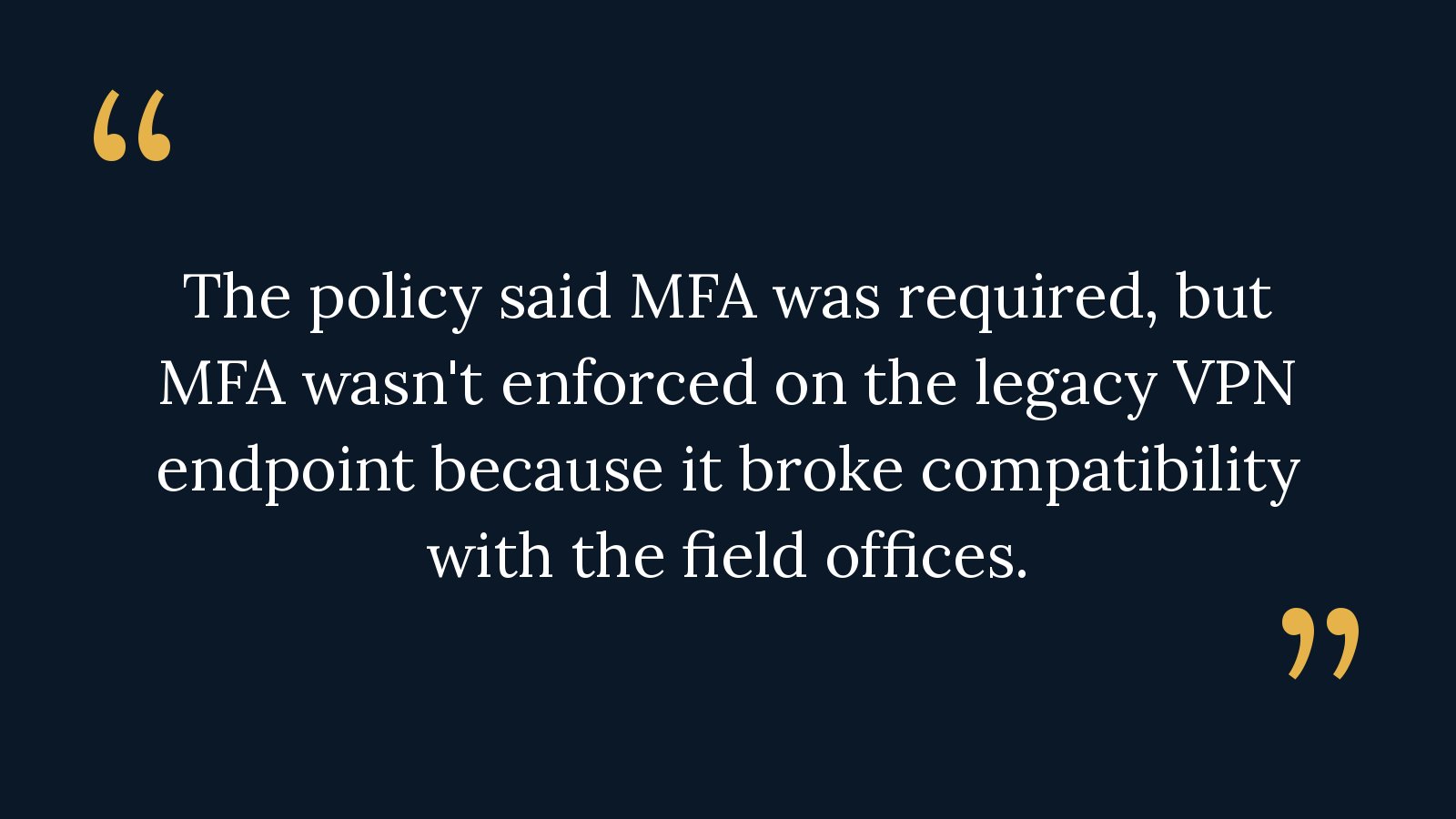
You can have perfect compliance documentation and still get compromised in the first fifteen minutes of a penetration test. I've seen it. The policy said MFA was required. The audit showed MFA was enabled. But MFA wasn't enforced on the legacy VPN endpoint because "it broke compatibility with the field offices." That VPN endpoint was the first thing the red team compromised.
Security also operates on a different timescale than compliance. A new vulnerability drops, you need to respond in hours or days, not in the next annual review cycle. Your compliance program probably has a change management process that requires a CAB meeting, impact assessment, and documentation before changes go to production. Your security reality might require patching now and documenting later.
The defender's disadvantage applies here. Compliance lets you succeed 99% of the time and still pass. Security requires you to succeed 100% of the time. An attacker only needs one path in.
The Coverage Problem
Compliance frameworks have gaps. Sometimes large ones. HIPAA doesn't prescribe specific technical controls for most scenarios. CMMC has maturity levels, but even Level 3 doesn't cover everything an APT might throw at a defense contractor. PCI DSS is probably the most technically specific framework I work with, and even PCI has interpretation room that lets organizations implement controls that satisfy requirements without actually securing card data.
Your adversaries don't limit themselves to the attack surfaces your compliance framework covers. They'll go after whatever works: the HVAC vendor remote access, the acquired company that never got integrated properly, the SharePoint site with overly permissive access, the S3 bucket with a guessable name.
Why Compliance-Focused Programs Fail at Security
When you build a program optimized for compliance, you get outcomes optimized for compliance. That sounds obvious, but the failure modes are predictable and expensive.
First, compliance-focused programs create checkbox cultures. Did we do the training? Yes. Did anyone learn anything? Not measured. Did behavior change? Not measured. Did risk actually decrease? Not measured. But the checkbox is checked, so we're compliant.
I worked with a healthcare organization that had beautiful policy documentation. Every required policy, reviewed annually, approved by the appropriate committees, distributed to staff. Compliance looked perfect. But when we did tabletop exercises, nobody could find the incident response plan. Nobody knew what it said. Nobody had practiced it. The documents existed to satisfy compliance, not to guide action.
Second, compliance-focused programs misallocate resources toward visible compliance activities and away from less visible security work. You spend budget on the GRC platform that generates beautiful audit reports. You don't spend budget on the log aggregation that would let you detect actual compromise. One helps you pass audits. The other helps you prevent breaches. Guess which one gets funded when compliance is the driver.
Third, compliance-focused programs struggle with threats outside the framework. When I ask compliance-focused teams about their API security posture, I often get blank stares. APIs might not be explicitly called out in their framework, so they haven't thought about them. Same with container security, IaC security, supply chain risk—anything that emerged after the framework was written.
The really insidious failure mode: compliance-focused programs create false confidence. You passed the audit. You must be secure. Except passing the audit means you documented that you have a firewall, not that the firewall is configured correctly, or that you're monitoring it, or that it's actually preventing the attacks you face.
Helping Organizations Navigate Compliance vs Security
Carl speaks to leadership teams, boards, and security conferences about building programs that achieve both compliance and actual security outcomes. His talks cut through the vendor noise to focus on what actually works.
Book Carl to SpeakWhy Security-Focused Programs Fail at Compliance
The opposite failure mode is just as common and often more frustrating because the actual security is frequently better.
I've worked with technical teams that had genuinely good security. Solid architecture, defense in depth, good visibility, competent response. They were prepared for real threats. But they couldn't pass an audit because they couldn't document what they were doing in the format the framework required.
Security-focused programs often treat documentation as overhead. The mentality is "we're actually securing things, why do we need to write it down?" But compliance requirements exist for reasons beyond security. They exist for consistency, for accountability, for legal defensibility, for due diligence in the event of a breach.
When the healthcare organization gets breached and OCR comes investigating, "we had good security" isn't a defense. OCR wants to see your risk assessment. Your policies. Your training records. Your BAAs. If you can't produce them, you're facing significant fines regardless of whether your actual security was better than organizations that can produce documentation.
The documentation gap creates business risk even when security risk is well-managed. You can't close deals that require compliance certifications. You can't get insurance at reasonable rates. You can't demonstrate due diligence to your board or your customers. The business consequences of compliance failure are real even when your security is solid.
Security-focused teams also struggle with the process requirements of compliance frameworks. Formal change management feels slow when you're used to pushing updates continuously. Required approval chains feel bureaucratic when you have a critical patch to deploy. Annual review cycles feel arbitrary when you're monitoring and adjusting constantly.
But here's the thing: some of those process requirements exist because they work. Formal change management catches mistakes. Approval chains ensure stakeholders know what's changing. Documentation helps when the person who implemented something leaves. Security-focused teams that dismiss all compliance process as bureaucracy miss opportunities to improve their own resilience.
The Integration Challenge
The real question isn't compliance versus security. It's how you build a program that achieves both.
This is harder than it sounds because the incentives pull in different directions. Compliance wants documentation and process. Security wants speed and effectiveness. Compliance operates on annual cycles. Security operates on continuous improvement. Compliance success is binary—you pass or fail. Security success is probabilistic—you reduce likelihood and impact.
The organizations that do this well start by recognizing that compliance and security serve different masters. Compliance serves regulatory and contractual obligations. Security serves risk management. Both are necessary. Neither is sufficient.
From there, the integration requires conscious design. You can't just bolt compliance onto a security program or vice versa. You need to build processes that serve both purposes.
Start with Risk, Add Compliance Requirements
Your actual risk assessment should drive your security program. Not the risk assessment you do for HIPAA compliance—the real one where you identify what would actually hurt your organization and what would actually prevent or detect it.
Then layer compliance requirements on top. Where compliance requirements align with actual risk, great. Where they don't, you implement them as process requirements but don't pretend they're your security strategy. When HIPAA requires annual training, you do annual training for compliance. But if your risk assessment says phishing is a real threat, you do phishing simulations monthly because that's what the risk requires.
This approach prevents compliance from becoming your ceiling while ensuring you still meet obligations. It also makes resource allocation clearer. This security control addresses real risk. This compliance requirement addresses regulatory obligation. Both get funded, but for different reasons.
Build Documentation Into Security Processes
Documentation doesn't have to be overhead if it's built into how you work rather than added afterward. When you implement a new security control, the documentation is part of the implementation. When you handle an incident, the documentation is part of the response process. When you make risk decisions, you document the decision as you make it.
The organizations I see doing this well use their security tools to generate compliance evidence. Their vulnerability management platform creates the documentation for their vulnerability assessment. Their SIEM creates the documentation for their monitoring. Their IdP creates the documentation for their access reviews.
This only works if you choose security tools with compliance requirements in mind. Not as the primary driver—security effectiveness is still primary—but as a factor. The tool that's 10% better at detection but has zero compliance reporting might not be the right choice if you're in a regulated industry.
Use Compliance Frameworks as Checklists, Not Strategies
Compliance frameworks are excellent checklists. They ensure you don't miss categories of controls. They provide structure for conversations with auditors and executives. They give you common language for discussing requirements with customers and partners.
What they're not is a security strategy. Your strategy should be threat-informed and risk-based. The compliance framework is a constraint you operate within, not the destination you're trying to reach.
In practice, this means when you're doing security planning, you think about adversaries and attack paths. When you're doing compliance planning, you think about requirements and evidence. The work often overlaps, but the framing is different and that difference matters.
For more on what this looks like in practice, I've written about what a regulatory compliance program actually looks like when it's designed to support rather than replace security work.
Need a Keynote Speaker Who Understands Both Compliance and Security?
Carl draws on his experience as a CISO in healthcare, federal contracting, and the defense industrial base to deliver practical talks that resonate with both technical and executive audiences. See all keynote speaking topics or reach out about your event.
Book Carl for Your EventWhat Good Integration Actually Looks Like
The best-integrated programs I've seen share common patterns. They're not perfect—no program is—but they manage to achieve both compliance and security without one undermining the other.
They have clear ownership. Someone owns compliance as a function. Someone owns security as a function. These might be the same person in a smaller organization, but the responsibilities are distinct and both are taken seriously. When the roles are separate, they work together instead of competing for resources or authority.
They have honest metrics. Compliance metrics measure compliance things: audit findings, policy review completion, training completion. Security metrics measure security things: time to patch, mean time to detect, coverage of critical assets. Neither set of metrics pretends to measure what it doesn't.
They maintain separate but linked documentation. The security documentation describes how things work and why. The compliance documentation maps those security implementations to framework requirements. You can read one or the other depending on what question you're trying to answer.
They treat audits as validation, not as the goal. The goal is to secure the organization and meet regulatory obligations. Audits validate that you're doing both. If an audit finding reveals a real security gap, that's valuable feedback. If an audit finding reveals a documentation gap, that's also valuable feedback. Both get fixed, but they're different types of problems.
They communicate differently to different audiences. To the board, they report on both compliance status and security posture, but they're clear about what each means. To auditors, they present compliance evidence in the format the framework requires. To security staff, they talk about threats and controls. The substance is consistent, but the framing matches the audience.
The Resource Allocation Problem
Here's where integration gets uncomfortable: compliance and security compete for the same budget and the same people, but they don't always compete fairly.
Compliance requirements are mandatory. You must allocate resources to them. Security improvements are risk-based. You should allocate resources to them, but you're making probability calculations. When budget gets tight, the mandatory compliance work crowds out the risk-based security work.
This creates a vicious cycle. You spend resources on compliance. You have less for security. Your security posture degrades. You get breached. Now you have breach response costs plus regulatory fines plus the compliance work you were already doing. I've seen this pattern destroy security programs.
The only sustainable answer is to fund both adequately. That requires executive leadership that understands the compliance vs security distinction and funds accordingly. It requires making the business case that compliance costs are overhead—necessary but not sufficient—while security investments reduce risk to business operations.
When I help organizations make the business case for compliance programs, I'm explicit about this distinction. The ROI of compliance is avoiding regulatory penalties and enabling business opportunities. The ROI of security is reducing breach likelihood and impact. Both matter. Both need resources.
In practical terms, this often means maintaining separate budget lines. Compliance costs are relatively stable and predictable—you know what the annual audit will cost, what the GRC tools cost, what the compliance staff costs. Security costs are more variable and require flexibility—you need to respond to new threats, new vulnerabilities, new business initiatives.
When Compliance and Security Conflict
Sometimes compliance requirements and security requirements actually conflict. Not often, but it happens, and you need a framework for handling it.
The most common conflict I see: compliance frameworks require specific documentation or process that slows security response. You have a critical vulnerability, you need to patch now, but your compliance program requires change approval that takes three days. What do you do?
The right answer is usually to patch immediately and document the emergency change process. Most compliance frameworks have provisions for emergency changes. Use them. But you need to have that emergency change process defined before you need it, and you need to document when and why you use it.
Another common conflict: compliance frameworks sometimes codify outdated security practices. Password complexity requirements are the classic example. Security research is clear that complexity requirements reduce security by encouraging password reuse and predictable patterns. But compliance frameworks often still require them. You implement them for compliance while doing the actual security work (password managers, MFA, monitoring for compromised credentials) separately.
Occasionally you'll hit conflicts where compliance requirements would materially harm security. This is rare with major frameworks, but it happens with contractual compliance requirements from customers who don't understand security. When this happens, you push back. You explain why the requirement creates risk. You propose alternatives that achieve the customer's underlying goal without the security harm. Usually this works. When it doesn't, you document the risk, get executive acceptance, and implement what you're required to implement.
The Strategic Imperative
Understanding the compliance vs security distinction isn't academic. It's strategic. Organizations that conflate the two end up with programs that fail at both.
Your board needs to understand this distinction. When you report that you're compliant, they need to understand that means you've met regulatory obligations, not that you're immune to breach. When you report security metrics, they need to understand those measure actual risk posture, not just compliance status.
Your customers and partners need to understand this distinction too. When they ask for compliance certifications, give them compliance certifications. When they ask about security, talk about security. Don't let compliance certifications become a proxy for security promises you can't keep.
Your team definitely needs to understand this distinction. The security engineers need to know that compliance documentation isn't overhead—it's a different but legitimate requirement. The compliance staff need to know that checking boxes doesn't create security—it creates evidence of controls that need to exist and function.
The organizations that get this right treat compliance and security as complementary disciplines that support the same goal: protecting the organization. They maintain distinct practices for each while ensuring those practices reinforce rather than undermine each other. They allocate resources to both. They measure both. They report on both honestly.
The organizations that get this wrong either end up compliant but insecure, or secure but unable to prove it. Both positions create business risk. Both are avoidable with clear thinking about what compliance is, what security is, and how they need to work together.
If you're building or rebuilding a program, start with clarity about this distinction. Build your security program to address actual threats. Build your compliance program to meet actual obligations. Design the intersection deliberately. Resource both adequately. And never pretend that achieving one means you've achieved the other.