
Your organization just handed a hiring manager the authority to use AI resume screening for 200 applicants. The system rejected 30% in the first pass. Two weeks later, you learn one of those applicants filed a complaint claiming the AI discriminated based on protected characteristics. Now you're explaining to the board why automated decision-making seemed like a good idea without documented oversight.
The question of AI vs human decision making isn't theoretical anymore. Organizations are delegating decisions to algorithms every day: who gets interviewed, which transactions get flagged for fraud review, how to route customer service requests, whether to approve a credit application. Some of these delegations work. Others create liability you won't discover until you're already defending it.
The pattern I see across regulated industries is consistent: organizations deploy AI without a clear framework for which decisions can be automated and which require human judgment. They treat all decisions as equivalent, or worse, they assume that if the AI performs well in testing, it's safe to deploy everywhere. That's not how risk works, and it's definitely not how regulators or plaintiffs' attorneys will evaluate your choices after something goes wrong.
The Spectrum of Decision Authority
Not all decisions carry the same weight. A system that suggests which email to archive operates in a completely different risk category than one that determines whether someone qualifies for medical treatment. Yet I consistently see organizations apply the same approval process, the same testing rigor, and the same governance to both.
Start by mapping your decisions on a spectrum based on three factors: consequence if wrong, reversibility, and regulatory exposure. A decision with high consequence, low reversibility, and direct regulatory implications should never be fully automated without specific legal authorization to do so. A decision with low consequence, easy reversibility, and no regulatory hooks can be delegated more freely.
In my experience working with healthcare organizations, for example, an AI system that flags potential drug interactions for pharmacist review sits in very different territory than one that automatically adjusts insulin dosing without human confirmation. Both involve clinical decision support, but the stakes and the regulatory frameworks are entirely different.
Consequence Assessment
What happens if the AI gets it wrong? In some cases, the answer is minor: a customer gets a slightly delayed response, a document is misfiled, a low-priority work order is routed to the wrong technician. These are operational inefficiencies, not crises.
In other cases, the consequences land hard: someone doesn't get a job interview because the system misread their resume, a patient doesn't receive a prior authorization for necessary treatment, a defense contractor's system flags the wrong data as ITAR-controlled and blocks a legitimate export. These outcomes create legal exposure, compliance violations, or significant harm.
The gap between these categories should drive your AI vs human decision making framework. If you can't tolerate being wrong, you can't delegate the final call.
Reversibility Matters
Some decisions can be unwound easily. If your inventory management system over-orders supplies based on an AI forecast, you have excess stock to work down next quarter. Suboptimal, but manageable.
Other decisions lock in consequences. If your hiring system screens out qualified candidates and they move on to other opportunities, you can't undo that. If your fraud detection system freezes a customer's account during a critical transaction and they leave for a competitor, the damage is done. If your access control system denies entry to a facility and the person misses a time-sensitive meeting, you can't replay the scenario.
Reversible decisions tolerate more automation risk. Irreversible ones demand human review before the decision becomes final.
Regulatory Bright Lines
Some industries don't give you a choice. The regulations define where humans must remain in the loop, and delegating those decisions to AI creates per se violations.
In healthcare, clinical decisions that directly affect patient care must involve qualified professionals. An AI can support the decision, but it can't make the final call on diagnosis, treatment plans, or whether to approve a procedure. HIPAA doesn't prohibit AI, but it doesn't exempt you from professional judgment requirements either. HIPAA compliance means understanding where the line sits.
In the defense industrial base, export control determinations require human review. You can use AI to flag potential ITAR or EAR issues, but you can't automate the jurisdictional determination or the decision to release technical data to a foreign person. The regulations explicitly require that determinations be made by qualified personnel, and "the algorithm said it was okay" won't hold up in an enforcement action.
In financial services, certain credit and lending decisions fall under fair lending laws that don't permit fully automated decisioning without specific controls and explainability. You need to be able to articulate why someone was denied, and "the model scored them below threshold" often isn't sufficient, especially when the model's logic is opaque.
If you're operating in a regulated industry, your starting point for AI vs human decision making isn't a blank slate. It's the regulatory floor. Some decisions are off-limits for full automation, and treating those limitations as suggestions creates exposure you don't want.
The "Human in the Loop" Illusion
The phrase "human in the loop" shows up in almost every AI governance framework, and it's almost always misunderstood. Organizations think they've addressed the problem by putting a person in the approval chain, but they don't consider whether that person has the context, authority, or practical ability to override the AI.
I've reviewed systems where the human "reviewer" sees 300 AI recommendations per day and approves 99.7% of them because they don't have time or information to evaluate each one meaningfully. That's not human oversight. That's human rubber-stamping. If your human reviewers are approving recommendations they don't understand at a rate that suggests they're not actually reviewing them, you don't have a human in the loop. You have a liability shield that won't hold up.
Effective human oversight requires three elements: the person must have sufficient information to evaluate the recommendation, sufficient time and cognitive capacity to do so, and sufficient authority to override the system without career consequences. If any of those is missing, your "human in the loop" is theatrical, not functional.
Information Asymmetry
If the AI is making recommendations based on 50 variables and the human reviewer sees a summary with three bullet points, the reviewer can't actually evaluate the decision. They're trusting the system, not reviewing it.
This shows up constantly in fraud detection systems. The AI flags a transaction as suspicious based on patterns the human reviewer can't see or reconstruct. The reviewer either approves everything (defeating the purpose) or declines everything the AI flags (in which case the AI is making the decision, not the human).
Real oversight requires that the human can see the reasoning, question the inputs, and make an informed judgment. That's harder than it sounds when the models are complex and the interfaces are designed for speed, not scrutiny.
Cognitive Load and Volume
Asking someone to review 400 AI-generated decisions per shift isn't oversight. It's throughput. The volume itself ensures that meaningful review is impossible.
If your process requires human review, the workflow must be designed so that review is actually feasible. That might mean the AI handles fewer cases, or it means you need more reviewers, or it means you need to tier the decisions so that only high-stakes or ambiguous cases require human review. What you can't do is pretend that a human glancing at a screen for three seconds per decision constitutes meaningful oversight.
Speaking on AI Governance and Decision-Making
Carl keynotes conferences on AI governance, regulatory compliance, and where to draw the line between automation and human judgment. His sessions are built on real implementation experience, not vendor talking points.
Book Carl to SpeakBuilding Your Decision Framework
A practical framework for AI vs human decision making requires answering four questions for each use case: What is the decision? What are the consequences if it's wrong? What does the regulation require? And who is accountable if something goes wrong?
Start with a clear taxonomy of your decisions. Not "we use AI for operations," but specifically: we use AI to prioritize help desk tickets, to recommend shipping routes, to flag expense reports for audit, to screen resumes for compliance roles. Each of those decisions sits in different risk territory and should be evaluated separately.
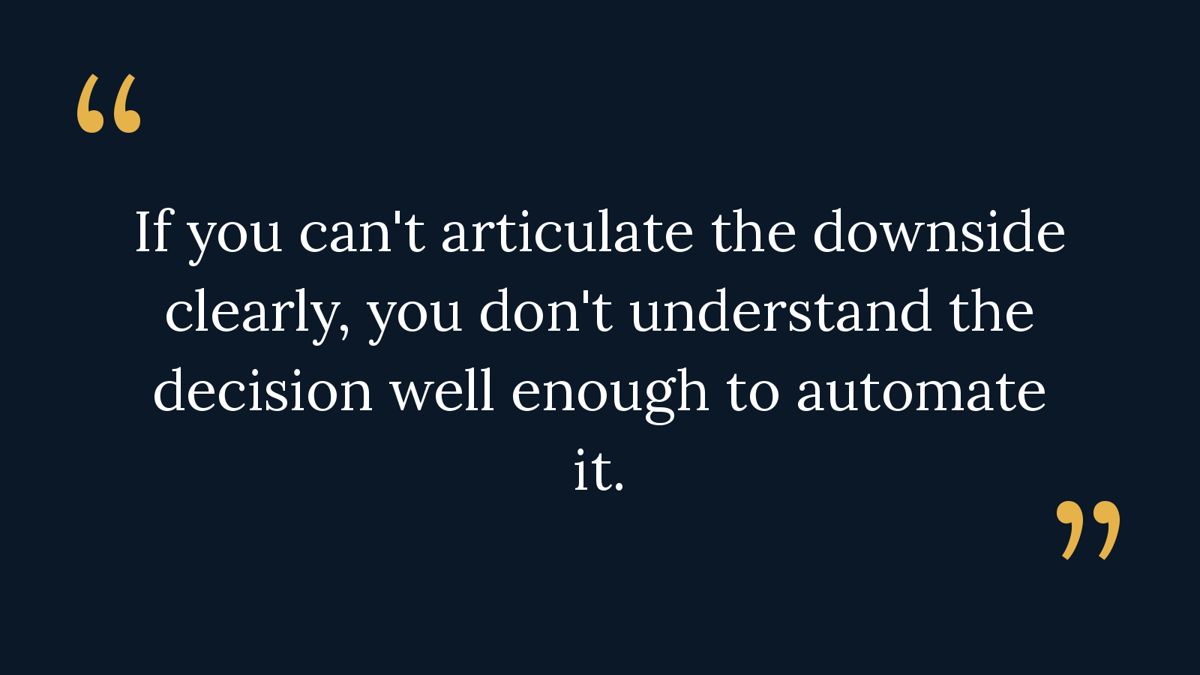
For each decision type, document the consequence profile. If the AI is wrong, what happens? Who is harmed? What is the financial, operational, or reputational impact? What is the legal exposure? If you can't articulate the downside clearly, you don't understand the decision well enough to automate it.
Then map the regulatory requirements. Does this decision fall under fair lending laws, clinical judgment requirements, export control determinations, or employment discrimination laws? If the answer is yes, what does the regulation specifically require in terms of human involvement, documentation, or explainability? The AI governance framework you build has to account for these constraints, not treat them as aspirational.
Finally, assign accountability. If this decision goes wrong, who is responsible? Is it the data science team that built the model? The business unit that deployed it? The compliance team that approved it? The executive who sponsored the project? Accountability has to be clear and documented before you deploy, because after an incident, everyone will claim they thought someone else was responsible.
Decision Tiers
I recommend a three-tier model for categorizing decisions, though your organization's risk tolerance and regulatory context may require adjustments.
Tier 1: Full Automation Permitted. Low consequence, high reversibility, no regulatory prohibitions. Examples: email sorting, meeting scheduling suggestions, inventory forecasting for non-critical supplies, routine report generation. Human review is optional and based on operational preference, not risk mitigation.
Tier 2: AI Recommendation with Human Approval. Moderate consequence, limited reversibility, or some regulatory considerations. Examples: fraud transaction flagging, resume screening for non-sensitive roles, access provisioning for low-sensitivity systems, content moderation for policy violations. The AI surfaces the issue, but a human makes the final call. The human review must be genuine, not perfunctory.
Tier 3: Human Decision with AI Support. High consequence, low reversibility, or direct regulatory prohibition on full automation. Examples: clinical treatment decisions, export control determinations, credit denials, termination decisions, safety-critical system overrides. The human makes the decision and may use AI to inform that decision, but the accountability and authority rest with the person, not the algorithm.
This tiering isn't about how accurate the AI is. It's about the nature of the decision and the consequences of error. A highly accurate model can still be inappropriate for Tier 1 treatment if the decision carries significant stakes.
Liability Follows Deployment, Not Intent
When something goes wrong with an AI system, the question isn't whether you had good intentions. It's whether you deployed a system in a context where the law required human judgment and accountability.
The emerging pattern in litigation and regulatory enforcement is straightforward: if you delegated a high-stakes decision to an AI without appropriate human oversight, you own the outcome. "We didn't realize the system would make that decision" is not a defense. "The vendor said it was safe to deploy" is not a defense. "The model performed well in testing" is not a defense.
What matters is whether you had a documented framework for evaluating where AI vs human decision making was appropriate, whether you followed that framework, and whether you can demonstrate that humans remained accountable for decisions that carried significant consequences or regulatory requirements.
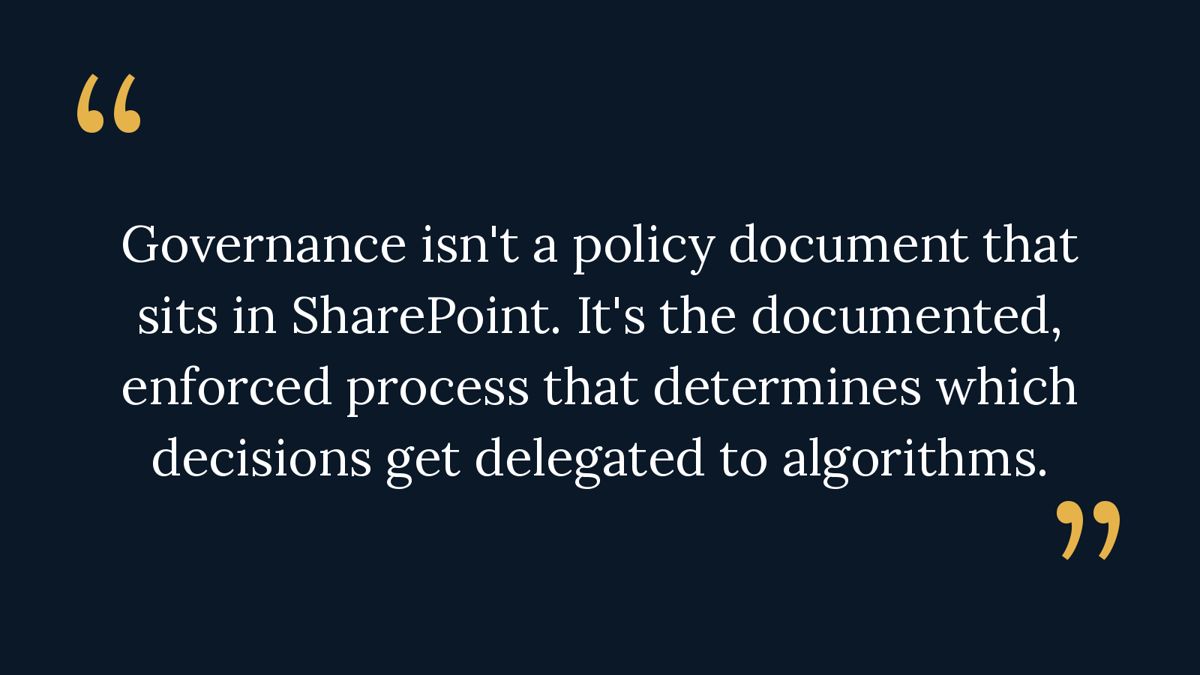
This is where the rubber meets the road on AI governance frameworks for business. Governance isn't a policy document that sits in SharePoint. It's the documented, enforced process that determines which decisions get delegated to algorithms and which require human judgment. If you don't have that process, you're accumulating liability every time you deploy a new model.
Documentation as Defense
When you're explaining your AI deployment decisions to a regulator or a plaintiff's attorney, the quality of your documentation determines whether you look negligent or thoughtful.
Did you document the decision type, the risk assessment, the regulatory analysis, and the approval process before deployment? Did you define what "human review" meant for this specific use case? Did you establish monitoring to confirm that human reviewers were actually reviewing, not rubber-stamping? Did you document the accountability structure so it's clear who was responsible for outcomes?
If the answer to those questions is yes, you're in defensible territory. If the answer is no, you're hoping nothing goes wrong, because when it does, you won't have much to work with.
The Explainability Requirement
Some decisions require that you be able to explain why they were made. This isn't just good practice. In many contexts, it's a legal requirement.
If you deny someone credit, employment, housing, or insurance, you often need to provide specific reasons. "The algorithm scored you below threshold" doesn't satisfy that requirement. Neither does "the model identified patterns in your data that correlated with higher risk." You need to articulate the specific factors that drove the decision in terms the person can understand and potentially contest.
This is where black-box models create real problems. If you can't explain the decision, you can't deploy the model in contexts where explainability is required. That means either choosing more interpretable models, building post-hoc explanation tools that are genuinely reliable, or keeping humans in the decision-making role for those use cases.
The push for explainable AI isn't about making data scientists feel good. It's about meeting legal obligations that exist independent of your technology choices. If the law requires you to explain your decisions and your model can't be explained, you've built the wrong system for that use case.
Need a Framework That Fits Your Industry?
Carl delivers keynotes on AI governance, compliance, and risk management tailored to healthcare, defense contractors, and regulated industries. See all keynote speaking topics or reach out about your event.
Book Carl for Your EventPractical Deployment Patterns That Work
The organizations getting AI vs human decision making right aren't the ones with the most sophisticated models. They're the ones with the clearest boundaries and the most disciplined deployment processes.
One pattern that works: start with AI in advisory mode, not decision mode. Deploy the model to make recommendations that humans review for six months. Track how often the recommendations are accepted, modified, or rejected. Analyze the cases where humans override the AI to understand whether the model is missing something important or whether the humans are introducing bias. Only after you've demonstrated that the recommendations are sound and that human review is meaningful do you consider reducing human involvement.
Another pattern: tier your cases based on confidence scores and stakes. The AI handles clear-cut, low-stakes cases automatically. Ambiguous or high-stakes cases get routed to humans. This keeps the volume manageable for human reviewers while still capturing the efficiency gains from automation where risk is low.
A third pattern: build your monitoring around human behavior, not just model performance. Track how long reviewers spend on each case, how often they override the AI, whether override rates vary by reviewer or shift, and whether the overrides correlate with better outcomes. If your reviewers are approving 99.9% of recommendations without meaningful evaluation, your process isn't working regardless of how accurate the model is.
Red Lines and Escalation
Every AI deployment should have documented red lines: conditions under which the system should not make a decision automatically and must escalate to a human. These might include cases where the data is incomplete, where the confidence score is below a threshold, where the decision involves a protected class, or where the stakes exceed a certain threshold.
Red lines should be defined before deployment, monitored continuously, and updated based on observed failures or near-misses. They're not static. As you learn how the system performs in production, you adjust the boundaries.
Escalation paths should be clear and fast. If the AI can't decide, who does? How quickly? With what information? If your escalation process is "send an email and wait for someone to get back to it," you've built a system that will fail when speed matters.
Special Considerations for Regulated Industries
If you're operating in healthcare, defense, financial services, or another highly regulated industry, the framework outlined above isn't optional. It's the baseline for avoiding enforcement actions.
In healthcare, clinical AI systems are increasingly scrutinized under FDA regulations, state professional practice laws, and HIPAA. You can't deploy a diagnostic or treatment-recommendation system without considering whether it constitutes a medical device, whether it requires professional oversight, and whether your data handling meets HIPAA standards. The intersection of AI and privacy risk in healthcare is particularly acute because the data is sensitive, the stakes are high, and the regulations are unforgiving.
In the defense industrial base, export control considerations dominate. AI systems that process or generate technical data may themselves be subject to ITAR or EAR, and any decision about releasing data to foreign persons must involve human review by qualified personnel. Automating those decisions creates strict liability violations.
In financial services, fair lending laws, equal credit opportunity requirements, and consumer protection regulations constrain what you can automate. You need documented processes for evaluating model bias, ensuring that protected characteristics aren't driving decisions, and providing explanations when required. AI governance in financial services isn't about innovation velocity. It's about not violating laws that carry significant penalties.
The common thread across all these industries: the regulations weren't written with AI in mind, but they apply nonetheless. Existing requirements for professional judgment, human accountability, and explainability don't disappear because you've deployed a sophisticated algorithm. Your AI governance framework has to integrate with your compliance program, not run parallel to it.
What Executive Leadership Needs to Own
The decision about where to draw the line between AI and human decision making isn't a technical question. It's a governance question, a risk question, and ultimately a leadership question.
Executives need to own three things. First, the framework itself: what decisions can be automated, under what conditions, with what oversight. That framework should be documented, approved at the executive level, and enforced across the organization. If different business units are making different calls about similar decisions, you don't have governance. You have improvisation.
Second, accountability. When an AI system makes a decision that goes wrong, who is responsible? That question should have a clear answer before deployment, not after the incident. Accountability can't be diffused across the team that built the model, the team that deployed it, and the team that monitored it. Someone owns the outcome.
Third, the process for revisiting decisions. AI systems aren't static. They drift, the environment changes, new regulations emerge, and failures reveal gaps in your framework. Leadership needs to establish a rhythm for reviewing AI deployments, updating the governance framework based on lessons learned, and pulling back authority from systems that aren't performing as intended.
The organizations that handle AI vs human decision making well aren't the ones that never make mistakes. They're the ones that have a disciplined process for deciding where to draw the line, the courage to enforce that line even when it's inconvenient, and the humility to adjust when they get it wrong. That's not a data science problem. It's a leadership problem.
If your organization is deploying AI without a clear, documented framework for decision authority, you're not innovating. You're gambling. The stakes are regulatory compliance, legal liability, and ultimately the trust of the people affected by your decisions. That's not a bet worth taking without a plan.