
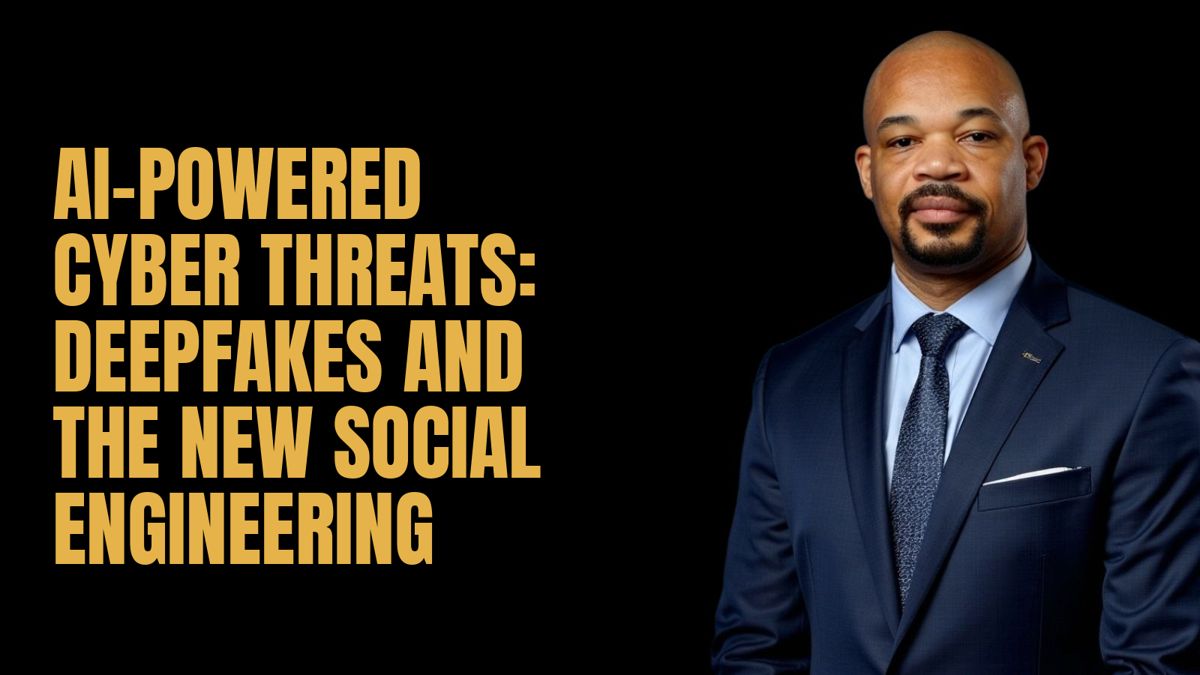
In February 2023, a finance worker at a multinational firm transferred $25 million to fraudsters after participating in a video conference call with what he believed were the CFO and other colleagues. Every person on the call was a deepfake. The technology that made this possible wasn't experimental or nation-state level. It was commercially available software repurposed for fraud at industrial scale.
AI-powered cyber threats aren't coming. They're here, and they've fundamentally changed the economics of social engineering. The attack surface hasn't expanded—it's fractured. Voice cloning that once required hours of audio samples now works with three seconds. Phishing emails that used to fail at basic grammar now pass executive review. Synthetic identities clear know-your-customer checks. The tools that democratized content creation have also democratized fraud.
From my position as a CISO working across healthcare, defense, and federal contracting, I'm watching a pattern emerge: organizations that understood traditional social engineering are failing to recognize how AI has industrialized the threat. The defenses that worked when phishing was a volume game don't hold when attackers can run targeted campaigns at scale with quality that matches legitimate communication.
The Deepfake Voice Problem Is Already Past Containment
Voice is now the least trustworthy verification channel we have, and most organizations haven't internalized this yet. I've seen the progression: early voice clones were uncanny-valley obvious, requiring extensive training data and producing stilted output. Current generation tools produce convincing clones from seconds of audio—a YouTube interview, a conference presentation, a single voicemail.
The Hong Kong case isn't an outlier. It's the documented example. Most deepfake fraud doesn't make headlines because victims prefer not to advertise successful social engineering. What I'm hearing through CISO networks: attempted voice-based CFO fraud is now routine for organizations with public executives. The attacks follow a pattern: brief call, urgent matter, unusual but plausible request, time pressure, just-below-normal-approval thresholds.
The defense everyone reaches for first—"verify through a different channel"—works only if organizations actually enforce it. In practice, the callback gets skipped because the voice sounds right and the request is time-sensitive and the relationship seems established. This is where AI-powered cyber threats excel: they don't just mimic voice, they exploit the cultural reluctance to distrust what sounds human.
The Audio Deepfake Supply Chain
Here's what makes this sustainable for attackers: the voice synthesis technology is legitimate software with legitimate uses—accessibility, content creation, entertainment. The same tools narrating audiobooks are cloning executives. There's no way to put this technology back in a box, which means defensive strategies that assume scarcity of capability are already obsolete.
The attack workflow is straightforward: harvest audio from public sources, synthesize voice model, research organizational structure and communication patterns through LinkedIn and social engineering, execute during known high-pressure periods. Total time investment: hours. Success rate: still high enough to justify the effort.
AI-Generated Phishing Has Crossed the Quality Threshold
Traditional phishing defenses relied on quality signals: poor grammar, generic greetings, obvious urgency tactics, mismatched sender domains. Large language models have eliminated most of these tells. The current generation of AI-powered cyber threats produce phishing content that matches organizational tone, references real projects and relationships, and adapts to context with minimal attacker effort.
I'm seeing this firsthand in incident response: phishing emails that pass initial review because they're contextually appropriate. An attacker researching a company through public sources and LinkedIn can feed that data into an LLM and generate dozens of targeted phishing messages that reference real initiatives, use appropriate jargon, and match communication style. The volume-versus-quality tradeoff that used to constrain targeted phishing no longer applies.
The pattern I see most often: attackers use AI to generate the initial contact, then engage in extended conversation. They're using the same technology you're using for customer service chatbots, but optimized for deception. Once they establish trust through seemingly knowledgeable dialogue, the payload delivery follows standard social engineering playbooks.
The Vendor Impersonation Vector
One specific variant deserves attention: AI-generated vendor impersonation. An attacker identifies a real vendor relationship through open-source intelligence, generates correspondence that matches that vendor's style and references actual projects, and requests payment changes or credential resets. Finance teams that would catch obvious phishing are approving these because the quality matches legitimate vendor communication.
The defense isn't technical—it's procedural. Organizations need out-of-band verification for financial changes and credential resets, with no exceptions for urgency or apparent relationship quality. The technology for detecting AI-generated text exists but isn't reliable enough for security decisions. We're back to process controls, which means this is an operational discipline problem.
Speaking on AI-Driven Security Threats for Leadership Teams
Carl delivers keynotes and workshops on AI-powered cyber threats, deepfake fraud, and executive-level defenses for organizations navigating this threat landscape. His presentations translate technical risks into strategic decisions.
Book Carl to Speak
Synthetic Identity: The Slow-Burn Threat
While deepfake voice and AI phishing get attention, synthetic identity fraud operates on a longer timeline and presents harder attribution problems. Synthetic identities—constructed personas with consistent digital footprints, generated documents, and algorithmically optimized social presence—are clearing background checks and establishing trusted relationships.
This isn't science fiction. The technology to generate realistic faces is commodity. The tools to create consistent persona histories exist. What's changed with AI is the scale and consistency: attackers can now maintain hundreds of synthetic identities with coherent histories, appropriate social media activity, and contextually appropriate communication styles.
For organizations with remote workforces and contractor ecosystems, synthetic identities represent a fundamental trust problem. If someone has a consistent LinkedIn presence, references that check out, and communication patterns that match expectations, how do you verify they're real? The pattern I'm tracking: insider threat programs designed for malicious insiders don't catch synthetic identities because synthetic identities aren't insiders—they're external attackers who've cleared your onboarding process.
The KYC and Background Check Gap
Know-your-customer and background verification processes were designed for an environment where creating convincing false identities required significant effort and left detectable traces. AI has changed the economics. Generated identity documents pass automated verification. Synthetic social media histories appear organic. Reference checks connect to attacker-controlled personas.
The industries most exposed: financial services, defense contracting, healthcare—anywhere background verification is required but relies primarily on document validation and reference checks. I've been working with defense contractors on identity verification, and the honest answer is that current processes aren't designed to catch well-constructed synthetic identities. The defenses that work—in-person verification, biometric validation, social network analysis—don't scale easily and aren't always feasible.
What Makes AI Social Engineering Different
The core change isn't that AI makes social engineering possible—social engineering predates computers. What's different is that AI removes the constraints that made targeted social engineering expensive. Historically, running a targeted campaign against specific executives required research, customization, and attacker time. The success rate had to justify the investment, which meant most organizations below a certain threshold weren't worth targeting.
AI-powered cyber threats have changed this calculus. Attackers can now run targeted campaigns at commodity pricing. An LLM can research targets, generate personalized content, maintain conversations, and adapt tactics based on responses. Voice synthesis can impersonate executives without extensive training data. Image generation can create convincing documents and identities. The technology doesn't eliminate the need for attacker skill, but it dramatically reduces the marginal cost per target.
This matters for threat modeling. If you've been assuming your organization is too small or too unglamorous for targeted attacks, that assumption no longer holds. The barrier to entry for convincing social engineering has dropped low enough that medium-sized organizations and individuals are viable targets for campaigns that would have been economically irrational five years ago.
The Attribution Problem Gets Worse
AI also complicates attribution. When attackers use AI-generated content and synthetic personas, traditional indicators of origin—language patterns, cultural references, operational security mistakes—become less reliable. An attacker using AI to generate native-quality English with American cultural references could be anywhere. The tells that used to help with attribution are being smoothed out by models trained on global datasets.
For incident response and threat intelligence, this means we're losing signal. When a convincing phishing campaign could have been generated by anyone with access to commodity AI tools, origin analysis becomes significantly harder. This isn't just an academic problem—it affects response decisions and risk assessment.
Executive-Level Defenses That Actually Work
The bad news: there's no technical control that reliably detects all AI-generated social engineering. The good news: effective defenses exist, but they require operational discipline and cultural change. This is a leadership problem more than a technology problem, which is why executive engagement matters.
First principle: assume voice and email are compromised channels. This sounds extreme until you've responded to a deepfake incident. For high-value transactions and sensitive operations, verification must happen through independent channels. "Call them back" only works if you're calling a known number that wasn't provided in the suspicious communication. "Confirm via email" doesn't work if email is the attack vector.
The practical implementation: establish clear thresholds for out-of-band verification and enforce them without exception. Financial transfers above X amount require in-person or previously-established-channel confirmation. Credential resets for privileged accounts require identity verification that doesn't rely on email alone. Changes to vendor banking information require verification through contact information from your system of record, not from the change request.
The Human Element Can't Be Automated Away
Organizations keep trying to solve social engineering with technology: more sophisticated spam filters, AI-powered phishing detection, behavioral analysis. These controls have value, but they're not sufficient against AI-powered cyber threats. The reason: sophisticated social engineering isn't about technical indicators, it's about trust exploitation.
What works: training that's specific, realistic, and ongoing. Generic "don't click suspicious links" training is inadequate when the links aren't obviously suspicious. People need to understand how voice cloning works, what AI-generated phishing looks like, why verification through independent channels matters even when the request seems legitimate.
More importantly, organizational culture needs to support verification behavior. If an employee delays a wire transfer to verify the request and gets reprimanded for the delay, you've taught everyone that speed matters more than security. If someone questions what appears to be a legitimate executive request and faces consequences, you've created an environment where social engineering succeeds.
The Verification Framework That Scales
For organizations serious about defending against AI social engineering, the framework is straightforward: identify high-value actions, establish verification requirements, train people on those requirements, and enforce them consistently. High-value actions include financial transfers, credential changes, access grants, sensitive data access, and system modifications.
Verification requirements should be specific: "Transfers over $10,000 require verbal confirmation via known phone number to approver" is implementable. "Use good judgment" is not. The specificity matters because social engineering attacks exploit ambiguity. If the policy has exceptions or judgment calls, attackers will engineer scenarios that seem to fit the exceptions.
The enforcement piece is where most organizations fail. Verification requirements that get waived for executives or during "emergency" situations aren't requirements—they're suggestions. AI-powered social engineering is specifically designed to create scenarios where normal processes seem inappropriate. The defense only works if the processes hold during pressure situations.
Keynote Speaking on Emerging Cyber Threats
Carl speaks to boards, executive teams, and security conferences on AI-driven threats, social engineering evolution, and building resilient security programs. See all keynote speaking topics or reach out about your event.
Book Carl for Your EventThe Regulatory and Liability Landscape Is Forming
We're early in the regulatory response to AI-powered cyber threats, but the direction is visible. Regulators are starting to recognize that AI introduces new risks that existing frameworks don't fully address. For organizations in regulated industries—healthcare, finance, defense—this means compliance expectations are evolving faster than most compliance programs.
In healthcare, the question is how AI-assisted attacks on HIPAA-protected data affect breach notification and liability. If an attacker uses AI to bypass authentication and access patient records, does the organization's response to AI-powered social engineering affect the determination of reasonable safeguards? We don't have case law yet, but OCR is paying attention to how organizations prepare for and respond to these threats.
In the defense industrial base, the concern is whether existing cybersecurity requirements—NIST 800-171, CMMC—adequately address AI-powered threats to controlled unclassified information. The controls around personnel security and access management were designed for traditional insider threats, not synthetic identities. Incident reporting requirements assume you can identify when a breach occurs, which gets complicated when attackers use AI to blend in.
The Duty of Care Question
From a liability perspective, the key question is what constitutes reasonable care when defending against AI-powered cyber threats. If these attacks are now well-documented and understood, does failure to implement appropriate defenses constitute negligence? Directors and officers should be asking: what are we doing specifically about AI social engineering, and is it sufficient to demonstrate reasonable care?
This matters for board-level discussions. When I'm talking to boards about cybersecurity trends, the question isn't whether AI-powered attacks are on the horizon—they're current. The question is whether the organization's defenses reflect the current threat landscape. If your security program hasn't been updated to address voice cloning, AI-generated phishing, and synthetic identities, you're defending against last decade's threats.
Building Resilience Into the Organization
The strategic approach to AI-powered cyber threats isn't to prevent every attack—that's not achievable. The goal is resilience: the ability to detect, respond to, and recover from successful social engineering with minimal damage. This requires assuming compromise and building controls that limit the damage from successful attacks.
Practically, this means: segregation of duties for high-value actions, so no single compromised individual can authorize significant transactions; monitoring and alerting for unusual patterns, even when the requests themselves look legitimate; incident response plans that specifically address social engineering scenarios; and regular testing of these controls through realistic exercises.
The pattern I see in organizations that handle this well: they've moved past the assumption that good enough email filtering and security awareness training will prevent social engineering. They've accepted that some percentage of attacks will succeed and built their defenses around limiting the impact of successful attacks. This is the same principle that drives zero-trust architecture—assume breach, verify continuously, limit lateral movement.
The Testing and Exercise Problem
Most organizations test their defenses against social engineering poorly or not at all. Annual phishing simulations with obvious tells don't prepare people for AI-generated targeted attacks. Tabletop exercises that assume everyone follows procedure don't test what happens when an executive is pressuring finance to rush a transfer.
Effective testing requires realism: using actual voice synthesis technology in authorized exercises, crafting phishing scenarios that match current AI capabilities, simulating pressure situations where verification processes face resistance. This makes people uncomfortable, which is precisely why it's necessary. If your team hasn't experienced a realistic deepfake scenario in a controlled setting, their first exposure will be during an actual attack.
The legal and ethical boundaries matter here. Testing should be authorized, documented, and conducted within appropriate guidelines. But within those boundaries, testing should be realistic enough to identify where your defenses actually fail.
What Leaders Should Be Doing Now
If you're responsible for security strategy, risk management, or executive leadership, the actions are specific. First, inventory your high-value targets: executives whose voices are publicly available, financial personnel with transfer authority, HR staff who can modify access, IT administrators with privileged credentials. These are the personas attackers will target with AI-generated social engineering.
Second, establish clear verification requirements for high-value actions and communicate them explicitly. This isn't a security policy buried in the handbook—this is operational procedure that finance, HR, and IT need to follow consistently. The communication matters: explain why these procedures exist and why they don't have exceptions for urgency or authority.
Third, test your defenses realistically. Run exercises that use AI tools to generate social engineering attempts. Document where your procedures hold and where they break down. Use those findings to improve both technical controls and operational processes.
Fourth, brief your board on AI-powered cyber threats specifically. This isn't general cybersecurity risk—this is an emerging threat category that changes the risk profile for social engineering. Directors should understand that voice is no longer a reliable verification channel, that phishing quality has crossed a threshold where quality signals no longer work, and that the organization needs defenses designed for this environment.
The Vendor and Third-Party Risk Dimension
Don't limit your thinking to direct attacks on your organization. AI-powered social engineering targets your vendors, partners, and service providers. If an attacker compromises a vendor's communication channels and uses AI to generate convincing correspondence, your organization becomes the victim through the vendor relationship.
This means third-party risk management needs to include questions about how vendors defend against AI-powered social engineering. Do they have verification procedures for sensitive communications? How do they validate identity for privileged access? Have they tested their defenses against voice cloning and AI-generated phishing? These aren't theoretical questions—they're practical vendor management concerns.
The Long Game: AI Defense Versus AI Attack
It's tempting to assume that AI will eventually solve the AI threat—that detection tools will catch up to generation tools and we'll reach a new equilibrium. I'm skeptical. The asymmetry favors attackers: they only need to succeed once, defenders need to succeed every time. Generative AI gives attackers new capabilities faster than defensive AI can adapt to detect them.
This doesn't mean defensive AI has no role. Behavioral analysis, anomaly detection, and pattern recognition can help identify unusual activity that might indicate social engineering. But these tools are supplements to human judgment and procedural controls, not replacements. The organizations that will handle AI-powered cyber threats well are those that combine technology, process, and culture—not those searching for a technical silver bullet.
The timeline matters for planning. This isn't a problem that peaks and subsides—AI capabilities will continue improving, which means attack quality will continue improving. The defenses you build today need to be adaptable to tomorrow's threat landscape. This argues for principle-based controls rather than technology-specific rules: verify through independent channels, enforce segregation of duties, monitor for unusual patterns, test regularly.
From my position working across regulated industries, what I'm telling leadership: treat AI-powered social engineering as a permanent shift in the threat landscape, not a temporary spike in attack sophistication. Your security strategy, operational procedures, and organizational culture need to reflect this reality. The organizations that adapt now will have a significant advantage over those that wait for the threat to become undeniable through successful attacks.