
Every compliance professional I know has been asked the same question over the past eighteen months: "Can AI do my GRC work for me?" The answer is both simpler and more complicated than most vendors want you to believe. AI won't replace your compliance program, but it's already changing how effective programs operate—particularly in the areas where compliance work has always been most tedious and error-prone.
I've watched AI-powered GRC tools evolve from glorified search functions to genuinely useful assistants in evidence collection, control monitoring, and policy mapping. I've also watched organizations waste budget on tools that promised to automate judgment calls that no algorithm should be making. The difference between these outcomes comes down to understanding where AI genuinely helps and where human expertise must stay in the loop.
Where AI Actually Delivers Value in GRC Programs
The pattern I see across healthcare providers, defense contractors, and financial services firms is consistent: AI-powered GRC tools deliver the most value in aggregation, pattern matching, and continuous monitoring. These are tasks humans can do, but doing them manually means they either don't happen consistently or they consume resources better spent on analysis and decision-making.
Evidence Collection and Aggregation
Evidence collection has always been the most time-intensive part of audit preparation. When I work with organizations preparing for assessments, I typically find compliance teams spending 60-70% of their prep time just locating, organizing, and formatting evidence that already exists somewhere in the environment.
AI-powered GRC platforms can continuously collect evidence artifacts—system logs, configuration snapshots, training completion records, access reviews—and map them to specific control requirements. The better systems don't just collect; they validate completeness and flag gaps before an auditor asks.
A healthcare system I worked with reduced their HIPAA audit prep time from six weeks to ten days by implementing automated evidence collection. The AI wasn't making compliance decisions—it was doing the unglamorous work of pulling weekly backup logs, correlating them with their retention policy requirements, and flagging any weeks where evidence was missing. The compliance team could then focus on investigating gaps rather than manually assembling proof of what worked.
Control Monitoring and Drift Detection
Controls drift. Configurations change. People create exceptions that never get documented. Traditional GRC approaches rely on periodic manual reviews to catch these issues, which means you're always operating with stale assurance.
AI-powered monitoring can establish baselines for what compliant configurations look like and continuously compare current state against those baselines. When I see this working well, it's not replacing the security team's judgment about what constitutes drift—it's automating the comparison and flagging deltas that warrant human review.
The key distinction: the AI isn't deciding whether the drift is acceptable. It's identifying that drift occurred and providing context for a human to make that call. A system configured to alert on any encryption setting change isn't exercising judgment—it's doing tireless pattern matching that humans are bad at sustaining over time.
Policy and Framework Mapping
One area where natural language processing has genuine utility is mapping your existing controls to multiple frameworks. If you're a defense contractor dealing with NIST 800-171, CMMC, and potentially ITAR requirements simultaneously, you're managing overlapping control sets with different terminology describing similar requirements.
AI can parse these frameworks, identify semantic similarities, and suggest mappings between your implemented controls and multiple regulatory requirements. I've seen this cut the time required for gap assessments by half when an organization needs to add a new framework to their compliance scope.
But—and this matters—the AI is suggesting mappings, not making compliance determinations. A human who understands both the control implementation and the regulatory intent still needs to validate that the mapping is substantively correct, not just linguistically similar.
The Critical Role of Human Judgment in AI-Powered GRC
Here's where many AI-powered GRC implementations go wrong: they automate decisions that require contextual judgment, regulatory interpretation, or risk tolerance calibration. These aren't tasks where AI assistance speeds up human work—they're tasks where removing human judgment creates compliance risk.
Risk Assessment and Appetite
AI can calculate risk scores based on parameters you define. It cannot determine your organization's risk appetite, assess whether a particular risk is acceptable given your specific business context, or make the judgment call about when to accept, transfer, mitigate, or avoid a risk.
I've reviewed AI-generated risk assessments that were mathematically consistent and completely divorced from business reality. The algorithm correctly calculated that a particular system scored high on a risk matrix, but it had no way to understand that the system was already scheduled for retirement in 60 days, making expensive mitigation controls a poor investment.
Risk management requires understanding strategic context, business constraints, and regulatory expectations within your specific industry. These are pattern-matching problems, but the patterns are too complex and context-dependent for current AI to handle reliably without human oversight.
Regulatory Interpretation
AI can retrieve regulatory text. It can even identify where your policies might conflict with regulatory language. What it cannot do—and what you should not trust it to do—is interpret ambiguous regulatory requirements or determine how a general principle applies to your specific circumstances.
When HIPAA requires "appropriate" safeguards or CMMC requires "adequate" security, those terms don't have algorithmic definitions. They require professional judgment informed by industry practice, prior enforcement actions, and understanding of the regulator's expectations. An AI can summarize what others have done; it cannot make the strategic judgment about what's appropriate for your environment.
The compliance programs that run into trouble are often the ones that treat regulatory requirements as checklists rather than principles requiring interpretation. Adding AI to that approach just automates the problem.
Speaking on AI, Compliance, and Strategic Risk Management
Carl delivers keynotes on implementing AI in regulated environments, balancing automation with accountability, and building compliance programs that scale. His talks cut through vendor hype to focus on what actually works in healthcare, defense, and financial services contexts.
Book Carl to Speak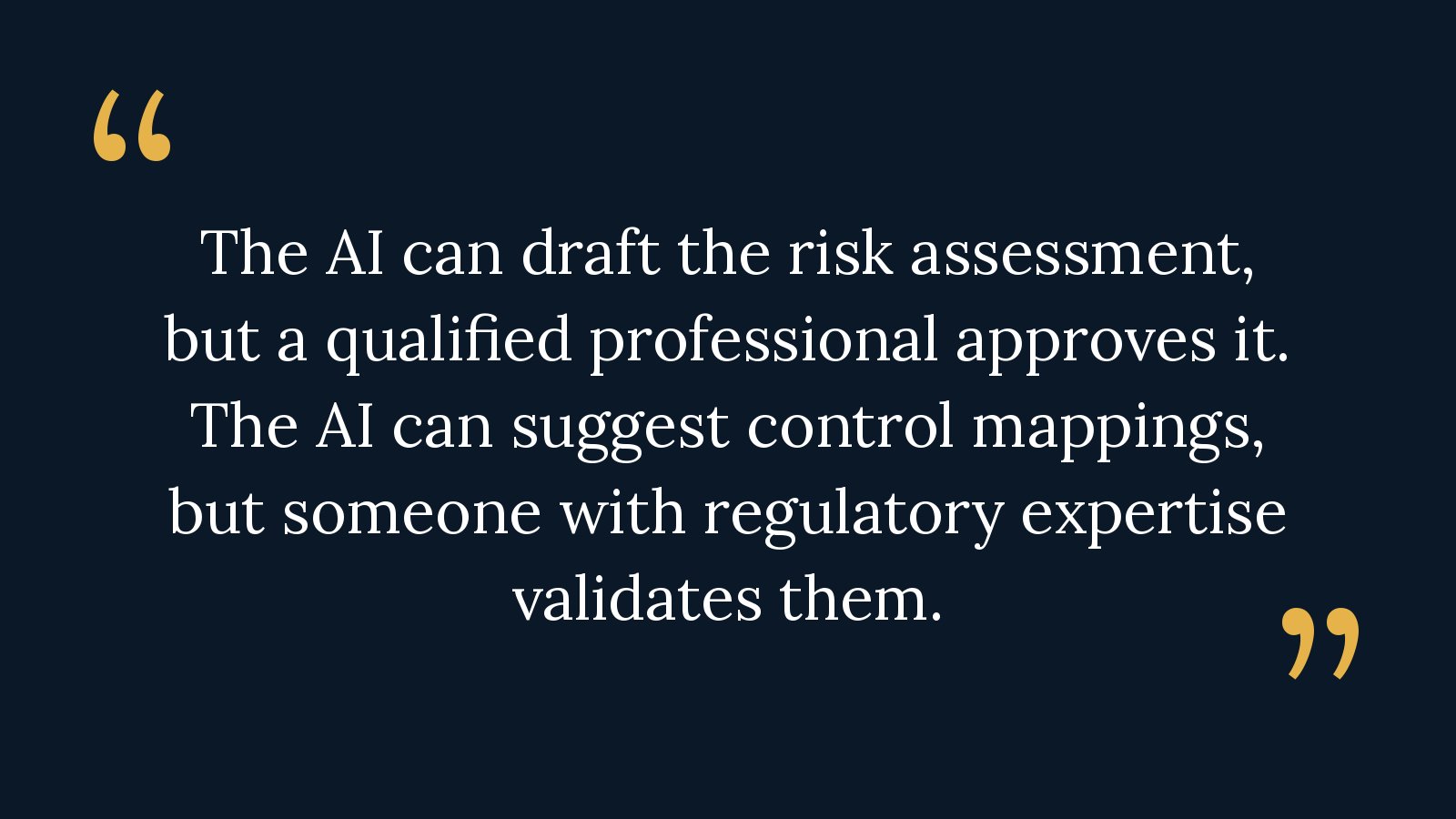
The Evidence Collection Engine: Where AI Shines
The single best use case for AI in GRC work is turning evidence collection from an episodic crisis into a continuous background process. This is where I see the clearest ROI and the least implementation risk.
Continuous Evidence Harvesting
Traditional compliance programs collect evidence when an audit is scheduled. This creates several problems: you're scrambling to reconstruct what happened months ago, you can't fix gaps you don't know about until it's too late, and you're always working with incomplete information about your actual control effectiveness.
AI-powered GRC platforms can continuously pull evidence from your environment—not just that it exists, but that it demonstrates the control is working as intended. Backup logs aren't useful unless they show successful completion. Access reviews aren't evidence unless they resulted in appropriate actions on identified exceptions.
The AI can validate evidence quality in real-time, flagging issues like incomplete logs, unsigned policy acknowledgments, or missing timestamps that would invalidate the evidence during an audit. This shifts evidence collection from "find anything that might work" to "ensure we have what we actually need."
Cross-System Correlation
Many controls require evidence from multiple systems. Demonstrating that terminated employees lose access promptly requires correlating HR system records with directory services changes, VPN access removals, physical badge deactivations, and potentially application-specific access reviews.
AI can monitor these disparate systems, identify the same event across multiple sources, and automatically assemble the complete evidence chain. When I see this working well, it's not just faster—it's more complete than manual evidence collection ever was, because humans naturally focus on the most obvious evidence sources and miss peripheral systems.
Gap Identification Before Audits
The real value of continuous evidence collection isn't just having evidence ready when auditors ask—it's identifying gaps while you still have time to fix them. If your backup evidence shows failures every weekend for a particular system, you want to know that in February, not during your July audit when it becomes a finding.
AI-powered gap analysis can run continuously, comparing required evidence against collected evidence and flagging control weaknesses before they become audit findings. This transforms compliance from reactive to proactive, which is where mature programs need to operate.
Control Monitoring: Automation Without Autopilot
Continuous control monitoring is another area where AI-powered GRC delivers clear value, provided you implement it with appropriate human oversight loops.
Baseline Establishment and Deviation Detection
AI can analyze your control environment, establish what normal looks like, and flag deviations from that baseline. This is particularly valuable for configuration management, where you need to know when systems drift from approved security settings.
But effective monitoring requires human expertise to set the right baselines. I've seen monitoring implementations that flagged every configuration change as a deviation, creating so much noise that teams started ignoring alerts. The AI needs to understand which configurations matter for compliance and which are operationally necessary variations.
This requires subject matter expertise in the setup phase. You're teaching the AI what "good" looks like in your environment, which means someone who understands both the regulatory requirements and your operational reality needs to be involved in baseline definition.
Anomaly Detection in Access Patterns
User behavior analytics powered by AI can identify access patterns that might indicate compromised credentials, insider threats, or just policy violations that need investigation. An account that suddenly starts accessing systems it hasn't touched in six months, or downloading volumes of data inconsistent with job role, warrants investigation.
The AI flags the anomaly; a human investigates the context. Maybe it's a legitimate role change, maybe it's a compromised account, maybe it's an authorized data migration project. The pattern detection is automated; the judgment about whether it's a problem is human.
Policy Violation Workflows
When AI-powered monitoring detects a potential policy violation, it can automatically initiate workflows—creating tickets, notifying responsible parties, escalating if not addressed within SLA timelines. This ensures violations don't get lost and creates an auditable trail of how issues were handled.
This workflow automation is different from automating the decision itself. The AI isn't deciding whether a violation occurred or what the response should be—it's ensuring the right people are notified and tracking that the issue gets resolved. That's valuable automation that doesn't require algorithm judgment about compliance matters.
Framework Mapping and Policy Analysis
Natural language processing has reached the point where it can genuinely help with the tedious work of mapping controls across frameworks and identifying policy gaps or conflicts.
Multi-Framework Control Mapping
If you're implementing controls for HIPAA, also maintaining NIST 800-171 compliance for defense contracts, and potentially subject to state privacy laws, you're managing overlapping requirements that often address the same risks with different language.
AI can analyze these frameworks, identify where requirements overlap, and suggest unified controls that satisfy multiple obligations. This doesn't just reduce implementation effort—it creates a more coherent control environment that's easier to maintain and audit.
The key is validation. AI-suggested mappings need review by someone who understands the substantive requirements, not just the linguistic similarity. A control that mentions encryption might map linguistically to multiple encryption requirements across frameworks, but the specific encryption standards, key lengths, and use cases matter for actual compliance.
Policy Gap Analysis
AI can compare your documented policies against framework requirements and identify where you might have gaps. It can flag missing required elements, identify policies that haven't been updated to reflect regulatory changes, and suggest where new policy language might be needed.
I've used AI tools to do initial policy gap assessments that would have taken junior analysts weeks to complete manually. The AI identifies the potential gaps; experienced compliance personnel review to determine whether the gaps are real or whether existing policies address the requirement in different language.
Policy Conflict Detection
As policy documents accumulate over time, conflicts and inconsistencies creep in. Your password policy might require 90-day rotation while your privileged access policy specifies 60 days. Your data retention policy might conflict with your backup policy.
AI can analyze your entire policy corpus, identify internal conflicts, and flag inconsistencies between policy and procedure documents. This is pattern matching at scale that humans are prone to miss, especially in organizations with dozens or hundreds of policy documents maintained by different teams.
Regulatory Compliance Keynotes for Leadership Teams
Carl speaks on building compliance programs that drive business value, not just check regulatory boxes. His keynotes address GRC strategy, AI implementation in regulated environments, and translating compliance into competitive advantage. See all keynote speaking topics or reach out about your event.
Book Carl for Your EventImplementation Realities: What Works and What Doesn't
After watching numerous AI-powered GRC implementations across regulated industries, I can identify clear patterns in what succeeds and what fails.
Start With Evidence Collection, Not Risk Analysis
The implementations I've seen succeed typically start with evidence collection automation. This is low-risk, high-value, and builds confidence in the platform before you start using AI for more judgmental tasks.
Starting with AI-powered risk assessment or automated control selection is starting at the wrong end. You're asking the AI to make judgment calls before you've established that it can reliably handle the more mechanical tasks. Build the foundation first.
Maintain Human Approval Loops
Every AI-powered GRC implementation needs clearly defined approval loops where human judgment is required. The AI can draft the risk assessment, but a qualified professional approves it. The AI can suggest control mappings, but someone with regulatory expertise validates them.
The organizations that get in trouble are the ones that let automation run without oversight because it's faster and requires less staff time. That efficiency comes with risk that manifests when an auditor or regulator questions a decision the AI made that no human reviewed.
Audit Trails for AI-Generated Decisions
When AI contributes to compliance decisions, you need audit trails that show what the AI recommended, what parameters it used, and what human review occurred. This isn't just good practice—it's necessary for demonstrating due diligence when those decisions are questioned.
I've been in audit situations where the organization couldn't explain why a particular control was implemented or risk accepted because the AI-powered GRC system made the recommendation and nobody documented the review process. That's a program maturity failure that happens to involve AI, but it's a failure nonetheless.
Integration With Existing Systems
AI-powered GRC tools are only as good as the data they can access. The implementations that deliver value are the ones that integrate with your actual operational environment—directory services, cloud platforms, SIEM tools, ticketing systems, HR systems.
Standalone GRC platforms that require manual data input defeat the purpose. You're not getting continuous monitoring if someone has to export logs monthly and upload them to the GRC platform. The integration work is typically the most time-consuming part of implementation, but it's also what determines whether the system provides ongoing value or becomes shelfware.
The Vendor Landscape: What to Look For
The GRC vendor market is crowded with tools claiming AI capabilities. Most of them are using basic automation or rules engines and calling it AI. Some have genuinely useful machine learning capabilities. Knowing the difference matters.
Distinguish Between Rules Engines and Actual AI
Many "AI-powered" GRC tools are actually rules-based systems with no machine learning at all. If the system only does what you explicitly configure it to do based on if-then rules, that's automation, not AI. There's nothing wrong with automation—it's valuable—but it's not what you're paying a premium for.
Actual AI in GRC should demonstrate learning from data, pattern recognition beyond explicit rules, and the ability to identify anomalies you didn't specifically configure it to look for. Ask vendors for specific examples of how their system learns and adapts, not just how it executes predefined workflows.
Evidence of Regulatory Expertise
AI-powered GRC tools built by vendors who understand regulatory compliance work differently from tools built by AI companies that decided to target GRC as a market. The former tend to solve real compliance problems; the latter tend to be impressive technology looking for a problem to solve.
Look for vendors with domain expertise in your regulatory environment. A tool built for general corporate compliance won't have the HIPAA-specific or CMMC-specific knowledge built into its frameworks and recommendations. You'll spend significant time customizing it to be useful, which undermines the value proposition.
Deployment Models and Data Security
AI-powered GRC platforms need access to sensitive organizational data to function effectively. Where that data goes and how it's processed matters, particularly in regulated environments.
SaaS deployments where your evidence and control data are processed in multi-tenant environments create risk. On-premise or private cloud deployments give you more control but require more infrastructure investment. There's no universal right answer, but the decision should be intentional and based on your data sensitivity and regulatory constraints.
For defense contractors dealing with CUI or ITAR-controlled information, a cloud-based GRC platform processing your evidence might create export control violations if the vendor's personnel include foreign nationals. This isn't theoretical—I've seen it happen. Your GRC platform selection is itself a compliance decision.
The Future State: Where This Is Heading
AI capabilities in GRC are advancing faster than most regulatory frameworks. Understanding where the technology is likely headed helps inform implementation decisions today.
Predictive Compliance Gaps
The next evolution beyond continuous monitoring is predictive analytics that identify likely future compliance gaps based on patterns in your environment. If backup success rates are trending downward, staff training completion is dropping, or access review cycles are lengthening, AI can flag these trends before they become audit findings.
This requires sufficient historical data and well-designed algorithms, but the technical capability exists. The organizations investing in AI-powered GRC now are building the data foundations that enable predictive capabilities later.
Natural Language Audit Response
Imagine responding to audit requests by asking your GRC system to pull evidence in natural language: "Show me all access reviews for privileged accounts in Q4 that resulted in access removals." The AI retrieves the evidence, validates it's complete, and formats it for auditor review.
This isn't science fiction—it's where natural language interfaces and evidence repositories are converging. The organizations with mature evidence collection processes and well-structured data will be able to implement this as it becomes available. The ones still doing manual evidence collection won't.
Automated Regulatory Change Impact Assessment
When regulations change, determining impact requires analyzing the change, comparing it against current controls, identifying gaps, and planning remediation. AI can automate much of this analysis, particularly the initial gap identification and control mapping phases.
Human judgment is still required for determining how to address gaps and what priority to assign remediation efforts, but automating the impact analysis reduces the time from regulatory change to implementation planning from weeks to days.
What This Means for Compliance Leadership
AI-powered GRC represents a real shift in how compliance programs can operate, but it's not the transformation vendors are selling. It's an operational efficiency improvement that lets compliance teams focus on judgment, strategy, and relationship management rather than evidence gathering and manual control testing.
The strategic question for compliance leaders isn't whether to adopt AI-powered GRC—it's how to implement it in ways that improve program effectiveness without introducing new risks. That requires clear thinking about where AI genuinely helps and where human expertise must remain in control.
The organizations getting this right are using AI to automate the tedious, repeatable tasks that have always consumed too much compliance team time. They're maintaining human oversight on decisions that require regulatory interpretation, risk judgment, or strategic context. And they're building the data foundations and integration architectures that will enable more sophisticated AI capabilities as the technology matures.
The ones getting it wrong are treating AI-powered GRC as a way to reduce compliance headcount or automate decisions that require professional judgment. Those implementations create compliance risk disguised as efficiency improvements. When the audit findings or regulatory inquiries arrive, the excuse that "the AI made that decision" won't help.
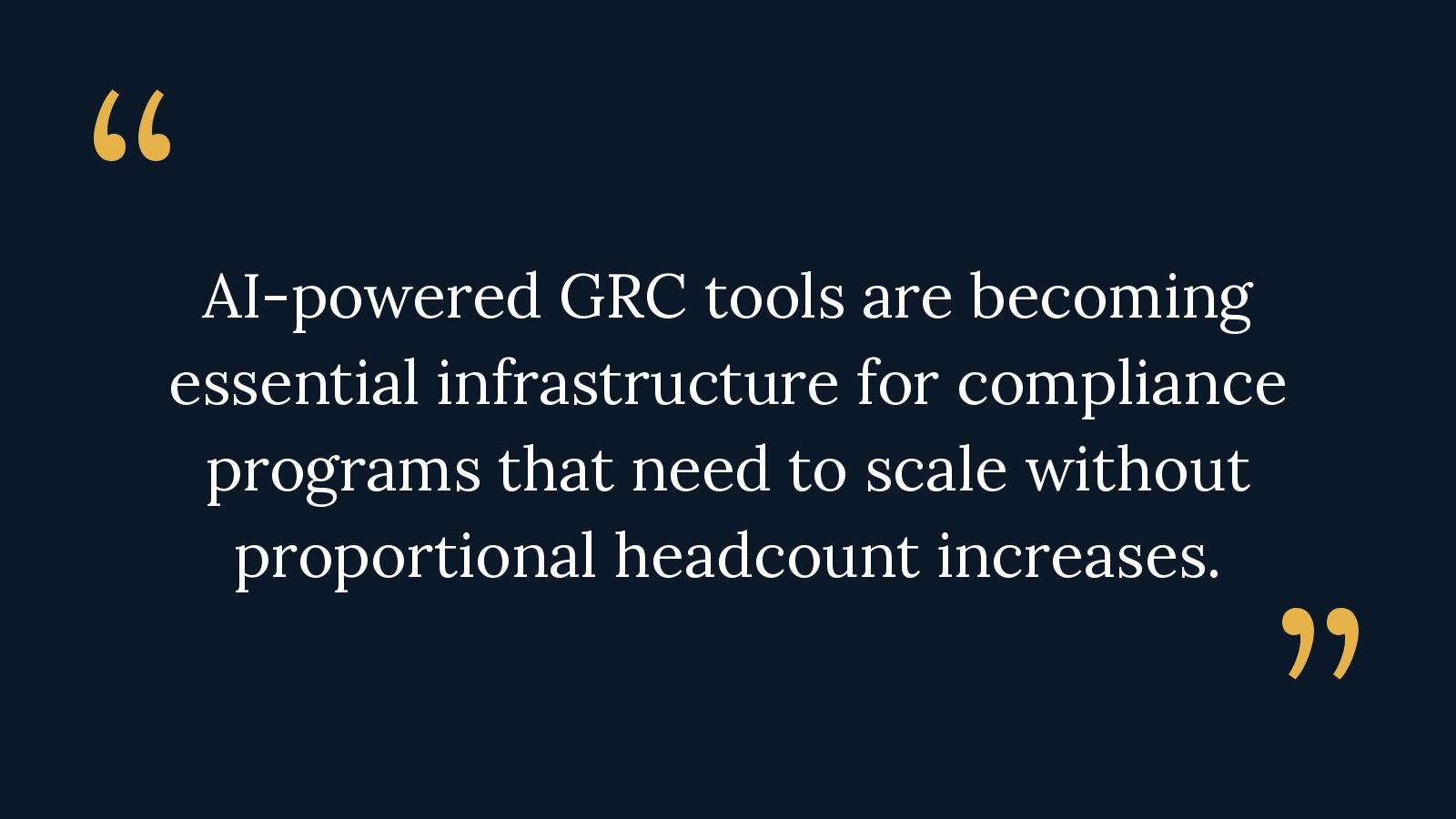
AI-powered GRC tools are becoming essential infrastructure for compliance programs that need to scale without proportional headcount increases. But they're tools, not replacements for compliance expertise. The future of compliance programs isn't AI-powered automation—it's AI-assisted humans making better-informed decisions faster.