
The EEOC filed suit last month against a staffing company for using an AI screening tool that allegedly filtered out older applicants. Two weeks before that, HUD announced a fair housing investigation into an algorithm used for tenant screening. The FTC continues to bring enforcement actions under Section 5 for what it calls "unfair" AI practices. State attorneys general are circling. And every time I talk to a compliance team in healthcare or financial services, the same question comes up: what do we actually need to do about AI bias compliance?
The answer isn't simple, but it's urgent. Regulators aren't waiting for comprehensive AI legislation. They're applying existing civil rights, consumer protection, and sector-specific laws to AI systems right now. If your organization is using AI for employment decisions, credit underwriting, patient risk stratification, or tenant screening, you're already subject to bias-related compliance obligations. The regulatory frontier isn't coming—it's already here.
Why Existing Laws Already Cover AI Bias
The pattern I see in conversations with legal and compliance teams is a fundamental misunderstanding of the regulatory landscape. Too many organizations assume that because AI is new, they're operating in an unregulated space. That's wrong. AI systems that make or inform decisions about people are subject to the same anti-discrimination laws that have been on the books for decades.
Title VII of the Civil Rights Act doesn't include the word "algorithm," but it doesn't need to. It prohibits employment discrimination based on protected characteristics. If your AI recruiting tool has a disparate impact on women or minorities, you have a Title VII problem. The Fair Housing Act predates machine learning by decades, but it applies perfectly well to automated tenant screening. The Equal Credit Opportunity Act covers AI-driven lending decisions. HIPAA's non-discrimination provisions extend to clinical algorithms that affect treatment.
This isn't theoretical. The EEOC has been clear in guidance dating back to 2022 that automated systems and AI tools must comply with civil rights laws. The CFPB has issued multiple statements about fair lending obligations in the context of AI. HUD's Office of Fair Housing and Equal Opportunity is actively investigating algorithmic discrimination in housing. State regulators are even more aggressive—New York City's Local Law 144, which took effect in 2023, requires bias audits for automated employment decision tools.
The regulatory theory is straightforward: if a traditional process would violate anti-discrimination law, an AI system that produces the same outcome violates the same law. The technology doesn't create a safe harbor. In many ways, it increases scrutiny.
Disparate Impact Is the Core Issue
Most AI bias cases don't require proof of intentional discrimination. They rely on disparate impact theory—the principle that a facially neutral practice can be unlawful if it disproportionately harms a protected class and isn't justified by business necessity. This matters because AI systems can produce disparate impact even when they're not explicitly considering protected characteristics. The model doesn't need to "see" race or gender to create racially or gender-biased outcomes. Proxy variables do the work.
I've reviewed AI implementations where teams were proud that they'd excluded protected characteristics from the training data. That's necessary but not sufficient. If your credit model uses zip code, and zip code correlates with race, you've potentially introduced bias through a proxy. If your resume screening tool learns from historical hiring decisions that reflected gender bias, it will replicate that bias going forward. Disparate impact analysis requires you to test outcomes, not just inputs.
Where Compliance Teams Are Getting It Wrong
The most common mistake is treating AI bias compliance as a one-time validation exercise. Teams conduct a bias audit before deployment, see acceptable results, and assume they're done. That approach fails for two reasons. First, AI models drift. Performance degrades, data distributions shift, and bias that wasn't present at launch can emerge over time. Second, the regulatory expectation is ongoing monitoring, not point-in-time validation.
Another pattern: organizations relying entirely on their AI vendors to handle bias testing. This is a critical error. You can't outsource compliance accountability. When the EEOC investigates your hiring practices, they're investigating you, not your HR tech vendor. When the CFPB examines your lending decisions, your vendor's fairness white paper won't satisfy them. You need independent validation of bias claims, and you need to understand what the vendor actually tested and what they didn't.
I've also seen compliance teams focus narrowly on demographic parity—ensuring that approval rates or selection rates are roughly equal across groups—while ignoring other forms of bias. Demographic parity is one fairness metric, but it's not the only one, and it's not always the right one. Equalized odds, calibration, and individual fairness are other concepts that matter depending on the use case. More importantly, regulators don't typically prescribe a specific fairness metric. They expect you to be able to articulate which metrics you're using and why they're appropriate for your context.
The third major gap is documentation. When a regulator comes asking, you need to be able to demonstrate what you tested, how you tested it, what you found, and what you did about it. "We used a reputable vendor and they said it was fair" is not documentation. You need test results, methodology descriptions, decision logs about fairness trade-offs, and evidence of ongoing monitoring. Most organizations don't have this because they treated bias testing as a checkbox rather than a compliance discipline.
Help Your Leadership Team Understand AI Risk
Carl's keynotes on AI governance and compliance give executives and boards the context they need to make better decisions about AI deployment. Real-world patterns, regulatory trends, and practical frameworks—no vendor pitches.
Book Carl to Speak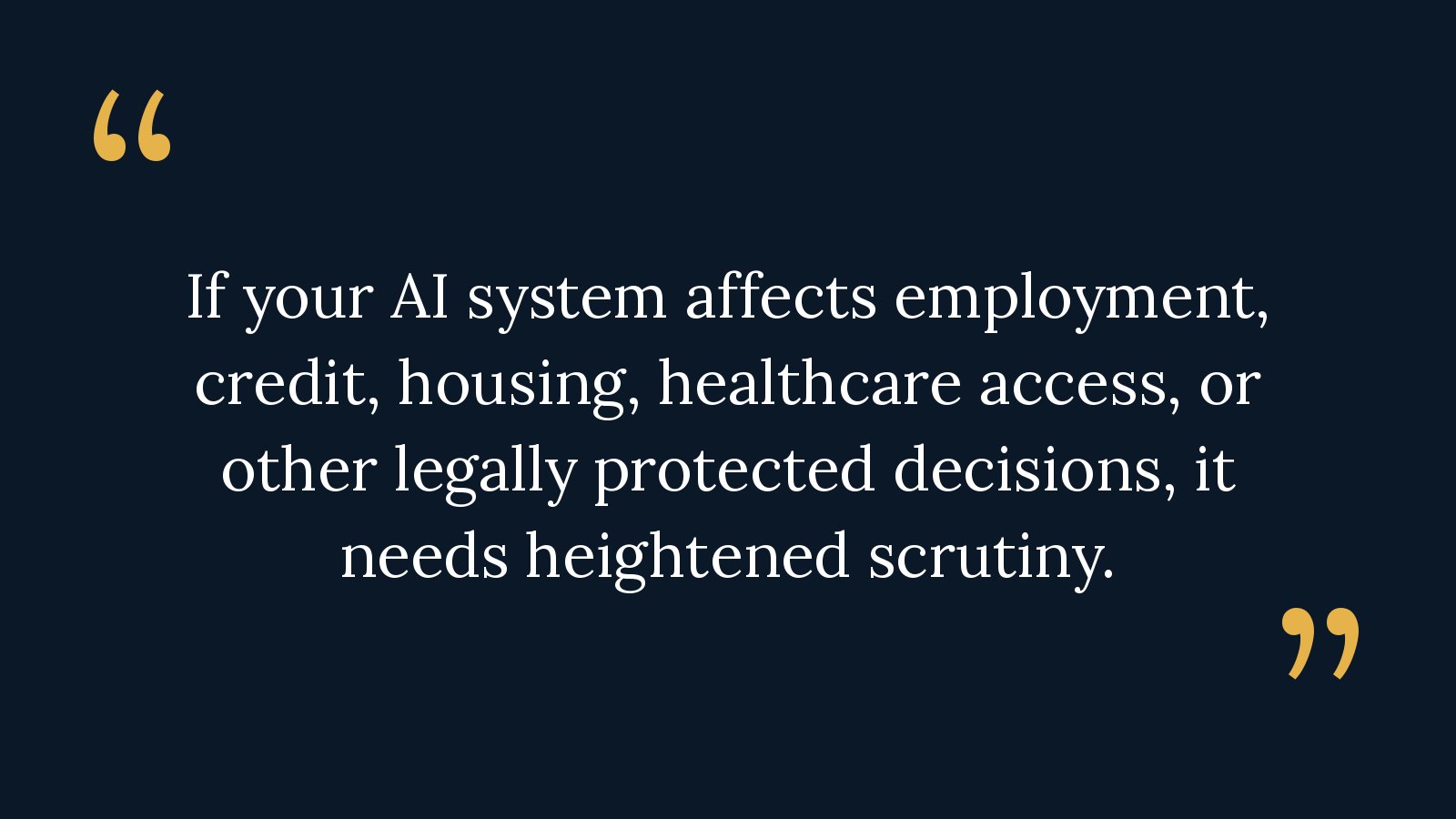
What Regulators Are Actually Looking For
Based on enforcement actions, guidance documents, and consent orders, a clear picture emerges of what regulators expect from organizations deploying AI in high-stakes contexts. It's not perfection. It's not elimination of all disparate impact. It's a structured, documented process for identifying and mitigating bias, with ongoing accountability.
First, they want to see that you've identified where you're using AI to make or inform decisions about people. This sounds obvious, but shadow AI is rampant. Departments procure tools, developers integrate APIs, and nobody in compliance knows these systems exist until there's an incident. Inventory is the foundation. You can't manage AI bias compliance if you don't know what AI you're using.
Second, they expect risk-based prioritization. Not every AI use case carries the same compliance risk. A chatbot that answers FAQ questions about your return policy is different from a model that decides who gets a loan. Regulators understand this. What they won't tolerate is high-risk applications being treated casually. If your AI system affects employment, credit, housing, healthcare access, or other legally protected decisions, it needs heightened scrutiny.
Third, they want evidence of testing. Pre-deployment validation is table stakes, but it's not sufficient. You need to test for disparate impact across protected classes, document your methodology, and be able to explain your results. If you find bias, you need to show what you did about it—retrain the model, adjust thresholds, add human review, or decide the risk is too high and not deploy. The choice matters less than the fact that you made an informed choice and documented it.
Fourth, ongoing monitoring is non-negotiable for high-risk systems. The CFPB's recent guidance on AI in credit decisions explicitly discusses the need for continuous monitoring. The EEOC's technical assistance document on algorithmic fairness emphasizes ongoing evaluation. The EU AI Act, which is influencing thinking globally, requires post-market monitoring for high-risk AI. If you deployed it and forgot it, you're not compliant.
Fifth, they expect human accountability. Automation doesn't eliminate the need for human judgment—it changes where that judgment is applied. Regulators want to see that humans are in the loop for consequential decisions, that there are meaningful opportunities to appeal or challenge automated decisions, and that someone in your organization is responsible for AI outcomes. The "the algorithm did it" defense has never worked and never will.
The Role of Explainability
A separate but related expectation is explainability. Regulators increasingly expect organizations to be able to explain, at least in general terms, how their AI systems make decisions. This doesn't mean you need to provide a line-by-line code review or expose proprietary algorithms. It means you should be able to describe what inputs the system considers, how it weighs them, and why that approach is appropriate for the use case.
The challenge is that many modern AI systems, particularly deep learning models, are difficult to explain even for their creators. This creates real tension. Organizations want to use state-of-the-art models because they perform better. Regulators want transparency. The practical middle ground is investing in explainability tools and techniques—SHAP values, LIME, attention mechanisms—that provide insight into model behavior even when the model itself is a black box. It's not perfect, but it's better than shrugging.
Building an AI Bias Compliance Program
What does a functional AI bias compliance program actually look like? I've worked with organizations across healthcare, defense, and financial services to build these programs, and while the specifics vary by industry, the core components are consistent.
Start with governance. You need a cross-functional AI governance committee or working group that includes legal, compliance, IT, data science, and business stakeholders. This group is responsible for setting policy, reviewing high-risk AI deployments, and escalating issues. The key is that it's not just a data science team making compliance decisions, and it's not just lawyers making technical decisions. Both perspectives are necessary.
For more on how to structure this governance function, I've written about AI governance frameworks that work in regulated environments. The governance piece is foundational. Without it, you're trying to manage AI bias compliance as a series of one-off projects rather than a systematic program.
Next, implement a tiered risk assessment process. Not every AI use case needs the same level of scrutiny. I typically recommend a three-tier model: low risk (minimal impact on individuals, no protected decisions), medium risk (affects individuals but not in legally protected domains), and high risk (employment, credit, housing, healthcare, or other areas covered by anti-discrimination law). High-risk systems go through enhanced review, bias testing, and monitoring. Low-risk systems get lighter treatment. The risk assessment itself should be documented.
For high-risk systems, mandate pre-deployment bias testing. This should include disparate impact analysis across relevant protected classes—race, gender, age, disability status, and others depending on the use case and applicable law. The testing should be done by someone independent of the team that built the model. If you're using a vendor solution, you need to conduct your own testing or hire an independent third party. Vendor-provided fairness reports are a starting point, not a substitute for your own diligence.
Establish thresholds for acceptable disparate impact. This is contentionally difficult because there's no universal standard. The EEOC's 80% rule (also known as the four-fifths rule) is a common starting point for employment contexts: if the selection rate for one group is less than 80% of the selection rate for the group with the highest rate, that's a red flag requiring further investigation. But the 80% rule isn't a legal safe harbor, and it doesn't apply neatly to all contexts. Your governance committee needs to decide what thresholds are appropriate for your use cases, document the rationale, and be prepared to defend those choices.
Build ongoing monitoring into your operations. For high-risk AI systems, this means regular testing—quarterly at minimum, monthly for the highest-risk applications. You're looking for model drift, changes in disparate impact, and anomalies that could indicate problems. This monitoring should be automated where possible, but it needs human review. Someone has to interpret the results and escalate issues.
Create an escalation process for when bias is detected. What happens when monitoring reveals disparate impact above your thresholds? Who gets notified? What actions are considered? Do you pause the system, adjust parameters, add human review, retrain the model, or accept the risk with documented justification? This process needs to be defined in advance, not invented during a crisis.
Finally, document everything. Every risk assessment, every bias test, every governance committee discussion about fairness trade-offs, every decision to deploy or not deploy, every monitoring report. This documentation serves multiple purposes. It demonstrates compliance to regulators. It provides institutional knowledge when staff turns over. It protects the organization if there's litigation. Compliance programs live or die based on documentation.
Keynotes on AI, Compliance, and Governance
Looking for a speaker who can connect regulatory realities to technical implementations? Carl delivers practical guidance on AI compliance, third-party risk, and governance for audiences ranging from boards to security teams. See all keynote speaking topics or reach out about your event.
Book Carl for Your Event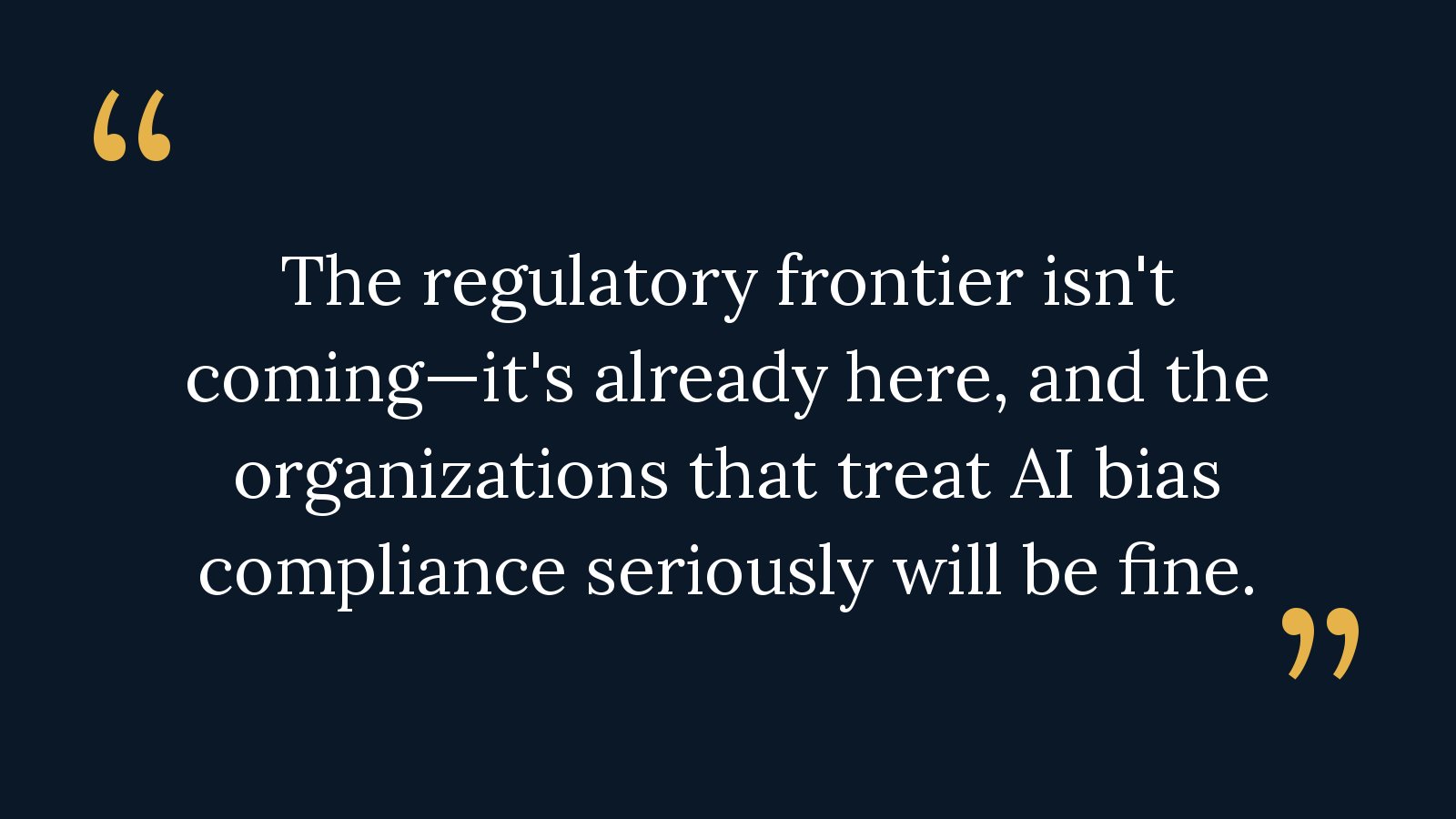
The Vendor Management Dimension
Most organizations aren't building AI from scratch. They're procuring vendor solutions—applicant tracking systems with AI screening, credit decisioning platforms, patient risk stratification tools, property management software with automated tenant screening. This means AI bias compliance is also a vendor management problem.
Your vendor contracts need to address bias explicitly. Standard SaaS terms won't cut it. You need contractual commitments that the vendor has tested for bias, that they'll provide evidence of that testing, that they'll notify you of material changes to the model, and that they'll support your own bias testing efforts. You need audit rights that allow you or a third party to validate fairness claims. And you need clarity about liability—if the vendor's model creates a disparate impact that leads to regulatory action, who's responsible?
In my experience, vendors resist these provisions. They'll cite proprietary algorithms, competitive concerns, and technical complexity. Push back. If a vendor can't or won't support your compliance obligations around bias, that's a red flag. Either they haven't done the work, or they don't want you to know what they found. Neither is acceptable for high-risk use cases.
You also need technical capabilities to test vendor systems independently. This is hard. Many vendor AI tools are black boxes—you send inputs, you get outputs, and there's limited visibility into what happens in between. But you can still test for disparate impact. Feed the system test data with known demographic characteristics and measure whether outcomes differ across groups. It's not perfect, but it's far better than trusting vendor assurances.
For a deeper discussion of how to manage AI vendor risk, including the compliance dimension, I've written specifically about AI third-party risk and what vendor management should look like as these tools proliferate. The short version: treat AI vendors like any other high-risk third party, but with additional diligence around bias, explainability, and ongoing monitoring.
Industry-Specific Considerations
While the core principles of AI bias compliance are consistent across industries, each regulated sector has nuances worth understanding.
Healthcare and HIPAA
In healthcare, AI bias isn't just a civil rights issue—it's a patient safety and quality of care issue. Clinical algorithms that underestimate risk for certain demographic groups lead to worse health outcomes. The now-infamous case of the Optum algorithm that systematically under-referred Black patients for care management programs is a perfect example. The algorithm used healthcare costs as a proxy for health needs, but because Black patients have less access to care, they had lower costs even when they were sicker. The result was algorithmic bias that perpetuated healthcare disparities.
HIPAA doesn't explicitly address algorithmic bias, but OCR has made clear that covered entities have obligations around non-discrimination. If your AI tool produces biased clinical recommendations, you have both a civil rights problem and potentially a HIPAA problem if it affects treatment. The compliance answer is the same: test for bias, monitor outcomes, document everything.
Healthcare organizations also need to think about bias in administrative AI—prior authorization systems, fraud detection, readmission risk scores. These may not be clinical algorithms, but they affect patient access and outcomes. They deserve scrutiny.
Financial Services
Fair lending laws are among the most mature areas of anti-discrimination regulation, and they map directly to AI bias compliance. ECOA, the Fair Housing Act, and the Community Reinvestment Act all apply to automated underwriting. The CFPB has been vocal about its expectations, and it has enforcement authority.
One specific challenge in financial services is the tension between accuracy and fairness. A model that perfectly predicts default risk based on historical data will likely perpetuate historical biases. Regulators understand this tension, but they still expect financial institutions to balance performance with fairness. That means you might need to accept a slightly less accurate model if it produces more equitable outcomes. The key is making that trade-off consciously and documenting the reasoning.
Financial institutions also face unique challenges around explainability. When you deny someone credit, you have to provide an adverse action notice explaining why. If an AI model made or informed that decision, you need to be able to translate model outputs into legally sufficient explanations. This isn't always straightforward.
Employment
AI in employment is ground zero for regulatory scrutiny right now. The EEOC has made this a priority. State and local laws are proliferating—New York City's bias audit requirement is just the beginning. Multiple states are considering or have passed laws regulating AI in hiring.
Employment AI includes resume screening, interview analysis, assessment tools, performance prediction, promotion recommendations, and termination risk scoring. All of these are subject to Title VII and related laws. All of them need bias testing. And because employment is such a visible and politically salient issue, this is where we're likely to see the most enforcement activity in the near term.
One pattern I see in employment AI is organizations focusing on hiring while ignoring promotion and termination. If you're using AI to screen resumes, you're probably testing for bias. But if you're using AI to rank employees for layoffs or identify high-potential talent for advancement, are you testing those systems too? You should be. Disparate impact in promotion and termination is just as problematic as disparate impact in hiring.
What Happens When You Get It Wrong
The consequences of AI bias compliance failures are real and growing. EEOC charges can lead to lengthy investigations, consent decrees, and significant financial settlements. The recent case involving an AI video interviewing tool resulted in regulatory scrutiny, public backlash, and the company eventually shutting down. HUD fair housing investigations can take years and result in substantial penalties. The FTC has shown it will use its Section 5 authority to go after what it characterizes as unfair AI practices, and it's not shy about seeking large civil penalties.
Beyond regulatory enforcement, there's reputational risk. Organizations that deploy biased AI make headlines, lose customers, and damage their brands. There's also litigation risk—private plaintiffs are bringing class actions alleging algorithmic discrimination, and they're starting to win. Employment law firms have figured out that AI bias is a lucrative practice area.
But the most concerning risk is operational. If you deploy an AI system in a high-stakes domain and it produces biased outcomes, you're making systematically bad decisions at scale. You're rejecting qualified candidates, denying credit to creditworthy applicants, providing substandard care to patients who need it. The harm isn't theoretical—it's real people being materially affected by your technology choices.
The Road Forward for Compliance Leaders
AI bias compliance isn't a problem you solve once and move on. It's an ongoing discipline that requires attention, resources, and executive support. The regulatory environment will continue to evolve—more guidance, more enforcement, more legislation. But the core obligation is already clear: if your AI affects people in legally protected contexts, you need to test for bias, monitor for bias, and mitigate bias.
As a compliance leader, your role is to ensure this happens. That means educating the business about the risks, building the governance structures to manage those risks, and insisting on the documentation and testing that prove you're managing them. It means pushing back when vendors make unsupported fairness claims, when data science teams want to deploy without testing, or when business leaders want to move faster than compliance allows.
It also means being realistic about what's achievable. Perfect fairness across all possible metrics is mathematically impossible in most contexts. There are trade-offs between different fairness definitions, between accuracy and equity, between innovation speed and risk management. Your job isn't to eliminate all risk—it's to ensure the organization understands the risks it's taking and makes informed decisions about which risks to accept.
The regulatory frontier is here. The organizations that treat AI bias compliance seriously, that build systematic programs rather than checking boxes, and that invest in the capabilities to test and monitor their systems will be fine. The organizations that assume they can deploy AI without scrutiny, that trust vendor assurances without verification, or that treat compliance as an obstacle rather than a discipline will face enforcement, litigation, and reputational damage. The choice is yours, but make it consciously.