
Most organizations treat privacy impact assessments as a compliance checkbox. They hire a consultant a week before a system goes live, rush through a template, and file it away with the hope that nobody asks to see it. Then they're surprised when regulators or auditors point out that the assessment doesn't match what the system actually does.
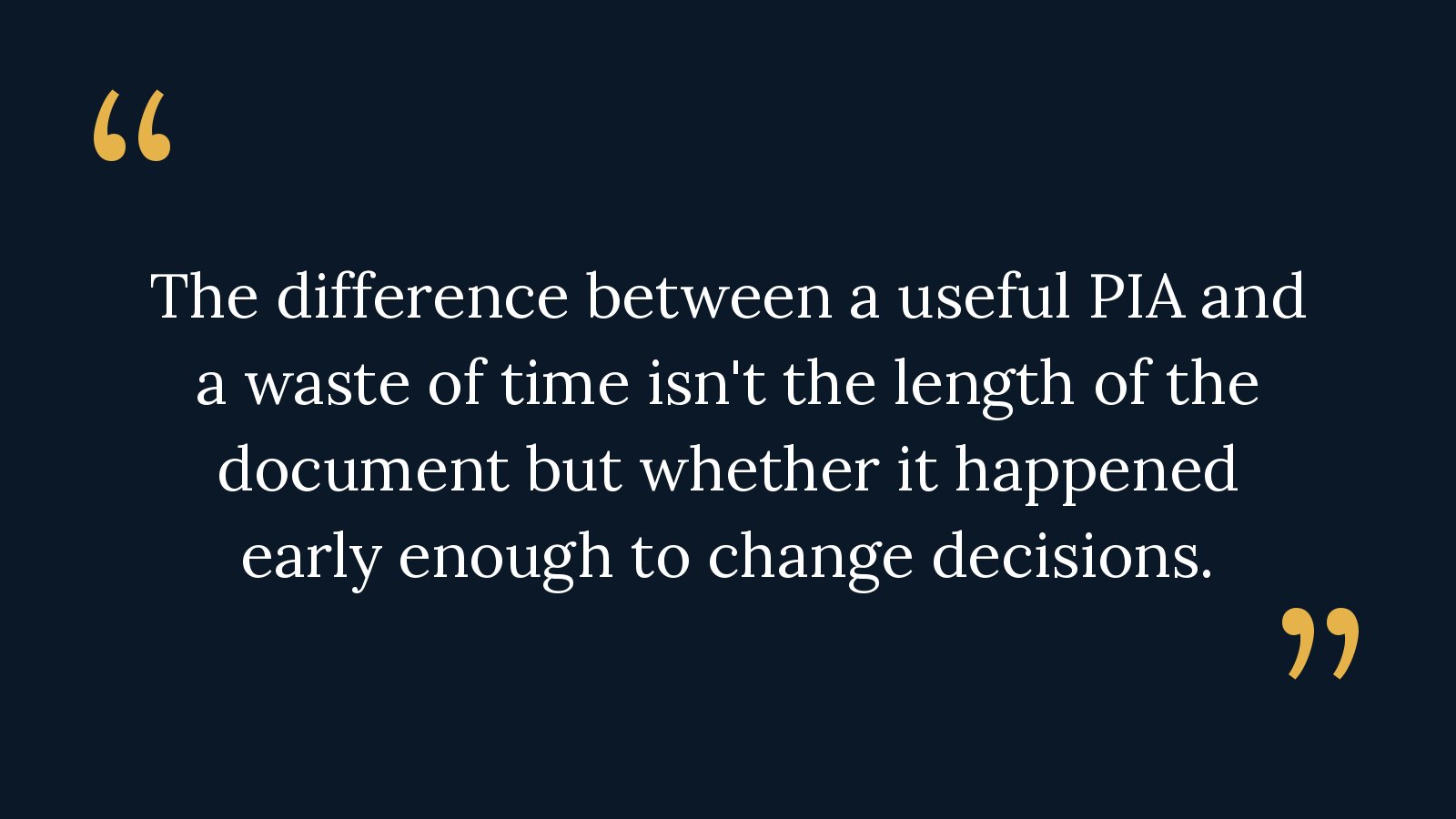
I've reviewed dozens of privacy impact assessments over the years, both as a CISO and in advisory roles. The difference between a useful PIA and a waste of time isn't the length of the document. It's whether the assessment happened early enough to change decisions, whether it asked the right questions, and whether anyone with authority actually read it.
This article covers when you're legally required to conduct a privacy impact assessment, how they differ from the European DPIA model, what separates meaningful assessments from box-checking exercises, and how to integrate them into project planning so they inform decisions instead of documenting them after the fact.
What a Privacy Impact Assessment Actually Is
A privacy impact assessment is a systematic evaluation of how a project, system, or initiative will affect the privacy of individuals whose data it collects, processes, or stores. The core question is simple: what privacy risks does this create, and how will we address them?
That sounds straightforward until you start working with organizations that confuse a PIA with a security risk assessment, a compliance checklist, or a data inventory. Those are related activities, but they're not the same thing. A security assessment asks whether your data is protected from unauthorized access. A privacy impact assessment asks whether you should be collecting that data in the first place, whether individuals understand how you're using it, and what happens when they want it deleted.
The pattern I see most often is organizations treating privacy as a subset of security. They assume that if the data is encrypted and access-controlled, they've handled privacy. That misses the point. You can have excellent security practices and still create significant privacy risks by collecting unnecessary data, using it for purposes individuals didn't expect, or retaining it longer than needed.
A good privacy impact assessment addresses the full lifecycle of personal information: collection, use, disclosure, retention, and disposal. It documents what data you're gathering, why you need it, who will have access, how long you'll keep it, and what rights individuals have regarding their information. Most importantly, it identifies risks and proposes mitigations before you've built the system.
When Privacy Impact Assessments Are Legally Required
The legal landscape for PIAs in the United States is fragmented. Unlike Europe's relatively uniform GDPR requirement for Data Protection Impact Assessments, U.S. requirements vary by sector, jurisdiction, and the type of data involved.
Federal Requirements
The E-Government Act of 2002 requires federal agencies to conduct PIAs for electronic information systems that collect, maintain, or disseminate personally identifiable information. This applies to new systems, significant modifications to existing systems, and systems that are being migrated to new platforms or operating environments. The Office of Management and Budget provides implementation guidance through Circular A-130.
I've worked with federal contractors who assumed this requirement only applied to agencies themselves. That's wrong. If you're developing a system for a federal agency that will handle PII, you need to support the agency's PIA process. That often means conducting your own assessment and providing documentation the agency can use.
Healthcare entities covered by HIPAA aren't explicitly required to conduct formal privacy impact assessments, but the HIPAA Privacy Rule requires a risk assessment before implementing new uses or disclosures of protected health information. In practice, this functions like a PIA, and organizations serious about HIPAA compliance conduct them for any system that touches PHI.
State Privacy Laws
State privacy laws take different approaches. California's CPRA requires businesses to conduct risk assessments for processing activities that present significant risk to consumers' privacy or security, particularly for sensitive personal information. The requirement focuses on high-risk processing rather than all systems. You can read more about what changed between CCPA and CPRA and how the risk assessment requirement evolved.
Other states have followed with similar requirements. Colorado's privacy law requires data protection assessments for certain processing activities, including targeted advertising, sale of personal data, and profiling that presents a reasonably foreseeable risk of unfair or deceptive treatment, financial or physical harm, or other substantial injury. Virginia, Connecticut, and other states have comparable provisions.
The threshold across these laws is generally "high-risk processing," but the definition varies. What's consistent is that if you're processing sensitive data, selling personal information, using it for automated decision-making that affects people's opportunities or rights, or processing children's data, you should be conducting a privacy impact assessment regardless of whether a specific statute uses those exact words. For a comprehensive overview of requirements across states, see U.S. State Privacy Laws in 2026.
Contractual and Industry Standards
Beyond legal mandates, you may be contractually required to conduct PIAs. I've seen this in vendor agreements with healthcare systems, financial institutions, and large enterprises that have mature privacy programs. They want assurance that you've thought through the privacy implications of the service you're providing.
Industry frameworks also recommend or require PIAs. ISO 27701, the privacy extension to ISO 27001, includes privacy impact assessments as a control. NIST's Privacy Framework recommends them as part of a comprehensive privacy program. If you're pursuing certification or following these frameworks, PIAs become part of your compliance obligations.
Privacy Impact Assessments vs Data Protection Impact Assessments
Organizations operating in both the U.S. and Europe often ask whether they can use one assessment to satisfy both PIA and DPIA requirements. The short answer is yes, with modifications. The longer answer is that while the concepts overlap significantly, the legal frameworks have different emphases.
GDPR's Data Protection Impact Assessment requirement is more prescriptive than most U.S. PIA frameworks. Article 35 specifies when DPIAs are mandatory: when processing is likely to result in high risk to individuals' rights and freedoms, particularly for systematic monitoring, large-scale processing of special categories of data, or automated decision-making with legal or similarly significant effects.
The GDPR also mandates specific content for DPIAs: a description of processing operations and purposes, an assessment of necessity and proportionality, an assessment of risks to individuals, and measures to address those risks. U.S. PIA frameworks cover similar ground but with less regulatory specificity about format and content.
One practical difference: GDPR requires consultation with the supervisory authority before processing begins if the DPIA indicates high residual risk that can't be adequately mitigated. U.S. frameworks generally don't have an equivalent pre-approval mechanism, though federal agencies must submit PIAs to their designated privacy officials.
Another distinction is the GDPR's explicit requirement to involve the Data Protection Officer in the DPIA process and, where appropriate, to seek input from data subjects or their representatives. U.S. PIAs don't universally require stakeholder consultation, though better practice includes it.
If you're conducting assessments for both frameworks, start with GDPR's requirements as the baseline. A well-executed DPIA will generally satisfy U.S. PIA requirements with minimal additions. Going the other direction requires more work to meet GDPR's specific mandates.
Privacy Compliance Programs for Regulated Industries
Carl speaks to compliance, privacy, and technology leadership teams about building practical privacy programs that work across multiple regulatory frameworks. His sessions focus on real implementation challenges, not theoretical frameworks.
Book Carl to SpeakWhat Makes a Privacy Impact Assessment Actually Useful
I can tell within five minutes whether a privacy impact assessment was conducted to inform decisions or to satisfy an auditor. The useful ones identify specific risks with enough detail that engineers and product managers can act on them. The perfunctory ones read like they were generated from a template by someone who never spoke to the development team.
Timing Matters More Than Format
The single biggest determinant of whether a PIA will be useful is when it happens. Conducting an assessment after you've built the system, selected the vendors, and made architectural decisions means you're documenting choices rather than informing them. At that point, the PIA becomes an exercise in justifying what you've already done.
Effective privacy impact assessments happen during the planning and design phase, when there's still time to change course. That might mean deciding not to collect certain data fields, implementing privacy-enhancing technologies from the start, or choosing a different vendor with better data handling practices.
I've seen projects where the PIA identified that the proposed system would collect substantially more personal information than necessary for the business purpose. Because the assessment happened early, the team redesigned the data model to minimize collection. That would have been expensive or impossible to fix after development was complete.
Specificity Over Generalization
Generic risk statements like "unauthorized access to personal information" or "data breach" aren't helpful. Those risks exist for any system. A meaningful PIA identifies risks specific to what you're building and how you're building it.
For example, if you're implementing a system that uses geolocation data to provide services, specific risks might include: revealing individuals' home addresses through pattern analysis of location check-ins, inadvertent disclosure of sensitive locations like medical facilities or places of worship, or use of location data for purposes beyond service delivery without clear consent.
The mitigation section should be equally specific. Instead of "implement appropriate security controls," describe what controls: geographic data will be stored at reduced precision after the initial service interaction, retained for no more than 30 days, and access will be limited to the operations team through role-based controls with audit logging.
Honest Risk Assessment
The least useful PIAs are the ones that identify every risk as "low" and claim all issues are adequately mitigated by existing controls. If your assessment genuinely found no significant risks, you're either working on a very simple system or you didn't look hard enough.
Privacy risk exists on a spectrum, and honest assessment means acknowledging where risks remain even after mitigation. Maybe you've decided that the business value justifies a particular privacy risk, but you're implementing additional transparency measures to give individuals more control. That's a legitimate decision, but it should be documented as such, not characterized as "fully mitigated" when it isn't.
I've been in situations where leadership wanted the PIA to conclude that a high-risk system posed only moderate risk because they were concerned about regulatory scrutiny. That's exactly backward. Regulators and auditors can read. They'll identify the same risks you did. The question they're evaluating is whether you identified them, took them seriously, and made thoughtful decisions about mitigation. Downplaying risks in your documentation doesn't reduce scrutiny; it undermines your credibility when you need it most.
The Privacy Impact Assessment Process
Running an effective privacy impact assessment requires clear roles, structured analysis, and documentation that serves both compliance and operational purposes. Here's how to approach it based on what actually works in organizations with mature privacy practices.
Assemble the Right Team
PIAs shouldn't be solo exercises conducted by the privacy office in isolation. You need input from the people who understand what the system does: project managers, engineers, product managers, security architects, and legal counsel.
The privacy team facilitates and ensures the assessment covers required elements, but they're not going to know that the marketing team plans to use the collected data for customer segmentation, or that the vendor you selected stores backups in a jurisdiction with weak data protection laws, or that the mobile app requests location permissions even when it doesn't need them. That information comes from the people building and operating the system.
Inventory Data Flows
Start with a clear understanding of what personal information you're collecting, where it comes from, where it's going, and who has access. This sounds basic, but I've reviewed PIAs that misrepresented fundamental aspects of data flow because nobody actually mapped it.
Create a data flow diagram showing sources of personal information, processing activities, storage locations, third-party recipients, and data disposal. Don't assume you know this from previous projects. Every system is different, and assumptions about data flow are where privacy problems hide.
Pay particular attention to indirect collection and secondary uses. If you're collecting email addresses for account creation but also using them for marketing, that's a secondary use that creates different privacy expectations and risks. If you're receiving personal information from a partner or data broker rather than directly from individuals, that affects transparency and consent considerations.
Analyze Privacy Risks
With the data flows documented, identify risks to individuals. This isn't just security risks—those belong in your security risk assessment. Privacy risks include:
- Collection of personal information that isn't necessary for the stated purpose
- Use of data in ways individuals wouldn't reasonably expect
- Disclosure to third parties without appropriate transparency or consent
- Retention longer than necessary for the business purpose
- Inability for individuals to exercise rights like access, correction, or deletion
- Potential for discrimination, bias, or unfair treatment through automated processing
- Risk of re-identification if you're working with de-identified data
- Combination of data sets that reveals more than either set alone
For each identified risk, assess likelihood and impact. Impact here means harm to individuals, not just organizational consequences. Could this processing result in embarrassment, discrimination, financial loss, physical harm, or loss of autonomy? The severity of potential harm should drive the rigor of your mitigation efforts.
Identify Mitigations
For each identified risk, determine how you'll address it. Mitigations fall into several categories:
Elimination: The most effective mitigation is not collecting or processing the data in the first place. If you can achieve your business purpose without a particular data element, don't collect it. If you can use aggregated or de-identified data instead of personal information, do that.
Minimization: If you need the data, collect only what's necessary and retain it only as long as needed. This might mean collecting date of birth instead of full birth date if you only need to verify someone is over 18, or purging detailed transaction records after the period required for customer service and financial reporting.
Technical controls: Encryption, access controls, de-identification, aggregation, and privacy-enhancing technologies can reduce risk even when you need to collect and process personal information. Be specific about which controls you're implementing and why they're appropriate for the identified risks.
Procedural controls: Training, access policies, data handling procedures, incident response plans, and vendor management processes reduce risk through how you operate. These matter most for risks related to insider misuse, third-party handling, and response to individual rights requests.
Transparency and control: Sometimes the appropriate mitigation is giving individuals clear information about what you're doing and meaningful control over it. Privacy notices, consent mechanisms, preference centers, and rights request processes don't eliminate privacy risk, but they respect autonomy and reduce the risk of surprise or misunderstanding.
Document and Review
The final privacy impact assessment should document everything you've identified: the system description, data flows, identified risks, proposed mitigations, and residual risks after mitigation. It should also identify who approved the assessment and any conditions or limitations on the processing.
This document serves multiple purposes. It's evidence of compliance with PIA requirements for regulations that mandate them. It's a reference for the team building and operating the system. It's a baseline for future assessments when the system changes. And it's your defense if a regulator or auditor asks whether you considered privacy before proceeding.
PIAs shouldn't be static documents. Set a review schedule—annually at minimum, or whenever there's a significant change to the system, the data processing, or the legal requirements. A PIA from 2020 doesn't tell you much about the privacy risks of a system that's been substantially modified since then.
Privacy and Compliance Strategy for Your Conference
Carl delivers keynote presentations on privacy program development, regulatory compliance, and the intersection of privacy and emerging technology. See all keynote speaking topics or reach out about your event.
Book Carl for Your EventIntegrating PIAs Into Project Planning
The challenge most organizations face isn't conducting privacy impact assessments—it's making them part of normal project workflow instead of an afterthought. This requires process changes, not just documentation templates.
Make Privacy a Project Gate
In organizations with mature privacy programs, you can't move from planning to development without completing a privacy review. This doesn't mean every project needs a full PIA—many low-risk projects can be handled with a screening questionnaire that determines whether a comprehensive assessment is necessary.
The screening should ask questions that identify privacy-relevant factors: Will this project collect, use, or disclose personal information? Will it involve sensitive data, children's data, or automated decision-making? Will it share data with third parties? Will it change how we handle data we already collect?
If the screening indicates privacy risk, the full PIA becomes a requirement before the project proceeds. This might feel like a burden to project managers eager to start building, but it's cheaper and less disruptive than discovering privacy issues during development or after launch.
Assign Clear Responsibility
Somebody needs to own privacy impact assessments for each project. In my experience, this works best when the project manager or product owner is responsible for ensuring the PIA happens, with the privacy office providing facilitation and review.
This assignment of responsibility addresses a common failure pattern: everyone assumes privacy is someone else's job. The developers think legal handles it. Legal thinks the privacy office handles it. The privacy office thinks the business unit handles it. Result: nobody handles it until it becomes a problem.
Provide Templates and Training
Don't expect project teams to figure out how to conduct a privacy impact assessment from scratch. Provide templates that cover required elements, examples of good risk identification and mitigation, and training on how to use them.
The template should be comprehensive enough to ensure consistency and completeness, but flexible enough to accommodate different types of projects. A PIA for a new customer-facing mobile app will look different from a PIA for an HR system or a data analytics platform. The core questions are the same, but the specific risks and mitigations vary.
Training should emphasize that the PIA is a tool for better decision-making, not just a compliance obligation. Teams should understand that identifying risks early gives them options they won't have later. I've seen this shift in mindset transform PIAs from resistance to acceptance when people realize the assessment helps them avoid expensive problems.
Common Privacy Impact Assessment Failures
Having reviewed many PIAs that didn't accomplish their purpose, certain patterns of failure emerge. Knowing what doesn't work helps you avoid the same mistakes.
The Template Copy-Paste
I once reviewed three PIAs from the same organization that had identical risk sections despite being for completely different systems. Someone had taken a template, changed the system name, and submitted it. This is worse than not conducting an assessment at all because it creates false confidence that privacy has been addressed.
Templates are useful starting points, but every PIA should reflect the specific characteristics of the system being assessed. If your PIAs all identify the same risks in the same language, you're not actually analyzing—you're filling in forms.
The Rubber Stamp
Some organizations conduct PIAs but never let them change anything. The assessment identifies risks, proposes mitigations, and then gets filed away while the project proceeds exactly as originally planned. This usually happens when the PIA is performed too late to influence decisions, or when leadership views it as a formality rather than a risk management tool.
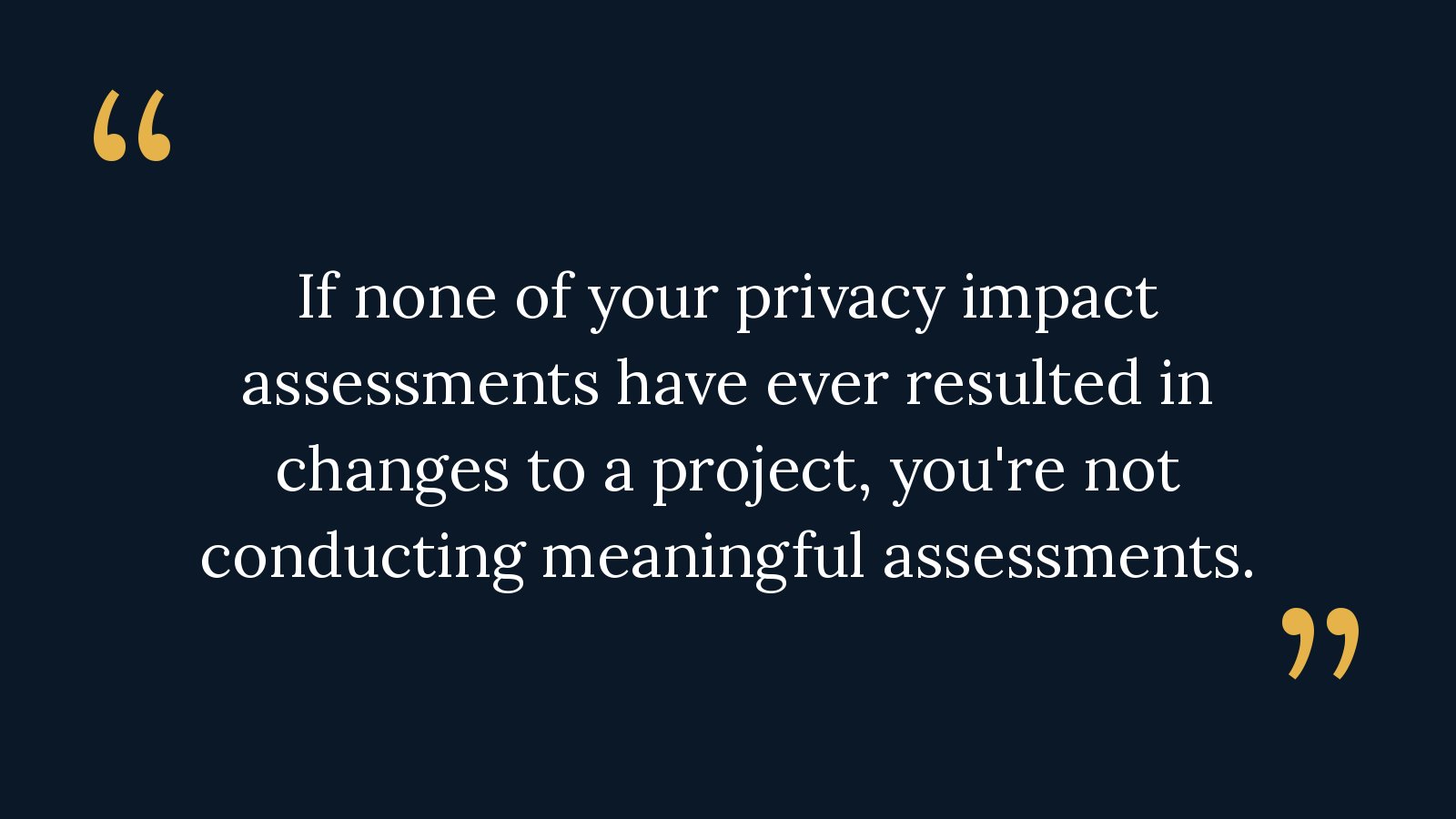
If none of your privacy impact assessments have ever resulted in changes to a project, you're not conducting meaningful assessments. The point is to identify issues while you can still address them.
The Security Assessment Disguised as a PIA
Security and privacy overlap but aren't identical. An assessment that focuses exclusively on whether data is encrypted, access-controlled, and protected from unauthorized disclosure might be a fine security review, but it's not a complete privacy impact assessment.
Privacy questions include whether you should be collecting the data at all, whether individuals understand how you're using it, how long you're keeping it, and whether they can access or delete it. These aren't primarily security concerns, and a security-focused review won't address them.
The Single-Point-in-Time Assessment
Systems change. Regulations change. What was a low-risk process two years ago might be high-risk now because you've expanded data collection, changed vendors, or started using the data for new purposes. PIAs that are never updated become inaccurate and eventually useless.
Establish a review cycle and stick to it. Also require a new assessment or update whenever there's a significant change to the system or how it processes data. "Significant change" should be defined in your policy—expanding data collection, adding third-party recipients, changing retention periods, or implementing new uses all qualify.
Privacy Impact Assessments as Strategic Tools
Organizations that treat privacy impact assessments as pure compliance obligations miss an opportunity. Done well, PIAs become strategic tools that reduce legal risk, build customer trust, and inform better product decisions.
From a risk management perspective, PIAs document that you conducted due diligence before processing personal information. If you face regulatory scrutiny or a privacy complaint, being able to show that you systematically identified and addressed risks before proceeding is substantially better than having nothing or having conducted a superficial review.
From a business perspective, PIAs surface issues that could damage customer relationships or create competitive disadvantage. Customers increasingly care about privacy. Learning through a PIA that your planned data collection is more extensive than necessary gives you the option to scale back and market your more privacy-conscious approach. Learning the same thing from customer backlash after launch is more expensive.
From a product development perspective, privacy impact assessments force clarity about what you're building and why. The process of documenting data flows and justifying collection purposes often reveals assumptions that haven't been validated or features that add complexity without corresponding value. I've seen PIAs lead to simpler, better products because the team had to articulate what they were doing and why.
The organizations getting the most value from privacy impact assessments are the ones that view them as part of responsible product development, not as a regulatory checkbox. They conduct them early, involve the right people, take the findings seriously, and use them to build systems that respect privacy by design rather than trying to retrofit privacy into systems that weren't designed with it in mind.
That requires executive support. Privacy impact assessments only work when leadership makes clear that privacy is a priority, that projects won't be approved without appropriate privacy review, and that identifying privacy risks is valued rather than discouraged. Without that support, PIAs become perfunctory exercises that consume time without producing value. With it, they become part of how the organization makes better decisions about data.